Need help?
Do you have a question about the C-TEC AlarmSense CFP704-2 and is the answer not in the manual?
Precautions to prevent electrostatic discharge when handling electronic components.
Crucial guidelines for insulating and earthing cable screens.
Overview of fault lights and their meanings on the panel.
Indications and causes for zone circuit faults.
Faults related to the panel's power supply unit.
Detailed steps for diagnosing zone circuit faults.
Detailed steps for diagnosing power supply faults.
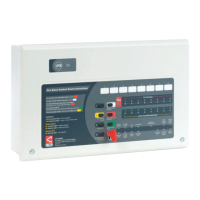
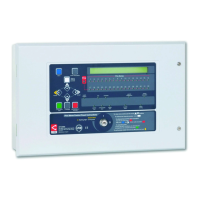
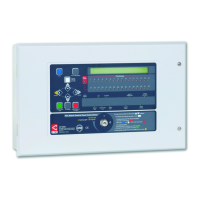
The LPCB Approved CFP 2/4/8 Zone Fire Alarm Control Panel is a sophisticated fire detection and alarm system designed for use in various building types. It offers a comprehensive set of features for both fire and security applications, with models available for two, four, or eight AlarmSense™ zone circuits.
The primary function of the panel is to detect fire conditions and activate alarms. Its AlarmSense™ zone circuits are a key feature, allowing detectors, manual call points, and sounders to be connected on the same two wires, which can lead to significant savings in cabling and installation labor compared to conventional four-wire systems. It's crucial to note that only AlarmSense™ devices are compatible with these zone circuits.
In addition to the AlarmSense™ zone circuits, the panel includes four conventional sounder circuits designed for use with non-AlarmSense™ sounders. These circuits provide the flexibility to integrate a wider range of alarm devices into the system.
The panel also incorporates two non-latching auxiliary input connections: "Alert" and "Class Change." The "Alert" input operates sounders intermittently when connected to 0V, while the "Class Change" input operates sounders continuously when connected to 0V. Neither of these inputs will trigger the panel's remote or auxiliary fire outputs.
For external control and integration, the panel offers several auxiliary outputs. These include a Reset output (RESET), a Remote output (REM), an Auxiliary 24V output (AUX 24V), an Auxiliary Fire Output (AUX), and a Fault Output (FAULT). The Reset output activates during the panel's reset cycle, useful for resetting other fire alarm system devices. The Remote output activates during any new fire alarm condition or when the Silence/Resound Sounders button is pressed for manual evacuation, but not from Class Change or Alert inputs unless other fire alarm conditions are present. The Auxiliary 24V output provides a positive voltage supply for peripheral loads, protected by a current-limiting fuse. The Auxiliary Fire Output activates during any fire alarm condition and deactivates upon reset, but not from Class Change or Alert inputs or manual evacuation unless other fire conditions exist. The Fault Output is normally energized and turns off when a fault occurs, ensuring fail-safe operation even during total power loss.
The panel offers three control levels: general user (access level 1), authorized user (access level 2), and engineer (access level 3).
General user controls (access level 1) provide a clear overview of the system's status, displaying fire and fault conditions and output statuses. Users at this level can mute the internal sounder, override programmed delays, and access authorized user controls.
Authorized user controls (access level 2) are accessible via a keypad code or keyswitch and allow for silencing sounders, resetting alarms, manually activating sounders for evacuation, testing indicator lights, and enabling/disabling zones, sounders, fault output, remote output, auxiliary fire output, and delays.
Engineer controls (access level 3) provide access to site-specific data and advanced programming functions. These include programming coincidence (double-knock) for specific zone pairs, setting up non-latching zones, programming delays for sounders and outputs, invoking test procedures, configuring sounder resound behavior for new alarms, and programming whether sounders are fitted on zone circuits.
A "coincidence" or "double-knock" feature can be programmed for zone pairs, requiring alarms on both zones before sounders and outputs activate. If only one zone alarms, the panel indicates the condition and sounds its internal sounder for investigation. This feature is non-compliant with EN54-2.
Non-latching zones can be configured to automatically clear alarm conditions once the stimulus is removed, without requiring a manual panel reset. Alarms from non-latching zones will not trigger auxiliary fire and remote outputs. This function is also non-compliant with EN54-2.
A delay of 1 to 10 minutes can be set between an alarm condition and the activation of sounders and outputs. This delay is adjustable via a VR1 control on the Main Control PCB. During the delay, the "Output Delays" light pulses, and pressing the Silence/Resound Sounders button will override the delay.
A "one man walk test" facility is available for commissioning and maintenance. When zones are in test mode, alarm sounders operate intermittently for approximately one second on and eight seconds off, continuing until the alarm cause is removed. This allows for checking multiple devices efficiently.
The panel can be programmed to either resound or not resound sounders when a new alarm is raised from a different zone after sounders have been silenced. Additionally, zone circuits can be programmed to indicate whether AlarmSense™ sounders are fitted or not.
The panel includes comprehensive fault diagnostic facilities accessible at access level 3. When a fault occurs, the internal sounder activates, the "General Fault" light illuminates, and specific fault lights provide detailed information. Faults typically indicated include zone faults (open/short circuit, detector head removal), power supply faults (Mains supply issues, fuse ruptures, low battery voltage, faulty PSU), system faults (microprocessor watchdog fault, site memory corruption, PLL fault), repeater faults, conventional sounder faults, and remote output faults.
The panel's power supply PCB monitors the supply and battery charging. The standby batteries are protected against deep discharge by a cut-off circuit. If batteries are not fitted, discharged, or in poor condition, a PSU fault will be indicated.
Periodic system maintenance, as prescribed by local regulations, is essential. This includes checking standby batteries for connection integrity, signs of venting, and performing a load test with the Mains supply disabled to ensure adequate capacity. Batteries should be renewed if their integrity is in doubt.
The manual provides detailed instructions for diagnosing and rectifying various fault conditions, including steps for checking wiring, fuses, and PCB components. It also outlines procedures for programming and configuring the panel's advanced features, emphasizing the importance of updating the System Set-Up Data chart in the User Manual/Log Book after any changes.
 General
| Type | Fire Alarm Control Panel |
|---|---|
| Number of Zones | 4 |
| Input Voltage | 230V AC |
| Frequency | 50/60Hz |
| Backup Battery | Yes |
| Operating Temperature | -5°C to +40°C |
| Enclosure Protection | IP30 |
| Battery Backup | 24 hours |
| Approval | EN54 |
| Relative Humidity | Up to 95% (non-condensing) |
| Enclosure Material | Steel |
| Standards Compliance | EN54-2/4 |


 To Next Page