Need help?
Do you have a question about the Cameo DROP B4 and is the answer not in the manual?
Lists DMX, Standalone, and IR remote control methods.
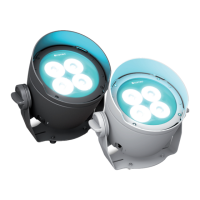
Highlights key specifications like LEDs, IP65 rating, battery, and DMX.
Covers the power switch and the device's main display functions.
Details the buttons for menu navigation, value changes, and selection.
Explains tilt adjustment, rubber feet, securing lug, handle screws, and bracket.
Details the charging port and the infrared sensor for remote operation.
Explains DMX operating mode, Standalone mode, and fixture status displays.
Guides on how to activate W-DMX and pair it with a transmitter.
Instructions to set the starting DMX address for device control.
Guide to choose between various DMX channel modes for operation.
Explains how to set up DMX delay for running light effects.
Explains DMX delay settings for synchronized effects and group assignments.
How to create custom scenes without a DMX controller.
Using preset and custom colour configurations without DMX.
Adjusting auto programs and accessing device settings.
Configuration for W-DMX, battery modes, display settings, and DMX fail behaviour.
Adjustments for dimmer curves, response, and LED colour calibration.
Settings for auto lock, IR remote, charging switch, and factory reset.
Information on firmware, temperature, battery charge, and operating hours.
How to use the optional IR remote, including activation and specific function buttons.
Instructions for attaching diffusers with different beam angles using magnetic mounts.
Covers positioning on surfaces, traverse mounting, and safety cable use.
Important safety notice regarding experience required for overhead installations.
Instructions on removing the mounting bracket for a cleaner uplighting look.
Explains DMX as a universal transmission protocol for device communication.
Details serial connection of multiple lights and DMX chain limits.
Information on DMX cable pin assignments and the need for terminating resistors.
Lists product number, type, LEDs, beam angle, DMX modes, and functions.
Covers operating voltage, power consumption, light intensity, and protection class.
Includes housing details, dimensions, weight, and included/optional accessories.
Provides information on warranty conditions and contact for service.
Instructions for environmentally friendly disposal and recycling of the product.
Details compliance with FCC rules and relevant EU directives.
Details functions, colour macros, and settings for 20 and 13 channel DMX modes.
Explains colour, dimmer, strobe, and chase functions for 7, 6, and 4 channel DMX modes.
Covers dimmer, colour temperature, and DMX delay for 3 channel mode.
 General
| LED Number | 4 |
|---|---|
| Refresh Rate | 3600 Hz |
| Power Consumption | 60 W |
| Housing Colour | Black |
| Cooling System | Fan |
| Protection Class | IP20 |
| DMX Input | XLR 3-pin |
| DMX Output | XLR 3-pin |
| DMX Mode | 4-channel, 6-channel |
| DMX Functions | Dimmer, Strobe |
| Standalone Modes | Master/Slave mode |
| Indicators | OLED display |
| Housing Material | Aluminum |
| Control | DMX512 |

 To Next Page