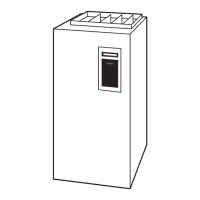
BACK
A93043
Fig. 14_Prohibit Installation on Back
--€ UNIT DAMAGE HAZARD
This gas fire, ace may be used %r construction heat provided
that:
-The hu'nace is permanently installed with all electrical
wiring, piping, air filters, venting and ducting installed
according to these installation instructions. A return air duct
is provided, sealed to the furnace casing, and tem_inated
outside the space containing the Nrnace. This prevents a
negative pressure condition as created by the circulating air
blower, causing a flame rollout and/or &awing combustion
products into d-_estructure.
-The t\lmace is controlled by a thermostat. It may not be "hot
wired" to provide heat continuously to the structure without
thermostatic control.
-Clean omside air is provided for combustion. This is to
minimize the con'osive eff)cts of adhesives, sealers and other
constr_ction materials. It also prevents the entrainment of
dwwall dust into combustion air, which can cause fouling and
plugging of furnace components.
-The temperature of the retmn air to the fhrnace is maintained
between 55_T (13%) and 80°F (27%), with no evening
sethack or shutdown. The use of the filrnace while the
structure is under construction is deemed to be intem_ittent
operation per our installation instructions.
-The air temperature rise is within the rated rise range on the
fm'nace rating plate, and the firing rate has been set to the
nameplate value.
-The filters used to clean the circulating air during the
construction process nmst be either changed or thoroughly
cleaned prior to occupancy.
-The fi/rnace, ductwork and filters are cleaned as necessary to
remove &ywall dust and construction debris tiom all HVA(
system components after construction is completed.
-After construction is complete, verii}' fhmace operating
conditions including ignition, input rate, temperatt_re rise and
venting, according to the manufhcturer's instructions.
Step 2--Furnace Location Relative to Cooling
Equipment
_he cooling coil must be installed parallel with or on downstleam
side of furnace to avoid condensation in heat exchanger. When
installed parallel with a f:tmaace, dampers or other means used to
control flow of air shall be adequate to prevent chilled air tiom
entering filrnace. If dampers are manually operated, they must be
equipped with a means to prevent operation of either unit unless
damper is in fi/ll-heat or fi/tl=cool position.
14
_32°F MINIMUM INSTALLED
/ AMBIENT OR FREEZE
_\\ _! PROTECTION REQUIRED
A93058
Fig. 15--Freeze Protection
FIRE, INJURY OR DEATH HAZARD
Failure to %llow this warning could result in fire, personal
iajury, or death
Do not install t'umace on its back. (See Fig. 14.) Safety
control operation will be adversely affected Never connect
return-air ducts to back of fi/rnace.
[N[T DAMAGE HAZARD
Failure to [bllow this caution may result in minor property or
unit damage.
If this f_/rnace is installed in an unconditioned space where
ambient temperatt_res may be 32_>For lower, fieeze protection
measures must be taken. (See Fig 15.)
Step 3--Hazardous Locations
[]
FIRE, EXPLOSION, INJURY OR DEATH HAZARD
Improper location or inadequate protection could result in fire
or explosion
When the 51mace is installed in a residential garage_ the
burners and ignition sources must be located at least 18 in.
above the floor. The filrnace must be located or protected to
avoid physical damage by vehicles. When the 141mace is
installed in a public garage, airplane hangar, or other building
having a hazardous atmosphere, the fi/rnace must be installed
in accordance with the NFG( or NSCNGPIC. (See Fig. 16.)
AIR FOR COMBUSTION AND VENTILATION
Provisions fbr adequate combustion, ventilation, and dilution air
must he provided in accordance with:
* U.S. Ins_alla{ions: Section 8.3 of the NFGC, Air for Combuso
tion and Ventilation and applicable provisions of the local
building codes
* (anadian Installations: Part 7 of the NS(NGPI(, Venting
Systems and Air Supply for Appliances and all authorities
having jurisdiction


 To Next Page
 Loading...