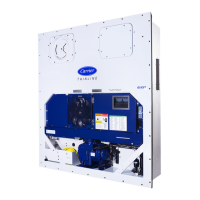
This document outlines the annual inspection procedures for Carrier Transicold ThinLINE 69NT40-541 and PrimeLINE 69NT40-561 container refrigeration units. The primary function of these units is to provide container refrigeration, ensuring the preservation of cargo during transport. The manual serves as a comprehensive guide for owners and operators to maximize the operational life of their equipment through regular maintenance.
Function Description
The Carrier Transicold ThinLINE and PrimeLINE container refrigeration units are designed to maintain precise temperature control within shipping containers. They utilize a refrigeration cycle to cool the container's interior, making them essential for transporting perishable goods. The units are equipped with various sensors to monitor internal and external conditions, ensuring optimal performance and cargo safety. Key components include an evaporator coil for heat absorption, a condenser coil for heat rejection, a compressor to circulate refrigerant, and expansion valves (either Thermostatic Expansion Valve - TXV or Electronic Expansion Valve - EEV) to control refrigerant flow. The system also incorporates defrosting mechanisms, including heaters and drain lines, to prevent ice buildup on the evaporator coil, which could impede airflow and reduce efficiency. Electrical control boxes house the necessary circuitry and controllers, such as the MicroLink controller, to manage the unit's operations, including temperature set points, fan speeds, and diagnostic functions.
Usage Features
The units are designed for ease of operation and monitoring. Operators can set the desired temperature using the control panel, and the MicroLink controller manages the refrigeration cycle to maintain this set point. For PrimeLINE units, operating pressures can be viewed via specific codes (code 12 for Suction Pressure and code 14 for Discharge Pressure), allowing for quick assessment of system performance. The units are also equipped with a DataCORDER, which records trip data, including temperature and PTI (Pre-Trip Inspection) information. This data can be downloaded using a DataBANK downloading card, providing a permanent record of the unit's performance during a trip. The system includes various sensors, such as return air, supply air, temperature recorder, humidity, and evaporator temperature sensors, which provide critical data for monitoring and control. The design allows for remote monitoring and interrogation through dedicated sockets, enhancing operational flexibility. The units are designed to operate with R-134a refrigerant, a common choice in container refrigeration.
Maintenance Features
The annual inspection outlined in this manual focuses heavily on preventive maintenance to ensure the longevity and reliability of the refrigeration units.
Rear of Unit Inspection:
- Evaporator Coil: Requires removal of the upper internal access panel for cleaning with low-pressure water to remove debris. If green patina or white powder is present, a specific cleaner (P/N NU4371-88) is recommended. Fin damage should be straightened with a fin comb, and the coil inspected for leaks and corrosion.
- Evaporator Motors and Fan Blades: Checked for excessive end play and bearing drag. Fan blades are inspected for cracking or wear, and clamp brackets are verified for security.
- Wire Harnesses: Examined for wear or damage and ensured they are properly secured.
- Defrost Termination Sensor (DTS): Inspected for proper security and damage.
- Other Sensors: Return air, supply air, temperature recorder, humidity, and evaporator temperature sensors are checked for proper positioning, security, and lead damage.
- Drain System: Drain cup, funnel, and gutters are examined, and defrost drain lines are cleaned with a low-pressure water hose to ensure free flow.
- Expansion Valves (TXV/EEV): Inspected for refrigerant leaks and corrosion. For TXV, proper insulation of the power head and sensing bulb location/insulation are checked. For EEV, the electrical coil's seating and coil boot fit are verified. The position of ETS1 and ETS2, securing tie, and insulation are also checked.
- Heaters and Brackets: Examined for damage, proper positioning in retaining clips, and correct wiring connections.
- Heater Termination Thermostat (HTT): Checked for proper positioning and damage.
- Internal Valves and Solenoid Coils: Inspected for proper positioning, physical damage, leaks, or corrosion.
- Airflow Channels: "T" bars on the floor, under the lower air baffle, and kick plate are checked for cleanliness and debris to ensure proper air circulation. Floor drains are also cleaned.
- Container Panels and Seals: Inspected for damage, including insulation and door seals.
- Sockets: USDA and interior communication sockets are checked for cleanliness, dryness, and fitted caps.
- Access Panels: The upper access panel is refitted, ensuring all hardware is correctly installed.
Front of Unit Inspection:
- Exterior Panels: All exterior panels must be removed before proceeding with this section.
- Oil Residue and Leaks: The unit is examined for oil residue, and an electronic leak detector is used to check for refrigerant leaks, particularly around compressor joints, high-pressure switch connections, pressure transducers, and piping. The unit, including the condenser coil, is cleaned with low-pressure water after leak repair.
- Painted Surfaces: Corrosion maintenance is required. Corroded areas are to be removed, primed, and repainted using specified paint part numbers (White P/N 36-00071-16, Blue P/N 76-00397-01).
- Monitoring/Interrogation Sockets: Remote monitoring and interrogation sockets are checked for security, damage, corrosion, and properly tethered caps.
- Compressor and Mounting Plate: Inspected for severe corrosion, and compressor shock mounts are checked for cracks. Mounting bolts are torqued to specifications.
- Electrical Control Box: The interior is checked for dryness, damage, overheating, corrosion, and moisture ingress. The control box door gasket is inspected. Loose wires are wire-tied. Contactor contacts are examined for severe pitting. Wiring diagrams and schematics are checked for presence and legibility. The circuit breaker panel is inspected for damage and corrosion. Wire harnesses and connections are checked for damage and tightness (using a Pozi drive screwdriver). A Megohm test is performed on all motors and heaters, with components replaced if readings are below recommended minimums.
- Condenser Motor and Fan Blade: Fan blade checked for cracking or wear. Fan positioning in the venturi is verified. Fan blade is spun to check for bearing drag. Fan motor is examined for corrosion, overheating, or physical damage. The CF mounting bracket is checked for cracks.
- Condenser Coil: Inspected for leaks and fin damage (straightened with a fin comb). Cleaned with a low-pressure water hose (top-down for flat coils, inside-to-outside for C coils, opposite to airflow direction). Checked for excessive corrosion on fins and tube sheets.
- Condensate Defrost Drain Tube: Examined for damage, blockages, or debris. Condenser fan removal may be necessary for full access.
- External Valves, Coils, Sight Glasses, Pressure Transducers: Inspected for physical damage, leaks, or corrosion.
- Filter/Drier: Inspected for excessive corrosion or physical damage and replaced if required. Periodic paint touch-up may be needed.
- Water-Cooled Condenser (if equipped): Periodic paint touch-up may be required. Checked for scaling, and assembly inspected for excessive corrosion or physical damage. Water connections and collar on the female fitting are checked for damage and free movement.
- Power Cables: Checked for secure attachment, damage, or crushing. Replaced if multiple repair joints are found. Plug pins are inspected for burning or pitting, and the locating lug is checked. The plug is disassembled to tighten wires to pins, and the cable gland is ensured to be tight and sealing. The plug gasket is examined for cracking/damage. Megohm tests are performed from the power plug ground pin to the control box ground plate (should be zero) and from each power plug pin to ground (should be infinity for other pins).
- Exterior Panels and Seals: All exterior panels are refitted, and door seals are checked for proper alignment and watertight integrity. Door fasteners and bolts (including Mylar washers) are ensured to be present and tight. Gaskets for the control box, access panels, and fresh air make-up slide are replaced if brittle or cracked.
- Wires and Wire Harnesses (outside control box): Examined for proper location and condition (e.g., wires to valves, heaters, switches, compressor terminals).
- Instructional Labels and Placards: All labels and the Model/Serial Number plate are checked for presence and legibility.
- Structural Integrity: The unit's structural integrity is inspected for cracks, damage, and missing items.
Operational Inspection:
- Power Supply: Lock Out/Tag Out device is removed, unit is plugged in, and voltage on all three phases is checked.
- Manifold Gauge Set: Installed using proper hygiene. For PrimeLINE units, pressures are checked via codes 12 and 14.
- Unit Start-up: Power is turned on, set point changed to 32°F (0°C). Container ID, date, time (GMT), software, and configuration on the MicroLink controller are verified.
- Fan Rotation: Condenser and both evaporator fans are checked for proper rotation.
- DataCORDER Trip Start: Initiated as per the instruction label.
- Pressures: Discharge and suction pressures are checked against acceptable levels based on ambient temperature.
- MicroLink Codes: User Selectable MicroLink codes (26 and higher) are set to customer default values.
- Auto 2 PTI: Initiated. During pull-down, the unit is checked for unusual noise/vibrations. During PTI test 8, the refrigerant level is checked via the sight glass.
- PTI Faults: Any faults from failing PTI tests are repaired.
- Superheat Setting: TXV and EEV superheat settings are checked. For PrimeLINE units, superheat can be observed at code 54. Adjustments are not made; if incorrect, the valve or sensors are replaced.
- Filter Drier: Operation is monitored by checking the temperature difference across it. Excessive drop or frosting indicates a restriction, requiring replacement.
- Moisture/Liquid Indicator: Checked for proper color. If moisture is indicated, the system is evacuated and dehydrated, the filter drier is replaced, and a Total Test kit is used to check for acid or remaining moisture.
- Water Fittings (water-cooled condenser): Inspected for damage. Connections are pressurized, and water pressure switch cut-out and cut-in values are recorded and checked against specifications.
- DataCORDER Download: The unit's DataCORDER is interrogated (e.g., using a DataBANK card) to download data from the "Last Trip Start" to ensure all PM temperature and PTI data are obtained.
- Power Disconnection: Unit is turned off and disconnected from power.
- Trip Report: Printed and retained as a permanent record of the PM.
This comprehensive maintenance regimen ensures that the ThinLINE and PrimeLINE units operate efficiently and reliably, minimizing downtime and extending their service life.

 Need help?
 General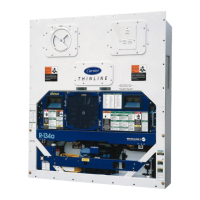


 To Next Page