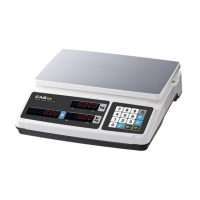
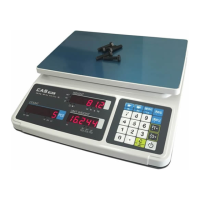
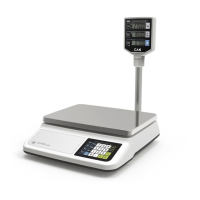
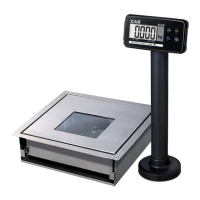
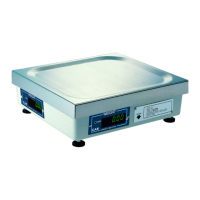
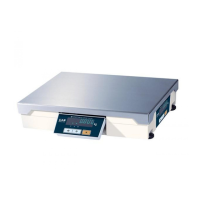
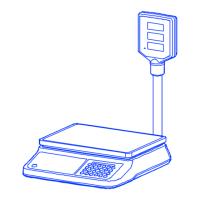
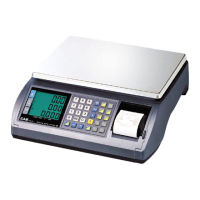
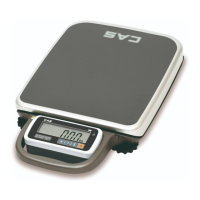
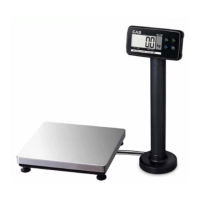
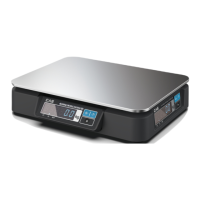
The CAS PR-LCD is a versatile and reliable weighing scale designed for various commercial applications, offering precise measurements and user-friendly operation. Its robust construction and thoughtful design ensure durability and consistent performance in demanding environments.
Function Description
The primary function of the CAS PR-LCD is to accurately measure weight and calculate the total price based on a given unit price. It features a clear display that simultaneously shows the weight, unit price, and total price, making transactions efficient and transparent. The scale is equipped with a comprehensive keypad that allows for easy input of numeric data, unit prices, and access to various functions.
Key functional components include:
- Weighing Platter: The flat surface where items are placed for weighing.
- Display Unit: A multi-segment LCD that presents weight, unit price, and total price information. It also includes indicators for stability, zero, tare, low battery, and other operational statuses.
- Keyboard: A keypad with numeric keys (0-9) for data entry, function keys for tare, zero, mode, power, and memory recall (M1-M4), as well as a PLU (Price Look-Up) save key.
- Load Cell: The internal sensor responsible for detecting the weight placed on the platter and converting it into an electrical signal for processing.
- Main PCB (Printed Circuit Board): The central electronic component that processes signals from the load cell, controls the display, manages keypad inputs, and executes various weighing and calculation algorithms.
- Power Supply: The scale can operate on both AC power and a built-in rechargeable Pb battery, providing flexibility for use in different locations and ensuring continuous operation during power outages.
The scale supports various weighing modes, including standard weighing and counting functions, which can be configured to meet specific business needs. It also incorporates a weight comparison function (hi, ok, low) for efficient sorting or quality control tasks.
Usage Features
The CAS PR-LCD is designed for ease of use, making it suitable for a wide range of operators.
- Intuitive Display: The display unit provides clear, easy-to-read information with a backlight for visibility in various lighting conditions. Separate displays for total price, weight, and unit price allow for quick comprehension of transaction details.
- Simple Data Entry: The numeric keypad enables straightforward input of unit prices. The decimal point key ensures accurate pricing for items with fractional unit prices.
- Tare Functionality: The dedicated TARE key allows users to easily subtract the weight of a container, ensuring that only the net weight of the product is measured. This is particularly useful for pre-packaging or when using various types of containers.
- Zero Correction: The ZERO key (►0-) allows for quick correction of the zero point, ensuring accurate measurements even if there are slight variations on the platter before weighing.
- Memory Keys (M1-M4) and PLU Save: These keys provide convenient access to stored unit prices for frequently sold items, speeding up transactions and reducing errors. The PLU SAVE key allows operators to store new unit prices for future use.
- Power Management: The scale features an ON/OFF key for simple power control. Its battery operation allows for portability, and a low battery indicator alerts users when charging is needed. An automatic shutdown feature helps protect the battery from over-discharge.
- RS232 Interface: The optional RS232 port enables connectivity with external devices such as printers or computers, facilitating data logging, inventory management, or receipt printing. This connectivity can be configured for various printing modes, including manual, auto-print when stable, and continuous auto-print.
Maintenance Features
Maintaining the CAS PR-LCD is straightforward, focusing on ensuring accuracy and longevity.
- Calibration Mode: The scale includes a dedicated calibration mode accessible by pressing the [CAL] key followed by the [ON/OFF] key. This mode allows for precise adjustment of the scale's accuracy.
- Weighing Specification Set (C1): Allows selection of the appropriate weighing capacity and division, ensuring the scale operates within its intended parameters.
- EEPROM Initiation (C2): Provides a function to clear and reinitialize the EEPROM, which can be useful for resolving data-related issues.
- Calibration (C3): Guides the user through the process of zero-point confirmation and loading a known weight for calibration. This ensures the scale provides accurate readings across its full range. The manual emphasizes that the calibration weight should not exceed 10% of the scale's capacity for optimal results.
- Function Set (C4): Allows configuration of various operational parameters, including:
- Initial Zero Range (C4-1): Sets the acceptable range for the initial zero point, accommodating minor variations on the platter.
- Zero Set Range (C4-2): Defines the range within which the ZERO key can re-establish the zero point during operation.
- Zero-Tracking Range (C4-3): Configures how the scale automatically maintains its zero point over time, compensating for minor environmental changes or debris.
- Backlight On/Off (C4-4): Allows control over the display backlight, which can be turned off to conserve battery life.
- RS232 Settings (C6-1): Configures the RS232 communication parameters, including print mode (Do Not Print, Manual Print, Auto Print when stable, Continue Auto Print) to suit different peripheral requirements.
- Baud Rate Settings (C6-2): Allows adjustment of the communication speed for the RS232 interface, ensuring compatibility with connected devices.
- Sealing Method: The device incorporates a sealing method using a sealing wire and lead, secured by sealing bolts and a sealing plate. This mechanism helps protect the internal calibration settings from unauthorized tampering, ensuring the integrity of measurements for legal-for-trade applications.
- Battery Monitoring: The scale's ability to display battery voltage (by pressing the PLU SAVE key for more than 2 seconds) allows users to monitor the battery's health and plan charging cycles, preventing unexpected shutdowns.
- Durable Construction: The overall design, including the platter and housing, is built to withstand typical commercial use. Regular cleaning of the platter and exterior is generally sufficient for routine maintenance.

 Need help?
 General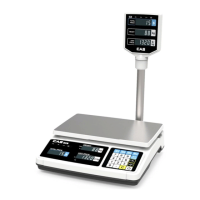

 To Next Page