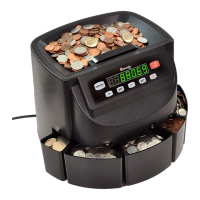
The Cassida C300 is a multi-functional coin processing machine designed for counting, sorting, and wrapping coins, aimed at streamlining cash handling for businesses. It offers a large hopper capacity and the ability to sort various coin denominations into designated trays or tubes, making it suitable for environments with high coin volumes.
Function Description
The primary function of the Cassida C300 is to accurately count and sort coins by denomination. It operates in a batching mode by default, allowing users to set specific quantities for each coin type. This feature is particularly useful for preparing coin rolls for banking or for managing specific cash drawer requirements. The machine automatically stops once a set batch quantity for any denomination is reached, indicating "BAT FULL" on the display. It also supports an ADD mode, where coin counts from multiple batches are accumulated, providing a running total.
The C300 is equipped with coin tubes that facilitate direct sorting into preformed paper bank roll wrappers. This eliminates the need for manual transfer of coins from trays to wrappers, significantly enhancing efficiency. The machine is designed to handle various coin denominations, with capacities that may vary by country.
For record-keeping, the C300 includes a printer port, allowing it to connect to a serial printer (RS-232) to produce detailed printouts of counting reports. This feature is valuable for auditing and reconciliation purposes.
Usage Features
- Powering Up and Self-Check: To begin, the unit is powered on after plugging it into a grounded outlet. It performs a self-check, and the main display shows the report screen upon successful completion. It's crucial to ensure no coins are in the hopper during this process to avoid an "EA" error.
- Counting: In its default batching mode, all batch quantities should be set to zero for simple counting. Coins are placed into the hopper, and counting begins by pressing the "START/STOP" button. The machine automatically sorts coins into trays or tubes and displays the total value and denomination breakdown. Counting can be paused and resumed using the "START/STOP" button. If a coin tray becomes full, the machine should be stopped and the tray emptied before resuming to ensure accurate operation. The count can be reset for a new batch by pressing "CLEAR."
- Adding Mode: The C300 operates in ADD mode by default, accumulating counts from previous batches. To start a fresh count, the "CLEAR" button resets the coin count to zero.
- Setting Batch Quantities:
- Coin Rolls: Batch quantities for coin rolls can be programmed by pressing and holding the "+" button for approximately three seconds until "L" appears on the display. This sets standard bank coin roll amounts for each denomination.
- Coin Trays: Similarly, batch quantities for coin trays are set by pressing and holding the "SET" button for about three seconds until "H" is displayed.
- Other Batch Quantities: For custom batching, the "BAT" button accesses the batch screen. The "SET" button selects the desired denomination, and the "BAT" button cycles through preset batch quantities (e.g., 0, 10, 20, 25, etc.). Fine adjustments can be made with the "-" or "+" buttons. Once set, "START/STOP" initiates counting. The machine will stop when a desired batch quantity is met, displaying "BAT FULL" and blinking the denomination line. Counting can be resumed, and pressing "CLEAR" twice resets the count and restarts batching from zero. The C300 maintains a running total for each denomination in batch mode.
- Clearing Batch Quantities: Batch quantities can be cleared by pressing and holding the "-" button on the report screen for three seconds, which displays "C" and resets all quantities to zero. Alternatively, from the batch screen, selecting a denomination with "SET" and pressing "CLEAR" clears that specific batch quantity.
- Using Coin Tubes: Coin tubes allow direct sorting into paper wrappers. Users must remove coin trays for the denominations using tubes, insert preformed paper wrappers completely (crimped side down), and ensure the wrapper shape is round and not bent. The tubes are then secured into the proper slots at the machine's base. After setting coin roll batch quantities, loading coins, and pressing "START/STOP," the machine dispenses the correct number of coins into each tube. When a tube is full, "BAT FULL" is displayed, and the full wrapper can be removed and crimped. A new wrapper is then inserted, and counting resumes. A "QUICK LOAD" feature allows for easy wrapper changes without removing the tubes.
- Printing: Pressing the "PRINT" button on the report screen generates a detailed printout of the counting report if a printer is connected.
Maintenance Features
Regular care and preventive maintenance are crucial for the Cassida C300's longevity and optimal performance.
- General Cleaning:
- Always power off the unit and disconnect it from the power source before cleaning.
- Clean all external parts with an air duster or a soft cloth.
- Remove the three housing screws and carefully lift the housing.
- Remove any foreign objects from the distribution plate.
- Vacuum or use an air duster to clean dust from the distribution plate.
- Sensor Cleaning: Dirty sensors can lead to various error codes (E1-E9, EA).
- Clean all sensors (running and counting sensors) using a Cassida air duster followed by a CleanPro swab or a microfiber cloth lightly moistened with isopropyl alcohol.
- For count sensors, clean the round end of each pair of counting sensors in the coin path.
- For run sensors, gently wipe the run sensor pair.
- Ensure sensors are aligned; avoid excessive force.
- Troubleshooting EA Error: If an "EA" error occurs, inspect the machine's interior for coins or foreign objects preventing the coin platter from rotating. Clean dust from the distribution wheel and sensors using an air duster, spraying in a circular motion and intensifying around sensors. Be cautious with the nozzle, keeping it 1-2 inches away.
- Reassembly: After cleaning, reinstall the housing, ensuring it aligns properly with the AC power cord and power switch. Do not force the housing to avoid damaging the coin feed mechanism. Reinstall all three cover screws.
- Post-Cleaning: Ensure all cleaned parts are dry before using the machine again.
The C300's internal memory stores batch quantities even when the machine is turned off, though the count itself resets. In case of persistent errors, users are advised to contact Cassida Technical Support, providing product model, serial number, problem description, and steps already taken.

 Need help?
 General

 To Next Page