7
BEARINGS
The radial bearing (180) is lubricated by the liquid being pumped
and therefore needs no external lubrication.
The thrust bearing(s) (25A) are grease packed “for life” and require
no further lubrication until the pump is rebuilt.
The RA2096 uses a “sealed for life” bearing that is packed with
grease by the ball bearing manufacturer.
The RA3146 and RA3186 have ball bearings that are hand
packed as an assembly procedure when the pump is assembled.
The grease is a lithium 12-hydroxysterate soap-thickened grease
that has rust inhibitors and extreme pressure additives. This is a
NLG1, Grade 2, similar to –
Shell Oil Company’s “Alvania” Grease #EP2 or
Union Oil of California’s “Unoba EP” Grease Grade 2
Grease is also available from Dean Pump in individual containers.
One container is required for a RA3146 pump. Two containers are
required for a RA3186 pump. Order “RA3000” Grease #2 for
bearing lubrication.
MECHANICAL SEAL
The “RA” pumps are arranged with a mechanical face seal (95A
and 95B) that was specifically selected for sealing the more
commonly used heat transfer oils. Some of the heat transfer oils
“oxidize”. The manufacturer of any heat transfer oil that oxidizes
will recommend that a nitrogen gas blanket be maintained on
the expansion tank of the system to assure that oxygen cannot
come in contact with the oil. The “RA” pumps have a cavity pro-
vided between the mechanical seal stationary (95A) and the
front grease seal (76) to allow the use of a barrier fluid to keep
oxygen away from the mechanical seal faces when operating
with an oxidizing oil.
All “oils” will oxidize at some point depending upon the amount of
air contamination and the temperature. Most “oils” will begin to
oxidize at 250°F. Some “oils” will oxidize as low as 150°F. The oxi-
dation rate doubles for every 18 to 20°F increase in temperature,
so it is very important to not use a barrier fluid that has a low oxi-
dation temperature. The user should check to see at what tempera-
ture his oil will start to oxidize.
When the oil being pumped is one that oxidizes, a barrier fluid
should be used. Select a fluid to be used as the barrier fluid that is
compatible with the pumpage and not detrimental to the lip seal,
bearings, mechanical seal, or the bearing housing. The best fluid to
use is nitrogen, but many customers prefer to use a liquid instead
of a gas. Many oil companies produce a (barrier) oil that would be
compatible with the oil being pumped, mechanical seal elastomers,
lip seal, bearings, bearing grease, and the bearing housing. Two
examples of this type of oil are Calflo AF (Petro-Canada) and
Dowtherm RP (Dow Chemical). The user should check with his oil
supplier for his recommendation for a non-oxidizing or low oxidiz-
ing oil to use as a barrier. Sometimes the oil being pumped can be
used as the barrier fluid.
Since most of our customers are using a liquid as a barrier fluid, the
pump is supplied with the barrier oil piping shown at the bottom of
page 6.
When using a liquid barrier fluid, the barrier cavity is filled through
the pipe tee located directly above the cavity. Remove the
3
/8" pipe
plug (84) from the top of the tee (see the drawing at the
bottom of page 6) and pour the barrier liquid into the tee until the
liquid level is flush with the bottom of the pipe nipple that extends
horizontally out of the side of the tee. Any excess above this level
will run out on to the baseplate. Rotate the shaft by hand (wear
gloves for this operation) to help remove any trapped air pockets.
Refill to previous level and replace the pipe plug (84).
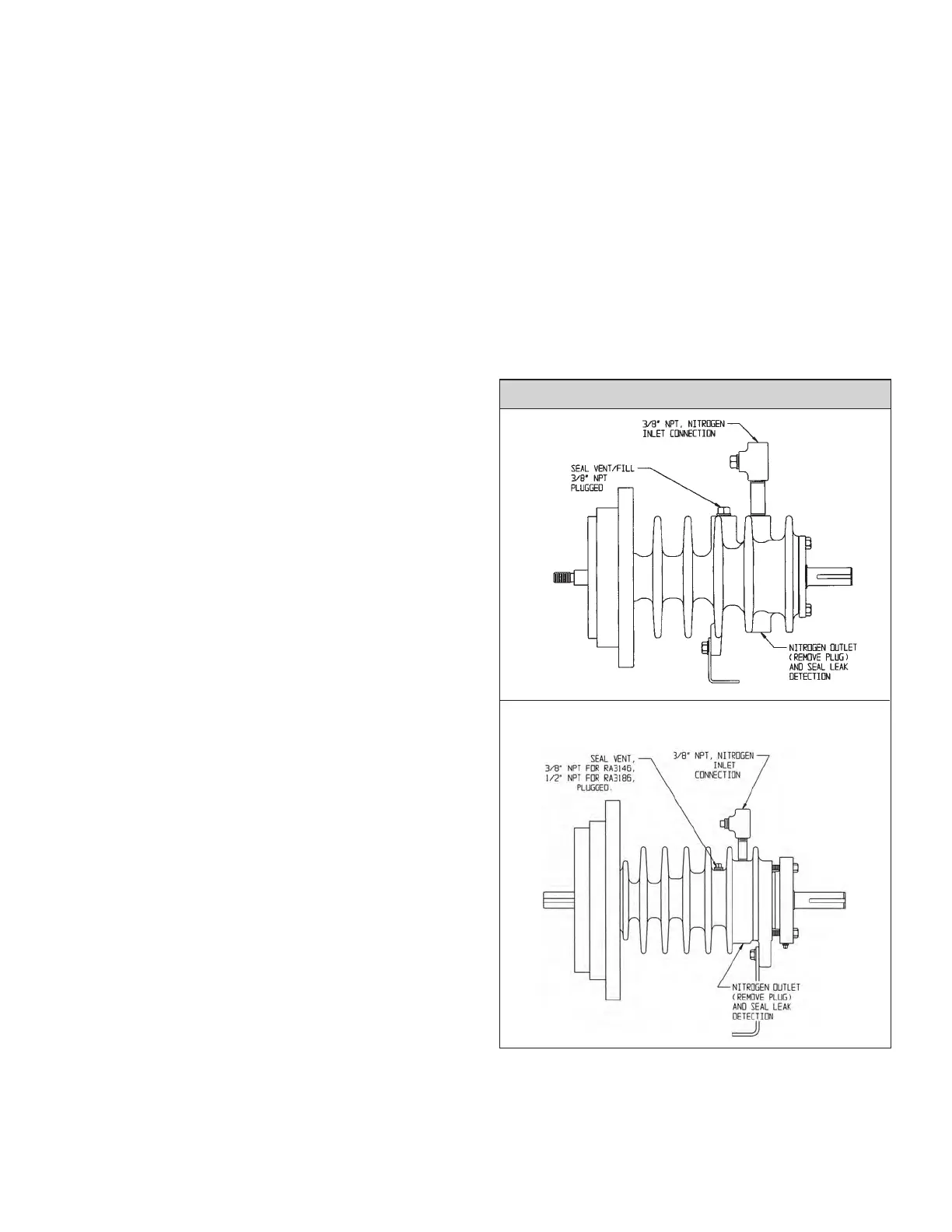
If nitrogen is to be used as the barrier fluid, the barrier piping must
be modified, from that shown on page 6, to that shown below.
Remove the vertical overflow pipe nipple, the
3
/8" pipe elbow, and
the horizontal pipe nipple connecting the pipe elbow to the pipe
tee. Discard these parts. Move the pipe plug in the top of the pipe
tee to the side connection of the pipe tee. Remove the
3
/8" barrier
oil drain plug from the bottom of the bearing housing, and discard
it. Connect the nitrogen supply line to the top of the pipe tee and
regulate the pressure to
1
/4 P.S.I.G. maximum. The
3
/8" connection
at the bottom of the bearing housing will be left un-plugged to
become an outlet for the nitrogen and serve as a leak detection in
the event of mechanical seal failure.
PUMP LUBRICATION
PIPING MODIFICATION FOR NITROGEN BARRIER
When pumping a heat transfer oil that does not oxidize, a barrier
fluid is not needed. Modify the barrier piping as described above
for the use of nitrogen except plug both of the connections in the
pipe tee. A collection pan could be placed on the baseplate under
this drain opening to collect any condensed vapors or leakage from
the mechanical seal when the faces wear.
RA2096
RA3146 AND RA3186


 To Next Page
 Loading...