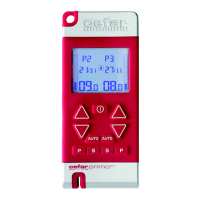
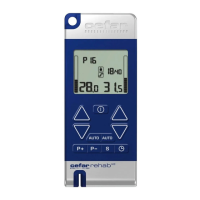
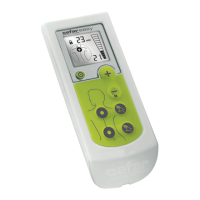
The Cefar Direct TENS™ is a transcutaneous electrical nerve stimulator designed for pain treatment. It uses electrical pulses delivered through the skin to stimulate cutaneous and afferent (deeper) nerves, alleviating various types of acute and chronic pain. Unlike medication or creams, TENS therapy has no known side effects.
Function Description:
The Direct TENS™ device operates based on two primary pain theories: the Gate Control Theory (by WALL and MELZACK, 1965) and the Endorphin Theory (by ERIKSON and SJÖLUND, 1979). Weak TENS impulses block pain signals traveling to the brain (sensor stimulation), while strong TENS impulses increase the release of internal substances like endorphins, which also alleviate pain (motor stimulation).
The device features two channels for stimulation, allowing for simultaneous treatment with different parameters or electrode placements. It offers a variety of pre-set programs tailored to specific indications and pain conditions. Users can adjust the intensity of stimulation for each channel and select programs based on the area to be treated (e.g., knee, shoulder, back-hip, neck, hand). The device also includes a therapy timer function, allowing users to set treatment durations from 1 to 59 minutes (in 1-minute increments) or 1 to 24 hours (in 30-minute increments), or opt for continuous operation. When the timer is activated, the stimulator automatically switches off at the end of the programmed interval.
Intended Use:
The Direct TENS™ (model 882700) is intended for use by both healthcare professionals and patients. It can be used indoors, in healthcare facilities, or at home. It is indicated for alleviating various types of acute and chronic pain, including:
- Joint pain (e.g., knee, hip arthrosis)
- Chronic pain originating from the spine
- Degenerative diseases of the musculoskeletal system
- Tension headache
- Radiating pain (e.g., back pain, cervicobrachial syndrome)
- Amputation stump/phantom limb pain
- Pain from rheumatic diseases
Contraindications:
The device should not be used in the following situations:
- If you have an implanted demand pacemaker, intracardiac defibrillator, or other active implants.
- For undiagnosed pain until the cause has been ascertained.
- If you have epilepsy.
- During pregnancy, unless approved by a gynaecologist.
- Near the area of an implant (cochlear, pacemakers, skeletal, or electrical).
- In the vicinity of metal (jewelry, body piercings, buckles, or other removable metallic products).
- On any part of the body not directly visible without assistance.
- At the front or side of the neck (to avoid a drop in blood pressure) or on the head.
- For symptomatic local pain relief unless a diagnosis is established or a pain syndrome has been diagnosed.
Warnings and Precautions:
- Consult a physician before use, especially for individuals susceptible to heart rhythm disturbances.
- Apply stimulation only to normal, intact, clean, healthy skin.
- The long-term effects of chronic electrical stimulation are unknown.
- Avoid stimulation over the neck (carotid sinus) or mouth, as it can cause severe muscle spasms, airway closure, breathing difficulties, or adverse effects on heart rhythm/blood pressure.
- Do not apply stimulation across the chest, as it may cause lethal heart rhythm disturbances.
- Do not apply stimulation across the head, or place electrodes on opposite sides of the head, due to unknown effects on the brain.
- Avoid stimulation over open wounds, rashes, swollen, red, infected, or inflamed areas, or skin eruptions.
- Do not apply stimulation over or in proximity to cancerous lesions.
- Do not apply stimulation directly on the eyes.
- Do not use in the presence of electronic monitoring equipment (e.g., cardiac monitors, ECG alarms), which may not operate properly.
- Do not apply stimulation in the bath or shower, or in humid atmospheres exceeding 75% relative humidity.
- Do not apply stimulation while sleeping, driving, or operating machinery, or during any activity where involuntary muscle contraction could pose a risk of injury.
- Disconnect stimulation electrodes before using electrosurgical equipment or defibrillators to prevent skin burns or device damage.
- Do not wear electrodes or the device during Magnetic Resonance Imaging (MRI) scans, as this may cause metal overheating and skin burns.
- Do not use in flammable or explosive environments (e.g., oxygen-rich environments, near flammable anesthetics).
- Never connect stimulation cables to an external power supply.
- Avoid using the device beside or stacked on top of other equipment without checking proper function in the chosen configuration.
- Electrodes are for single patient use only to prevent skin reactions or disease transmission.
- Use only new AA type batteries.
- Do not open the battery cover during stimulation.
- Remove batteries if not used for prolonged periods (more than 3 months) to prevent damage.
- Do not jerk cables or connections.
- Avoid using heat or cold-producing devices near electrodes, as they may impair performance or increase injury risk.
- Do not apply electrodes over pulled muscles.
- TENS is not effective for central pain (including headache), is not a substitute for pain medications, and has no curative value.
- The effectiveness of TENS depends on patient selection by a qualified practitioner.
- Use electrodes with a minimum active area of 16 cm² to prevent burns at higher intensities.
- Patients may experience skin irritation, burns, headache, or other painful sensations. Discontinue use and consult a physician if adverse reactions occur.
- Do not disconnect stimulation cables or move/remove electrodes while the stimulator is switched on.
- Do not apply stimulation in the vicinity of metal; remove all metallic items.
- Never carry out an initial stimulation session on a standing person; perform the first five minutes while sitting or lying down to prevent vasovagal reactions.
- Allow the stimulator to reach room temperature before use to prevent condensation.
Important Technical Specifications:
- Number of channels: 2
- Constant Voltage: Up to a resistance of 1000 ohms (increased load can reduce maximum current).
- Output Intensity: 0-60, adjustable in 0.5 steps.
- Maximum Output: 40 mA @ 1000 ohms, 250 µs (charge maximum: 10µC).
- Waveform: Asymmetrical biphasic square impulse.
- Frequency Range: 0.5 - 1000 Hz.
- Impulse Duration: Determined by intensity setting, 0-250 µs.
- Power Supply: 2 x 1.5 V AA disposable batteries or 2 x 1.2 V AA rechargeable batteries.
- Current consumption for 1 channel (200 µs impulse duration, 100 Hz, 40 V): 50 mA.
- Ambient conditions (operation): Temperature 10°C to 40°C, Relative humidity 30-75% (no condensation), Atmospheric pressure 700 to 1060 hPa.
- Ambient conditions (storage, transport): Temperature -40°C to 70°C, Relative humidity 10-90% (no condensation), Atmospheric pressure 500 to 1060 hPa.
- Dimensions (HxWxD): 110 x 70 x 30 mm.
- Weight: 165 g (including batteries).
- Classification: Class IIa medical device (MDD), Type BF applied part.
- Compliance: CE-0473, EN 60601-1, EN 60601-1-2.
Usage Features:
- Quick Start Guide: Provides a simple step-by-step process for inserting batteries, attaching the belt clip, connecting electrodes, applying electrodes, connecting leadwires to the device, switching on, selecting a program, and setting intensity.
- Program Selection: Offers 13 pre-set programs for various pain conditions, with specific frequencies and advantages (e.g., Kaada TENS, muscle relaxation, strong analgesia, bi-modal, burst, multi-modulation). Programs 9-13 allow for frequency selection (2-60 Hz for chronic pain, 60-150 Hz for acute pain).
- Intensity Adjustment: Users can increase or decrease stimulation intensity for each channel using dedicated keys.
- Key Lock Function: Keys automatically lock after approximately 10 seconds to prevent accidental changes to treatment parameters. They can be unlocked by pressing either channel's intensity key.
- Electrode Placement: Guidelines for bilateral, diagonal, parallel, and bracket positions, as well as specific configurations for various body parts and pain conditions (e.g., cervical dysfunction, shoulder/knee, scarred tissue, shoulder blade, lumbar spine, knee joint, phantom limb pain).
- Therapy Timer: Allows setting treatment durations from 1 minute to 24 hours, or continuous operation.
- Factory Defaults Reset: A function to reset all stored data, deactivate the timer and program lock, reset frequencies to default values, and select program 9.
Maintenance Features:
- Battery Replacement: Instructions for inserting and replacing AA type batteries, including observing polarity and proper disposal of worn-out batteries.
- Electrode Care: Electrodes can be used 20 times or more with proper handling.
- Clean skin application sites with mild soap and water before attaching electrodes.
- Recondition dry electrodes with a small quantity of water on the adhesive surface.
- Change electrodes if poor contact or repeated open lead detection occurs.
- Remove electrodes by pulling on edges, not leadwires.
- Reattach electrodes to protective paper and store in their bags (preferably in a refrigerator).
- Shave hairy skin sites 24 hours before applying electrodes.
- Remove electrodes after each use and apply them on different sites to avoid skin irritation.
- Device Cleaning: Wipe the stimulator with a damp cloth; never expose it to water.
- Storage: Store the stimulator and accessories in the original case when not in use.
- Service Life: Typical service life is 7 years. No other maintenance is required.
- Troubleshooting: Provides guidance for issues like unpleasant stimulation, weak stimulation, or error messages (e.g., "E" for defective stimulator, "circuit interrupted" for poor electrode contact).
- Biocompatibility: Parts of the device that come into contact with the user are designed to fulfill biocompatibility requirements.

 Need help?
 General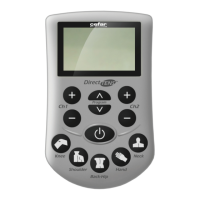

 To Next Page