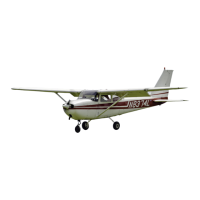
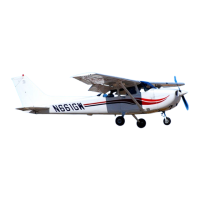
Cessna 170 Service Manual
Electrical System
CLEANING THE BATTERY. For maximum efficiency, the battery and connections should be kept clean at
all times.
a. Remove the battery in accordance with the preceding paragraph.
b. Tighten battery cell filler caps to prevent the cleaning solution from entering the cells.
c. Wipe battery cable ends, battery terminal and the entire surface of the battery with a clean cloth
moistened with a solution of baking soda and water.
d. Rinse with clear water, wipe off excess water and allow batteries to dry.
e. Brighten up cable ends and battery terminals with emery cloth or a wire brush.
f. Coat the battery terminals and the cable ends with petroleum jelly or battery terminal grease.
g. Install the batteries according to the preceding paragraph.
ADDING ELECTROLYTE OR WATER TO THE BATTERY. A battery being charged and discharged with
use will decompose the water from the electrolyte. When the water is decomposed hydrogen and oxygen
gases are formed which escape into the atmosphere through the battery vent system. The acid in the
solution chemically combines with the plates of the battery during discharge or is suspended in the
electrolyte solution during charge. Unless the electrolyte has been spilled from a battery, acid should not be
added to the solution. The water however will decompose into gases and should be replaced regularly. Add
distilled water as necessary to maintain the electrolyte level with the horizontal baffle plate or the split ring on
the filler neck inside the battery. When "dry charged" batteries are put into service fill as directed with
electrolyte. When the electrolyte level falls below normal with use, add only distilled water to maintain the
proper level. The battery electrolyte contains approximately 25% sulphuric acid by volume. Any change in
this volume will hamper the proper operation of the battery.
Do not add any type of "battery rejuvenator" to the electrolyte. When acid has been spilled from a battery,
the acid balance may be adjusted by following instructions published by the Association of American Battery
Manufacturers
TESTING THE BATTERY .The specific gravity, of the battery may be measured with a hydrometer to
determine the state of battery charge. If the hydro- meter reading is low, slow-charge the battery and
retest. Hydrometer readings of the electrolyte must be compensated for the temperature of the electrolyte.
Some hydrometers have a built-in thermometer and conversion chart. The following chart shows the battery
condition for various hydrometer readings with an electrolyte temperature of 80 degrees Fahrenheit. For
higher temperatures the readings will be slightly lower. For cooler temperatures the readings will be slightly
higher.
BATTERY HYDROMETER READINGS
1.280 Specific Gravity 100% Charged
1.250 Specific Gravity 75%Charged
1.220 Specific Gravity 50% Charged
1.190 Specific Gravity 25% Charged
1.160 Specific Gravity Practically Dead
CHARGING THE BATTERY. When the battery is to be charged, the level of electrolyte should be checked
and adjusted by adding distilled water to cover the tops of the internal battery plates. The battery cables and
connections should be clean. If the aircraft is equipped with the optional ground service receptacle the
charge may be applied to the battery by plugging a ground service generator into the ground service
receptacle. Turn off all electrical switches including the master switch when charging.
Note: When a battery is charging, hydrogen and oxygen gases are generated. Accumulation of these gases
can create a hazardous explosive condition. Always keep sparks and open flame away from the battery.
Allow unrestricted ventilation of the battery area during charging. The main points of consideration during a
battery charge are excessive battery temperature and violent gassing. Test the battery with a hydrometer to
determine the amount of charge. Decrease or stop the battery charging temporarily if the battery
temperature exceeds 125 degrees F.
REMOVAL AND REPLACEMENT OF BATTERY BOX. The battery box is riveted to the firewall. It is
necessary to drill out the rivets to remove the box. When an aluminum box is installed and riveted into place,
any rivets or scratches inside of the battery box should be coated with black acid-proof lacquer such as
Enmar Type TT-L-54 or Randolph Acid-Proof #345 (also meets Mil Spec TT-L-54.)


 To Next Page