150 STARTING AND OPERATING
VEHICLE LOADING CHART
Follow these steps to determine the total weight the
vehicle can carry:
1. Determine the cargo capacity of your vehicle.
Load Capacity = GVWR – Curb (weight of vehicle,
full fluids, no occupants).
2. Determine occupant count.
For calculation purposes, average weight of an
occupant is 150 lb (68 kg).
EXAMPLE:
GVWR = 6,005 lb (2,723 kg)
CURB = 4,500 lb (2,041 kg)
Load Capacity = GVWR – CURB = 6,005 lb (2,723 kg) -
4,500 lb (2,041 kg) = 1,505 lb (682 kg)
4 Occupants (at 150 lb [68 kg]) + Max Trailer =
1,505 lb (682 kg) – 600 lb (272 kg) (4 x 150 lb [68 kg]) –
360 lb (163 kg) (10% of 3,600 lb [1,632 kg]) =
545 lb (247 kg) of cargo in vehicle
Make sure loading does not exceed GAWR of front or rear axles.
GAWR is found on the certification label affixed to the driver’s side door jamb.
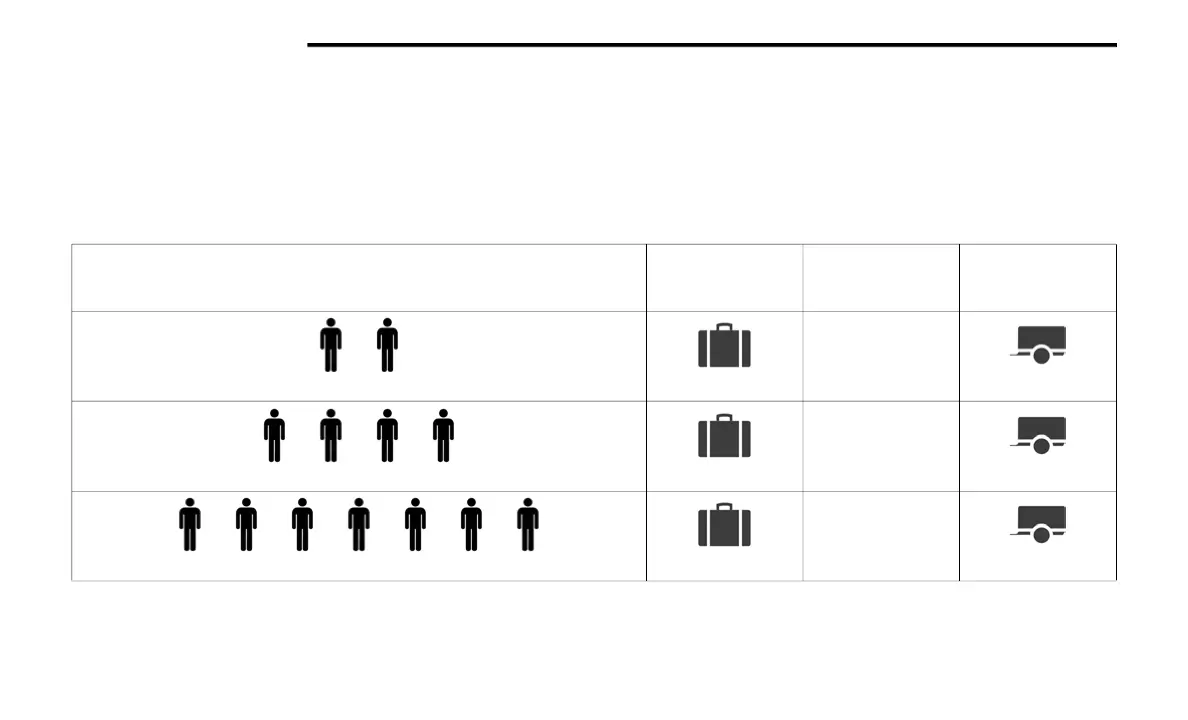
Number Of Persons / Weight Of Occupants Max Cargo No Trailer
Max Trailer TW, Max
Trailer
Max Cargo With Max
Trailer TW 360 lb
(163 kg)
2 People / 300 lb (136 kg) 1205 lb (546 kg)
1,205 lb (546 kg) –
360 lb (163 kg) = 845 lb
(383 kg)
845 lb (383 kg)
4 people / 600 lb (272 kg) 955 lb (433 kg)
955 lb (433 kg) – 360 lb
(163 kg) = 545 lb
(247 kg)
545 lb (247 kg)
7 people / 1050 lb (476 kg) 455 lb (206 kg)
455 lb (206 kg) – 360 lb
(163 kg) = 95 lb (43 kg)
95 lb (43 kg)
23_RUP_OM_EN_USC_t.book Page 150















 To Next Page