212 SAFETY
The OCS will NOT prevent deployment of the Passenger
Advanced Front Air Bag. The OCS may reduce the inflation
rate of the Passenger Advanced Front Air Bag if the OCS
estimates that:
The front passenger seat is unoccupied or has very
light objects on it; or
The front passenger seat is occupied by a small
passenger, including a child; or
The front passenger seat is occupied by a rear-facing
child restraint; or
The front passenger is not properly seated or his or her
weight is taken off of the seat for a period of time.
* It is possible for a child to be classified as an adult,
allowing a full-power Passenger Advanced Front Air Bag
deployment. Never allow children to ride in the front
passenger seat and never install a child restraint system,
including a rear-facing child restraint, in the front
passenger seat.
The OCS determines the front passenger’s most probable
classification. The OCS estimates the seated weight on the
front passenger seat and where that weight is located. The
OCS communicates the classification status to the ORC.
The ORC uses the classification to determine whether the
Passenger Advanced Front Air Bag inflation rate should be
adjusted.
In order for the OCS to operate as designed, it is important
for the front passenger to be seated properly and properly
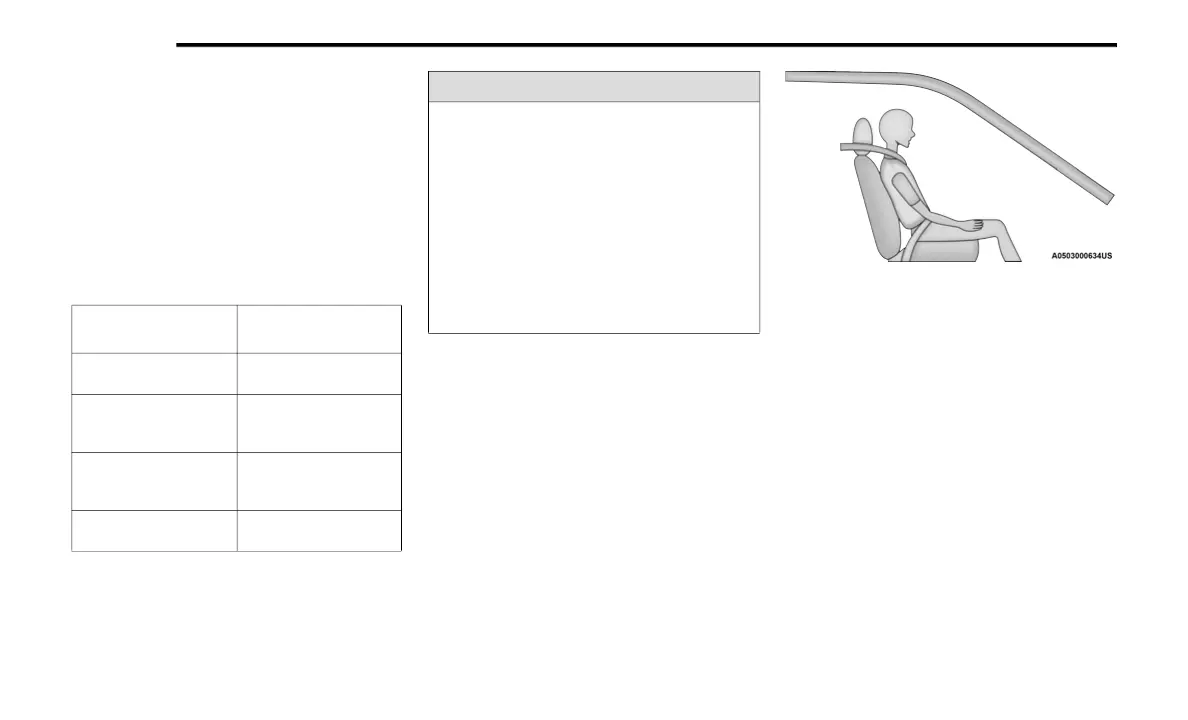
wearing the seat belt. Properly seated passengers are:
Sitting upright
Facing forward
Sitting in the center of the seat with their feet comfort-
ably on or near the floor
Sitting with their back against the seatback and the
seatback in an upright position
Seated Properly
Lighter Weight Passengers (Including Small Adults)
When a lighter weight passenger, including a small adult,
occupies the front passenger seat, the OCS may reduce
the inflation rate of the Passenger Advanced Front Air Bag.
This does not mean that the OCS is working improperly.
Do not decrease OR increase the front passenger’s seated
weight on the front passenger seat
The front passenger’s seated weight must be properly
positioned on the front passenger seat. Failure to do so may
result in serious injury or death. The OCS determines the
most probable classification of the occupant that it detects.
The OCS will detect the front passenger’s decreased or
increased seated weight, which may result in an adjusted
inflation rate of the Passenger Advanced Front Air Bag in a
collision. This does not mean that the OCS is working
improperly. Decreasing the front passenger’s seated weight
on the front passenger seat may result in a reduced-power
deployment of the Passenger Advanced Front Air Bag.
Increasing the front passenger’s seated weight on the front
passenger seat may result in a full-power deployment of the
Passenger Advanced Front Air Bag.
Front Passenger Seat
Occupant Status
Front Passenger Air Bag
Output
Rear-facing child restraint
Reduced-power
deployment
Child, including a child in a
forward-facing child
restraint or booster seat*
Reduced-power
deployment OR Full-power
deployment
Properly seated adult
Full-power deployment OR
reduced-power
deployment
Unoccupied seat
Reduced-power
deployment
WARNING!
Never place a rear-facing child restraint in front of an
air bag. A deploying passenger front air bag can
cause death or serious injury to a child 12 years or
younger, including a child in a rear-facing child
restraint.
Never install a rear-facing child restraint in the front
seat of a vehicle. Only use a rear-facing child
restraint in the rear seat. If the vehicle does not have
a rear seat, do not transport a rear-facing child
restraint in that vehicle.
Children 12 years or younger should always ride
buckled up in the rear seat of a vehicle with a rear seat.
23_RUP_OM_EN_USC_t.book Page 212













 To Next Page