
 Need help?
Do you have a question about the CIGWELD WeldSkill 120 Turbo and is the answer not in the manual?
Explains how to navigate and understand the manual's structure and annotations.
Details how to locate and record unit identification numbers like model and serial number.
Guides on checking received equipment for completeness and damage, and how to report issues.
Outlines user responsibility for managing electromagnetic disturbances from welding.
Advises on assessing the environment for potential electromagnetic problems before installation.
Provides general information about the 120 Turbo model, its current range, and electrode usage.
Details the 140 Turbo model, its current range, and electrode compatibility for various materials.
Clarifies user obligations for proper installation, operation, maintenance, and repairs.
Explains the concept of duty cycle for welding power sources and how it's measured.
Lists essential safety precautions for operators during welding operations.
Details essential personal protective equipment and clothing for welding safety.
Provides step-by-step instructions for performing resuscitation on electric shock victims.
Presents detailed technical specifications for both 120 Turbo and 140 Turbo models.
Lists the included items and accessories provided with the welding equipment.
Advises on suitable environmental conditions for operating the welding equipment safely.
Provides guidelines for selecting an appropriate and safe location for the welder.
Emphasizes the importance of adequate ventilation for safe welding operations.
Specifies the required mains supply voltage and connection standards for the welder.
Details the steps for assembling the welding handshield with its components.
Describes the function of controls like the ON/OFF switch, overload light, and current control.
Classifies and describes different types of arc welding electrodes and their applications.
Explains how electrode size is determined by metal thickness and welding machine capability.
Provides guidance on the proper storage of welding electrodes to maintain their quality.
Discusses the connection of electrodes and work leads, and where to seek advice.
Details various welding positions like flat, horizontal, vertical, and overhead.
Guides on preparing surfaces and joints for welding to ensure sound welds.
Offers initial advice for new welders on practicing with scrap metal and basic setup.
Provides tips on adopting a comfortable posture and safe practices for the welder.
Explains the technique for striking an arc and maintaining the correct electrode gap.
Discusses the importance of maintaining the correct arc length for weld quality.
Details how to adjust the travel speed for optimal weld bead formation.
Guides on creating welded joints, including butt welds and weld build-up sequences.
Explains the primary causes of distortion in welding, such as metal contraction.
Outlines methods to minimize distortion, including peening, presetting, and preheating.
Provides instructions for cleaning the welding power source to maintain performance.
Details the cleaning procedure for the face shield and lens.
Lists common welding faults, their causes, and remedies for issues like porosity and cracks.
Addresses common power source faults, their causes, and necessary troubleshooting steps.
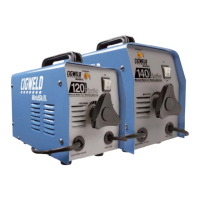
The CIGWELD 120 Turbo and 140 Turbo are compact, portable, fan-cooled Manual Metal Arc Welding (MMAW) machines designed for home handyman use. These welders are suitable for light gauge work, generally less than 3.0mm thick, with the 140 Turbo model also capable of handling 3.2mm electrodes for heavier materials. They operate from a domestic 240V, 10 amp or 15 amp outlet, respectively, and offer infinitely adjustable welding current.
The primary function of these devices is arc welding, a process that joins metals by creating an electric arc between an electrode and the workpiece. This arc generates intense heat, melting the metals to form a weld pool that solidifies into a strong joint. The core wire of the electrode is surrounded by a flux coating, which serves several crucial purposes:
The CIGWELD 120 Turbo and 140 Turbo are designed for ease of use, even for beginners.
Routine maintenance is crucial for ensuring the safe and efficient operation of the CIGWELD 120 Turbo and 140 Turbo.
 General
| Welding Current Range | 20 - 120A |
|---|---|
| Weight | 4.5kg |
| Dimensions | 300 x 130 x 210mm |
| Protection Class | IP21S |
| No Load Voltage | 48V |
| Welding Process | MMA (Stick) |
| Electrode Size Range | 1.6 - 3.2 mm |
| Input Voltage | 240V |
| Duty Cycle | 20% at 120A |
| Protection Rating | IP21 |

 To Next Page