EasyManua.ls Logo

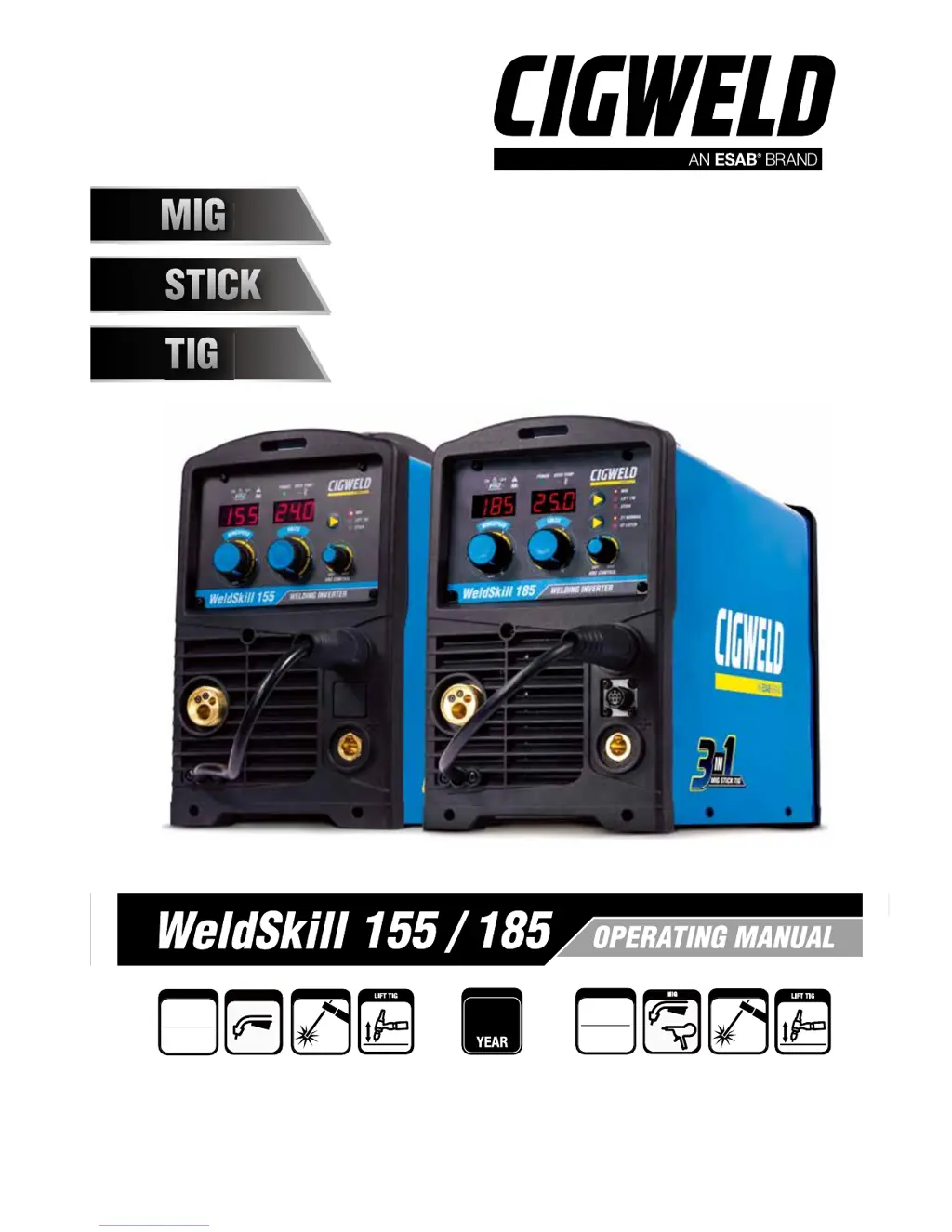
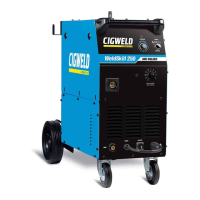
CIGWELD WeldSkill 185 - User Manual

CIGWELD WeldSkill 185
88 pages
Print Icon
To Next Page IconTo Next Page
Loading...
Version No: AB Issue Date: 07-09-2017 Manual No: 0-5492
Art # A-13435_AB
155 Inverter W1008155 185 Inverter W1008185
OUTPUT CURRENT
DC
OUTPUT CURRENT
DC
STICK
ELECTRODE
3.2mm MAX
STICK
ELECTRODE
4.0mm MAX
WARRANTY*
2
WARRANTY*
2
155A
185A
MIG

Table of Contents

Questions and Answers

  • A
    Amy GarciaAug 22, 2025
    Why CIGWELD WeldSkill 185 has undercut?
    • K
      Kevin ScottAug 22, 2025
      Undercut in your weld might be due to a welding arc voltage that's too high. Try decreasing the voltage or increasing the wire feed speed. Also, check your torch angle and adjust it as needed. Excessive heat input can also cause undercut; increase the torch travel speed and/or decrease welding current by decreasing the voltage or decreasing the wire feed speed.
  • L
    lambertjohnAug 26, 2025
    What causes excessive spatter in CIGWELD Welding System?
    • L
      leslieheathAug 26, 2025
      Excessive spatter can be caused by voltage being too high or too low. To resolve this, decrease voltage or increase the wirespeed control if the voltage is too high. If the voltage is too low, increase the voltage or decrease wirespeed.
  • V
    Victoria CainAug 29, 2025
    How to fix lack of penetration in CIGWELD WeldSkill 185 Welding System?
    • S
      Sherry ArroyoAug 29, 2025
      Lack of penetration can be due to several factors. If the welding current is too low, increase it by increasing wire feed speed and increasing voltage. If the joint preparation is too narrow or the gap is too tight, increase the joint angle or gap. Also, the shielding gas might be incorrect; change to a gas which gives higher penetration.
  • R
    Ryan GrossSep 1, 2025
    What causes weld cracking in CIGWELD Welding System?
    • M
      Michael GibsonSep 1, 2025
      Weld cracking can occur for several reasons. If the weld beads are too small, decrease travel speed. If weld penetration is narrow and deep, reduce current and voltage and increase Mig torch travel speed or select a lower penetration shielding gas. Excessive weld stresses can also cause cracking; increase weld metal strength or revise design. Excessive voltage can be a factor, so decrease voltage. If the cooling rate is too fast, slow it by preheating the part to be welded or cool slowly.
  • W
    wyatttoddSep 4, 2025
    What causes irregular weld shape in CIGWELD WeldSkill 185?
    • T
      tlloydSep 4, 2025
      An irregular weld shape can be caused by several factors. Incorrect voltage and current settings can be a cause; adjust voltage and current by adjusting the voltage control and the wirespeed control. If the wire is wandering, replace the contact tip. An incorrect shielding gas can also lead to this issue; check the shielding gas. Insufficient or excessive heat input can also be a factor; adjust the wirespeed control or the voltage control.
  • J
    Jessica SpencerSep 7, 2025
    What causes cold weld puddle in CIGWELD Welding System?
    • H
      Heather AndradeSep 8, 2025
      A cold weld puddle may be caused by a loose welding cable connection; check all welding cable connections. It could also be due to low primary voltage. In this case, contact supply authority. A fault in the power source can also lead to this; have an Accredited CIGWELD Service Provider test then replace the faulty component.
  • U
    upattersonSep 12, 2025
    Why doesn't the arc have a crisp sound in CIGWELD WeldSkill 185?
    • T
      Tammy MilesSep 12, 2025
      The MIG torch might be connected to the wrong voltage polarity on the front panel. Connect the MIG torch to the positive (+) welding terminal for most solid wires and gas shielded flux cored wires. Connect MIG Torch to the negative (-) welding terminal for most Gasless Wires. Refer to the electrode wire manufacturer for the correct polarity.
  • N
    Natalie HarrisNov 14, 2025
    How to fix porosity in CIGWELD WeldSkill 185?
    • M
      Marco FullerNov 14, 2025
      Porosity can occur due to several reasons. First, ensure your shielding gas cylinder isn't empty and the flow meter is correctly adjusted to 15 litres per minute. Check for gas leaks between the regulator/cylinder connection and in the gas hose to the Power Source. Also, ensure the internal gas hose from the solenoid valve to the torch adaptor hasn't fractured and is connected to the torch adaptor. If welding in a windy environment, shield the weld area or increase the gas flow. Clean any contaminates off the work piece if it is dirty, oily, painted, oxidised or greasy. Keep the distance between the MIG torch nozzle and the work piece to a minimum. Finally, maintain the MIG torch in good working order by ensuring the gas holes aren't blocked, preventing spatter build-up inside the torch no...
  • I
    iwatkinsNov 17, 2025
    What to do if CIGWELD Welding System has inconsistent wire feed?
    • A
      austinwoodNov 17, 2025
      Inconsistent wire feed can stem from several issues. Check if the wire spool brake is too tight or too loose. Ensure you have the correct feed roll fitted for the wire you're using, and replace it if it's worn. Mis-alignment of inlet/outlet guides may cause wire to rub against them. Increased amounts of swarf are produced by the wire passing through the feed roller when excessive pressure is applied to the pressure roller adjuster. Swarf can also be produced by the wire passing through an incorrect feed roller groove shape or size. Swarf is fed into the conduit liner where it accumulates thus reducing wire feedability. Also, inspect the contact tip; if the hole is too large or if you're using soft wire, it may cause jamming. Poor work lead contact can also reduce power at the arc. Finally,...

Summary

Section 1: Arc Welding Safety Instructions and Warnings

Arc Welding Hazards

Dangers of electric shock, fumes, fire, noise, and protective measures.

Section 2: Introduction

Section 3: Installation

Section 4: Operation

Operation Overview and Power Source Controls

General operation and description of front panel controls.

Indicators, VRD, and Switches

Explanation of power indicators, VRD function, and switches.

Welding Mode Controls and Digital Meters

Wirespeed, Amps, Voltage adjustments, and digital displays.

Section 5: MIG (GMAW) Welding

MIG Welding Setup and Techniques

Setup for gas shielded, gasless, spool gun, and basic welding techniques.

MIG Wire Selection and Troubleshooting

Guidance on choosing MIG wire and solving common welding problems.

Section 6: STICK (MMAW) Welding

Distortion and Welding Problems

Managing distortion effects and troubleshooting welding issues.

Section 7: TIG (GTAW) Welding

TIG Welding Technique and Troubleshooting

Basic TIG welding techniques and common problem solutions.

Section 8: Routine Service Requirements and Power Source Problems

Welding Power Source Problems

Common power source faults and their remedies.

CIGWELD - Limited Warranty Terms

CIGWELD WeldSkill 185 Specifications

General IconGeneral
Protection ClassIP21S
Input Current15A
Protection RatingIP21S
Input Voltage240V
Welding ProcessMMA (Stick)
Duty Cycle20% @ 185A

Related product manuals