EasyManua.ls Logo

Cisco MX450 - User Manual

Cisco MX450
4 pages
Print Icon
To Next Page IconTo Next Page
Loading...
MX450 Installation Guide
This document describes how to install and set up the MX450 security appliance. Additional reference documents are available online at: www.meraki.com/
library/products.
MX450 Overview
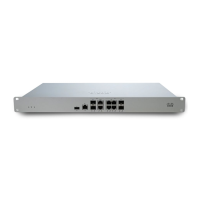
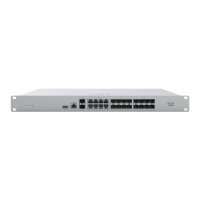
The Meraki MX450 is an enterprise security appliance designed for distributed networks that require remote administration. It is ideal for network administrators
who demand both ease of deployment and a state-of-the-art feature set. The MX450 appliance provides the following new features:
Two dedicated uplink SFP+10GbE ports
Support for eight configurable GbE(RJ45), eight GbE SFP and eight 10GbE SFP+ connections
USB port, to support approved 3G/4G cards for failover to cellular networks
128GB (SSD) cache storage
Dedicated management port
Front-panel rack mounts
Package Contents
In addition to the MX450, the following are provided:
1
Question and Answer IconNeed help?

Do you have a question about the Cisco MX450 and is the answer not in the manual?

Summary

MX450 Overview

MX450 Front Panel Features

Ports and Status Indicators

Explains front panel LEDs for power, USB, HA status, and the reset button functionality.

Physical Installation and Safety

Mounting Hardware

Details rack screw sets, nuts, and ventilation clearance requirements for installation.

Safety Guidelines

Provides warnings regarding power disconnection and optical transceiver usage.

WAN and Network Configuration

Setting Up a Static IP Address

Steps to configure a static IP address via the appliance's web service.

Setting Up a DHCP IP Address

Describes default DHCP configuration via upstream WAN/ISP servers.

Setting VLANs

Configuration for VLAN tagging on trunk ports for network setup.

Setting PPPoE

Steps for PPPoE authentication required for DSL circuit connections.

Web Proxy Settings

Configuration for using web proxy for fallback HTTP communication.

Configuring Physical Link Settings

Options to configure Ethernet port link settings like duplex and data rates.

Overview

The Meraki MX450 is an enterprise security appliance designed for distributed networks, offering remote administration capabilities. It is well-suited for network administrators who prioritize ease of deployment and a comprehensive feature set.

Function Description:

The MX450 serves as a security appliance, providing network security and connectivity management for enterprise environments. It is designed to be remotely administered, simplifying management for distributed networks.
Important Technical Specifications:

  • Uplink Ports: Features two dedicated SFP+ 10GbE uplink ports.
  • Configurable Connections: Supports a total of 24 configurable connections, including:
    • Eight GbE (RJ45) ports.
    • Eight GbE SFP ports.
    • Eight 10GbE SFP+ connections.
  • USB Port: Includes a USB port for supporting approved 3G/4G cards, enabling failover to cellular networks for continuous connectivity.
  • Storage: Equipped with 128GB of SSD cache storage.
  • Management Port: Features a dedicated management port for configuration and monitoring.
  • Mounting: Designed for rack mounting with front-panel rack mounts.
  • Power: The system requires disconnection from all power sources and removal of the power cord from the power supply module(s) before accessing, installing, or removing system components.
  • Optical Transceiver: If used, optical transceiver products should be UL listed and rated Laser Class I, 3.3Vdc.
  • Airflow: Ventilation is from side to side, not front to back. A minimum of 10mm clearance is required between venting holes and any obstruction to ensure adequate airflow.

Usage Features:

  • Remote Administration: Ideal for distributed networks requiring remote management.
  • Connectivity Options: Offers a wide range of connectivity options with configurable GbE and 10GbE ports, allowing flexibility in network design.
  • Cellular Failover: The USB port enables the use of 3G/4G cards for automatic failover to cellular networks, ensuring high availability.
  • Local Management Web Service: The appliance has a built-in web service accessible via a browser on a client PC (http://setup.meraki.com) for configuring basic ISP/WAN connectivity. This service is used for initial setup and monitoring.
  • IP Address Configuration:
    • DHCP: By default, MX devices are configured to obtain an IP address via DHCP from upstream WAN/ISP servers. Simply plug the WAN/Internet port into the upstream circuit. The Internet LED will turn green when the WAN connection is fully enabled.
    • Static IP: Users can configure a static IP address by connecting a client machine to the management port, accessing the local web service, and entering the IP address, subnet mask, default gateway IP, and DNS server information under the "Uplink configuration" tab.
  • VLAN Tagging: Supports VLAN tagging for WAN uplinks on trunk ports, allowing users to specify a VLAN ID.
  • PPPoE Authentication: Provides support for PPPoE authentication, which may be required for DSL circuits. Users can select the connection type as PPPoE and configure authentication options, including username and password if required by their ISP.
  • Web Proxy Settings: Allows configuration of web proxy settings for instances where the MX device needs to fall back to using HTTP to contact the Cloud Controller. Users can enable the web proxy, specify hostname or IP and port, and configure authentication if necessary.
  • Physical Link Settings: Users can configure physical link settings for Ethernet ports, including half-duplex, full-duplex, auto-negotiation, and data rates (10 Mbps or 100 Mbps) via the "Local status > Ethernet configuration" menu.
  • LED Indicators: The device uses LEDs to indicate its status:
    • Power LED (Item 1):
      • Solid orange: Power is applied.
      • Rainbow colors: Unit is attempting to contact the Cloud.
      • Flashing white: Operation is in progress.
      • Solid white: Fully operational.
    • USB Connectivity LED (Item 2):
      • Off: During boot or USB link.
      • Solid orange: Initial link.
      • Flashing orange: Internet connectivity not complete.
      • Green: USB connection detected.
    • HA Status LED (Item 3):
      • Off: No HA available.
      • Orange: Initial link.
      • Flashing orange: High availability not complete.
      • Green: HA available.

Maintenance Features:

  • Rack Mounting: Comes with a rack mounting kit, including standard slot-head rack screws and nuts, designed to accommodate common rack mounts.
  • Reset Button: A reset button is available for maintenance:
    • A brief, momentary press: Deletes a downloaded configuration and reboots the device.
    • Press and hold for more than 10 seconds: Forces the unit into a full factory reset.
  • Serial Number Location: The serial number is located on the product label at the back panel of the MX450-HW for easy identification.
  • Airflow Considerations: When installing, ensure sufficient space (minimum 10mm) between the rear of the rack and other obstacles to guarantee adequate airflow, as ventilation is side-to-side.

Cisco MX450 Specifications

General IconGeneral
BrandCisco
ModelMX450
CategoryModem
LanguageEnglish

Related product manuals