EasyManua.ls Logo

Cisco SG500X-48P - User Manual

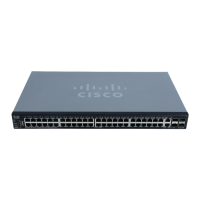
Cisco SG500X-48P
24 pages
Print Icon
To Next Page IconTo Next Page
Loading...
Quick Start Guide
Cisco 500 Series Stackable Managed Switches

Other manuals for Cisco SG500X-48P

Question and Answer IconNeed help?

Do you have a question about the Cisco SG500X-48P and is the answer not in the manual?

Summary

Welcome to Cisco 500 Series Switches

Package Contents

Lists the items included in the Cisco switch package.

Mounting the Cisco Stackable Managed Switch

Ambient Temperature Ratings

Details high temperature ratings for various Cisco switch models.

Rack-Mount Placement Guide

Step-by-step instructions for physically mounting the Cisco switch in a standard rack.

Power over Ethernet (PoE) Considerations

PoE Capabilities of 500 Series Switches

Details power capabilities and standards for Cisco PoE-enabled switches.

Configuring the Cisco 500 Series Stackable Managed Switch

Configuration Prerequisites

Verifies managing computer requirements before proceeding with switch configuration.

Switch Access and Management Methods

Describes the different methods available to access and manage the Cisco switch.

Web-Based Interface Configuration

Provides instructions for accessing and configuring the Cisco switch via its web interface.

IP Network Configuration Steps

Step-by-step guide for configuring the Cisco switch using an IP network connection.

Console Port Configuration Guide

Instructions for configuring the Cisco switch by connecting through its console port.

Stacking the Switches

Cisco Stack Unit Modes

Standalone Mode

Describes the standalone mode where a Cisco switch is not connected to other devices.

Native Stacking Mode

Explains native stacking, connecting same-type Cisco devices to form a stack.

Basic Hybrid Stacking Mode

Details basic hybrid stacking for Cisco 500 series devices, with limitations.

Advanced Hybrid Stacking Mode

Describes advanced hybrid stacking for Cisco switches, supporting VRRP/RIP.

Advanced Hybrid XG Stacking Mode

Covers Advanced Hybrid XG stacking for SG500XG and SG500X Cisco switches.

Cisco Stack Configuration Options

SG500 X Stacking Configurations

Details SG500X native stacking options and port speed configurations.

Sx500 Stacking Configurations

Details Sx500 native stacking options and port speed configurations.

Hybrid Stacking Configurations

Details SG500Xs and Sx500s in Basic and Advanced Hybrid stacking modes.

SG500 XG Stacking Configurations

Details SG500XG native stacking and hybrid XG configurations.

Example Stacking Scenarios

Provides practical examples for stacking different Cisco switch models.

500 X Series Stacking Options

Details Stacking Option One, Two, and Standalone for 500X models.

SF;SG 500 Series Stacking Options

Details Stacking Option One, Two, and Standalone for SF/SG 500 models.

External Features of Cisco 500 Series Switches

Front Panel Overview and Left Sides

Illustrates and labels the front panel and left sides of Cisco 500 series switches.

Front Panel Right Sides and Ports

Illustrates right sides of Cisco switch panels and details RJ-45 and SFP ports.

Front Panel LED Indicators

Explains the meaning of various LEDs on the Cisco switch front panels.

Gigabit and SFP Port LEDs

Describes the Gigabit and SFP LEDs indicating connection status.

Reset Button and Back Panel Ports

Explains the reset button function and identifies back panel power/console ports.

Factory Default Settings and Troubleshooting

Rebooting and Resetting the Switch

Provides steps to reboot or restore the Cisco switch to factory default settings.

Troubleshooting Cisco Switch Connections

Testing Network Connectivity

Instructions for testing Cisco switch network connectivity using the ping command.

Common Connection Issues and Resolutions

Lists common connection problems like bad cables or wrong IP addresses and their fixes.

Advanced Connectivity Troubleshooting

Addresses issues such as no IP route and unusually long access times for Cisco switches.

Where to Go From Here

Cisco Support and Firmware Resources

Provides links to Cisco support communities, resources, and firmware downloads.

Product Documentation and Safety Information

Links to Cisco switch documentation, regulatory compliance, and warranty details.

Additional Cisco Resources

Provides links to Cisco Partner Central and EU Lot 26 Test Results.

Summary

Welcome to Cisco 500 Series Switches

Package Contents

Lists the items included in the Cisco switch package.

Mounting the Cisco Stackable Managed Switch

Ambient Temperature Ratings

Details high temperature ratings for various Cisco switch models.

Rack-Mount Placement Guide

Step-by-step instructions for physically mounting the Cisco switch in a standard rack.

Power over Ethernet (PoE) Considerations

PoE Capabilities of 500 Series Switches

Details power capabilities and standards for Cisco PoE-enabled switches.

Configuring the Cisco 500 Series Stackable Managed Switch

Configuration Prerequisites

Verifies managing computer requirements before proceeding with switch configuration.

Switch Access and Management Methods

Describes the different methods available to access and manage the Cisco switch.

Web-Based Interface Configuration

Provides instructions for accessing and configuring the Cisco switch via its web interface.

IP Network Configuration Steps

Step-by-step guide for configuring the Cisco switch using an IP network connection.

Console Port Configuration Guide

Instructions for configuring the Cisco switch by connecting through its console port.

Stacking the Switches

Cisco Stack Unit Modes

Standalone Mode

Describes the standalone mode where a Cisco switch is not connected to other devices.

Native Stacking Mode

Explains native stacking, connecting same-type Cisco devices to form a stack.

Basic Hybrid Stacking Mode

Details basic hybrid stacking for Cisco 500 series devices, with limitations.

Advanced Hybrid Stacking Mode

Describes advanced hybrid stacking for Cisco switches, supporting VRRP/RIP.

Advanced Hybrid XG Stacking Mode

Covers Advanced Hybrid XG stacking for SG500XG and SG500X Cisco switches.

Cisco Stack Configuration Options

SG500 X Stacking Configurations

Details SG500X native stacking options and port speed configurations.

Sx500 Stacking Configurations

Details Sx500 native stacking options and port speed configurations.

Hybrid Stacking Configurations

Details SG500Xs and Sx500s in Basic and Advanced Hybrid stacking modes.

SG500 XG Stacking Configurations

Details SG500XG native stacking and hybrid XG configurations.

Example Stacking Scenarios

Provides practical examples for stacking different Cisco switch models.

500 X Series Stacking Options

Details Stacking Option One, Two, and Standalone for 500X models.

SF;SG 500 Series Stacking Options

Details Stacking Option One, Two, and Standalone for SF/SG 500 models.

External Features of Cisco 500 Series Switches

Front Panel Overview and Left Sides

Illustrates and labels the front panel and left sides of Cisco 500 series switches.

Front Panel Right Sides and Ports

Illustrates right sides of Cisco switch panels and details RJ-45 and SFP ports.

Front Panel LED Indicators

Explains the meaning of various LEDs on the Cisco switch front panels.

Gigabit and SFP Port LEDs

Describes the Gigabit and SFP LEDs indicating connection status.

Reset Button and Back Panel Ports

Explains the reset button function and identifies back panel power/console ports.

Factory Default Settings and Troubleshooting

Rebooting and Resetting the Switch

Provides steps to reboot or restore the Cisco switch to factory default settings.

Troubleshooting Cisco Switch Connections

Testing Network Connectivity

Instructions for testing Cisco switch network connectivity using the ping command.

Common Connection Issues and Resolutions

Lists common connection problems like bad cables or wrong IP addresses and their fixes.

Advanced Connectivity Troubleshooting

Addresses issues such as no IP route and unusually long access times for Cisco switches.

Where to Go From Here

Cisco Support and Firmware Resources

Provides links to Cisco support communities, resources, and firmware downloads.

Product Documentation and Safety Information

Links to Cisco switch documentation, regulatory compliance, and warranty details.

Additional Cisco Resources

Provides links to Cisco Partner Central and EU Lot 26 Test Results.

Overview

This document describes the Cisco 500 Series Stackable Managed Switches, a line of network communication devices designed for small and medium-sized businesses. These switches are engineered to be operational right out of the box, functioning as standard Layer 2 and Layer 3 switches that forward packets between connected devices upon power-up.

The Cisco 500 Series switches offer robust functionality for network connectivity and management. They are designed to be deployed in various network environments, providing a flexible solution for connecting computers, printers, network storage, and other network devices. A key feature of these switches is their stackable nature, allowing multiple units to be combined into a single logical unit, which simplifies management and increases network capacity and resilience.

Function Description

The primary function of the Cisco 500 Series switches is to facilitate network communication by forwarding data packets. They operate at both Layer 2 (data link layer) and Layer 3 (network layer) of the OSI model, enabling them to handle both local network traffic and routing functions. In their factory default configuration, they are ready to forward packets immediately after being powered on, making initial setup straightforward.

These switches support Power over Ethernet (PoE) on specific models, allowing them to supply DC power to attached Powered Devices (PDs) such as VoIP phones, IP cameras, and wireless access points over the same Ethernet cable that carries data. This eliminates the need for separate power outlets for these devices, simplifying deployment and reducing cabling complexity. The PoE models are capable of detecting and supplying power to both pre-standard and standard PoE Powered Devices. However, users are cautioned to disable PoE on ports connected to other Power Sourcing Equipment (PSEs) to prevent false detection and potential operational issues.

The stacking capability is a significant feature, allowing up to eight 500 Series switches to be connected together to form a single, high-performance stack. This provides increased port density, aggregated bandwidth, and simplified management as the entire stack can be managed as a single entity. The switches support different stack unit modes:

  • Standalone: The device operates independently and is not connected to any other device as part of a stack.
  • Native Stacking: Devices of the same type (all Sx500s or all SG500Xs) connect through their stack ports to form a stack.
  • Basic Hybrid: Allows different types of 500 Series devices to form a stack. In this mode, any device can function as master or backup, but only 5G stacking ports can be used. VRRP (Virtual Router Redundancy Protocol) and RIP (Routing Information Protocol) are not supported.
  • Advanced Hybrid: Also allows different 500 Series devices to form a stack, but with enhanced capabilities. Only SG500X devices can function as master/backup, and auto-numbering of units is not supported. VRRP and RIP are supported in this mode. Sx500 devices can only act as slaves, with up to six Sx500 units stackable with two SG500X devices.
  • Advanced Hybrid XG: Specifically for SG500XG series devices connecting to other SG500X devices, offering the SG500X feature set with VRRP and RIP support. Any device can function as master, backup, or slave.

The stack ports can be configured with various speeds (1G, 5G, 10G, or auto-detection) depending on the switch model and stacking option chosen. It is crucial that stack ports are configured with the same port speed or have compatible speed capabilities on the modules/cables to ensure proper stack formation.

Usage Features

The Cisco 500 Series switches are designed for ease of use and flexible deployment. They can be placed on a flat surface or mounted in a standard 1-rack unit (1RU) rack. When rack-mounting, it's important to ensure proper airflow and avoid mechanical or circuit overloading. The package includes a rackmount kit, power cord, serial cable, and rubber feet for various installation scenarios.

Connecting network devices is straightforward:

  1. Connect an Ethernet cable from a network device (computer, printer, network storage) to one of the numbered Ethernet ports on the switch.
  2. The Ethernet port light will turn green when an active connection is established.
  3. Cisco recommends using Cat5 or better cable for Gigabit connectivity, with a maximum cabling distance of 100 meters (328 feet).

Management of the switch can be done through two primary methods:

  • Web-Based Interface: This is the recommended method for most users. The switch uses a factory default IP address (192.168.1.254). Users can access the interface by connecting their computer to the switch, configuring their computer's IP address within the same subnet (e.g., 192.168.1.1 to 192.168.1.253), and then entering the switch's IP address into a web browser. The default login credentials are "cisco" for both username and password. Upon the first login, users are prompted to change the default password for security.
  • Command Line Interface (CLI) via Console Port: For advanced users, the switch can be configured using the CLI through a serial console port. This requires connecting a computer to the switch's console port using the provided serial cable and using a terminal application (e.g., HyperTerminal) with specific parameters (115200 bits per second, 8 data bits, no parity, 1 stop bit, no flow control). The default username and password are also "cisco," and users are prompted to change the password on the first login.

The front panel of the switch features various LEDs that provide visual status indicators:

  • Master LED (Green): Steady when the switch is a stack master.
  • Fan LED (Green): Steady when the cooling fan is operational, blinks green if there is a failure.
  • System LED (Green): Steady when powered on, flashes during booting, self-tests, or IP address acquisition. Flashes amber for hardware failures.
  • Stack ID LEDs (Green): Indicate the switch's Stack ID when stacked. For Stack IDs greater than 4, a combination of LEDs lights up to represent the ID.
  • LINK/ACT LED (Green): Located on the left of each port, steady for a link, flashes for traffic.
  • PoE LED (Amber): Located on the right of a PoE port, steady when power is supplied to a device.
  • 100M LED (Green): Located on the right of the port, steady for a 100 Mbps link. Off if speed is under 100 Mbps or no cable.
  • XG LED (Green): Located on the right of a 10G port, steady for a 10G link. Off if speed is under 10G or no cable.
  • Gigabit LED (Green): Located on the right of a GE port, steady for a 1000 Mbps link. Off if speed is under 1000 Mbps or no cable.
  • SFP LED (Green): Located on the right of a GE port, steady when a connection is made through the shared port, flashes for traffic.

Maintenance Features

The Cisco 500 Series switches include features to aid in maintenance and troubleshooting.

  • Reset Button: A reset button on the front panel allows for two functions:
    • Reboot: Press and hold for less than 10 seconds to reboot the switch.
    • Factory Default Settings Restore: Disconnect the switch from the network or disable DHCP servers, then with power on, press and hold for more than 10 seconds to restore factory defaults.
  • Configuration Saving: It is crucial to save any configuration changes made through the web-based interface to the Startup configuration before exiting or rebooting the switch. Failure to do so will result in the loss of all current changes. When using the CLI, the command copy running-config startup-config is used to save changes.
  • Troubleshooting Connection Issues: The manual provides guidance for troubleshooting common connection problems:
    • Bad Ethernet Connection: Check port LEDs and cable connectors.
    • Bad Console Port Connection: Verify console cable connections and terminal application parameters.
    • Wrong IP Address: Confirm the switch's IP address (via System LED or console port) and ensure no other device uses the same IP.
    • No IP Route: If the switch and computer are in different IP subnets, a router is needed.
    • Unusually Long Access Time: New connections might take 30-60 seconds to become operational due to spanning tree loop detection logic.

The switches support SFP (small form-factor pluggable) and SFP+ modules, which are connection points for linking to other switches. These ports are also known as miniGigaBit Interface Converter (miniGBIC) ports. The SFP ports are compatible with various Cisco and other brand modules, while SFP+ optical modules are supported in 500X switches for higher-speed connections. SFP interfaces are combination ports, sharing functionality with an adjacent RJ-45 port; when the SFP is active, the RJ-45 port is disabled.

The Cisco 500 Series Stackable Managed Switches are designed to be a reliable and scalable solution for network infrastructure, offering a balance of performance, flexibility, and ease of management for growing businesses.

Cisco SG500X-48P Specifications

General IconGeneral
BrandCisco
ModelSG500X-48P
CategorySwitch
LanguageEnglish

Related product manuals