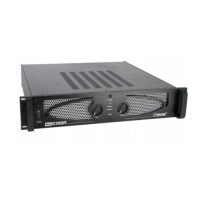
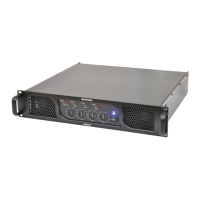
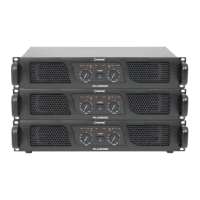
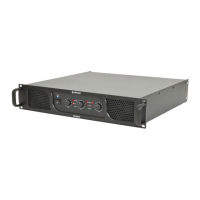
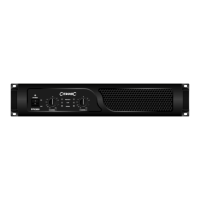
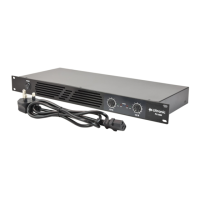
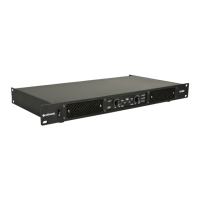
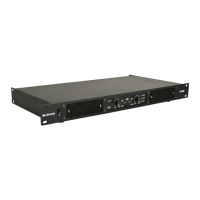
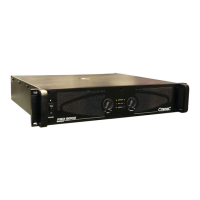
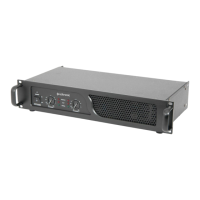
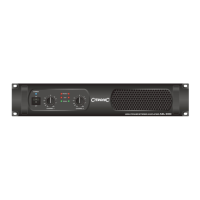
The Citronic P44800 is a 3-way power amplifier designed for sound reinforcement systems, suitable for both mobile and installed setups. It delivers high-quality, dependable service, amplifying audio signals for speaker cabinets.
Function Description
The P44800 serves as a central component in an audio system, taking line-level signals from a mixer or other source and amplifying them to drive speakers. It features three distinct output channels: two stereo channels (CH1 and CH2) for mid-top or full-range speaker cabinets, and a dedicated SUB output for subwoofers. Each stereo output is designed to handle speaker loads with a minimum impedance of 4Ω. The SUB output is specifically engineered to power a single sub cabinet or two sub cabinets connected in parallel, provided the total load remains at or above 4Ω.
The amplifier incorporates various controls and indicators to manage and monitor its operation. On the front panel, a power switch with an integrated LED allows users to turn the unit on and off. Level controls are provided for the SUB, CH1, and CH2 channels, enabling precise adjustment of the output volume for each section. Visual feedback is offered through LED indicators: "SIGNAL" LEDs illuminate when an audio signal is present, "CLIP" LEDs light up if the output is reaching clipping levels, and "PROTECT" LEDs indicate if the internal protection circuitry has detected a fault or if a channel has entered protect mode. Cooling vents are strategically placed on both the front and rear panels to ensure adequate airflow and prevent overheating.
The rear panel offers a comprehensive set of connections and controls. For signal input, each channel (CH1, CH2, and SUB) features parallel XLR and 6.3mm jack connectors, allowing for flexible input options and signal pass-through to other amplifiers. The output connections for CH1, CH2, and SUB are provided via SPK connectors. The amplifier includes a "LOW CUT" on/off switch, which removes very low frequencies that might be inefficient for speaker drivers, thus conserving power. Additionally, the SUB output features a "FILTER" on/off switch and a "FREQ" rotary control. When the filter is active, it removes signals above a user-adjustable cutoff frequency (ranging from 50Hz to 250Hz), ensuring that only low frequencies are amplified by the subwoofer. The IEC mains inlet and fuse are located on the rear panel for power connection. Cooling fan vents are also present on the rear to aid in thermal management.
Usage Features
To operate the P44800, users should first ensure all channel gain controls are turned fully down. The amplifier should be connected to a mains outlet using a securely earthed IEC lead. Once powered on, the unit performs a "soft-start" sequence, conducting internal checks before engaging power to the amplifiers, which may take a few seconds.
Signal inputs from a mixer or other line-level source should be connected to the XLR or jack inputs on the rear panel using good quality signal leads. Speaker cabinets are then connected to the corresponding channel outputs (CH1, CH2, SUB) using appropriate speaker leads, ensuring that the combined load on each channel does not fall below 4Ω.
During operation, the channel level controls should be gradually increased to the desired level, typically to full, and then the signal level from the mixer or sound source should be gradually increased until the desired sound is achieved. The green "SIGNAL" LEDs will indicate the presence of an audio signal. If the red "CLIP" LEDs illuminate more than momentarily, the input volume should be reduced to prevent distortion. If a "PROTECT" LED illuminates, it indicates a fault in the speakers or amplifier. In such cases, the amplifier should be switched off, and the entire system (including leads) should be checked before powering up again.
The "LOW CUT" switch can be engaged to remove inefficiently low frequencies, optimizing power usage and speaker performance. For the SUB output, the "FILTER" switch can be activated to ensure only low frequencies are sent to the subwoofer. The "FREQ" rotary control allows fine-tuning of the subwoofer's cutoff frequency, with a recommended starting point around 150Hz, which can be adjusted for optimal bass response. If the SUB output seems quiet with the filter on, adjusting the "FREQ" control may improve the output. If built-in crossovers are present in the subwoofers, the amplifier's filter can be switched off.
Before powering down, it is crucial to turn the channel gain controls fully down to avoid loud noises.
Maintenance Features
The P44800 is designed for reliable service, but proper care and maintenance are essential. The casing should be cleaned with a soft cloth and a neutral detergent as needed. Strong solvents should be avoided. To maintain optimal cooling, the ventilation grilles on both the front and rear panels should be regularly cleared of dust and debris using a vacuum cleaner.
The amplifier is not designed for user servicing; there are no user-serviceable parts inside. Any servicing requirements should be referred to qualified service personnel. To prevent electric shock or fire, the unit should not be exposed to rain or moisture. If liquids are spilled on the casing, the unit should be immediately disconnected from power, allowed to dry, and then checked by qualified personnel before further use. The amplifier should also be protected from impact, extreme pressure, or heavy vibration.
When rack-mounting, ensure adequate support for the amplifier's base and secure front fixings. Always ensure sufficient airflow around the unit and avoid covering the cooling vents. The device should be kept away from direct sunlight, heat sources, and damp or dusty environments. Regular checks of the mains voltage and the condition of the IEC lead, as well as speaker leads, are recommended to ensure safe and efficient operation. It is also important to verify that speaker load impedances do not exceed the minimum stated load for the amplifier.


 To Next Page
 General