Need help?
Do you have a question about the Clarion PN-2940S-C and is the answer not in the manual?
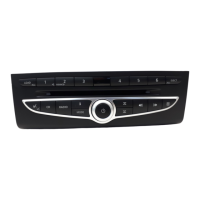
Identifies the RENAULT 6-disc CD/MP3/WMA Autochanger models, including their genuine part numbers and facial colors.
Details disc formats, MP3/WMA modes, sampling/bit rates, power supply voltage, current consumption, and dimensions.
Diagnoses issues related to no power, non-operating key switches, and LED illumination failures.
Guides through troubleshooting no sound from CD, disc mechanism issues, and communication line problems.
Depicts the first section of the Main Printed Wiring Board (PWB) circuit, showing key ICs and connections.
Depicts the second section of the Main Printed Wiring Board (PWB) circuit, continuing the schematic.
Illustrates the circuit schematic for the Switch Printed Wiring Board (PWB), detailing button and LED functions.
Shows the first part of the circuit schematic for the CD Printed Wiring Board (PWB).
Shows the second part of the circuit schematic for the CD Printed Wiring Board (PWB).
This document outlines the service and maintenance procedures for the RENAULT Genuine 6-disc CD/MP3/WMA Autochanger, equipped with a Sub Control Panel Switch. This device is available in several models: PN-2940S-A, PN-2940S-B, PN-2940S-C, PN-2940S-D, PN-2940S-E, and PN-2940S-F, each identified by a unique Genuine Number and facial color, catering to different regional markets (Korea and Europe).
The autochanger is designed to provide multi-disc audio playback, supporting CD-DA, CD-R/RW, MP3, and WMA formats. Its primary function is to store and play up to six discs, offering convenience for users who wish to have a selection of music readily available in their vehicle. The sub-control panel switch allows for seamless interaction with the unit, providing controls for disc loading, ejection, mode selection (radio/CD, TDMB, RDS/B), mute, and track navigation.
The autochanger's core function revolves around its ability to manage and play multiple discs. The "DISC HOLDER" mechanism, driven by the UP/DW-Motor, is capable of holding six discs. The "DRIVE UNIT" handles the chucking (securing) of a play disc, controlled by the Mode motor. The "LOADING ROLLER," operated by the Loading Motor, is responsible for storing and ejecting discs. A "SHUTTER" mechanism, also controlled by the Mode Motor, operates during disc insertion.
The unit incorporates several switches and photo sensors to monitor and control its operations. Switches S1, S2, and S3 detect the home position and overall position of the mode plate, providing feedback through combinations of on and off states. Switch S4 detects the initial position of the disc holder, indicating its status (ON when bright). Switch S5 detects the opening and closing of the shutter, with OFF indicating a closed state and ON indicating an open state.
Photo sensors play a crucial role in disc detection and movement. PT1 detects the start of disc loading and disc passing, indicating "no DISC" when bright and "DISC" when dark. PT2 detects the completion of disc ejection and disc passing, with similar bright/dark indications. PT3 detects disc storage and disc passing. Q1 also detects disc passing, and IC10 detects the holder position. These sensors ensure precise control over disc handling within the autochanger.
The motors within the unit are integral to its mechanical functions. The "MOT1 LOADING MOTOR" rotates the loading roller for disc storage and ejection, with its operation monitored by PT1, PT2, PT3, and Q1. The "MOT2 MODE MOTOR" rotates the mode plate, chucks discs, opens/closes the holder, moves the loading/ejecting roller, and opens/closes the shutter, with its status monitored by S1, S2, and S3. The "MOT3 UP/DW-MOTOR" moves the disc holder up and down for disc selection, monitored by S4 and IC10.
The autochanger is designed for integration into Renault vehicles, offering a user-friendly interface through its sub-control panel. Users can load and eject discs using dedicated buttons. The mode button allows switching between various audio sources, such as radio, CD, MP3, WMA, and potentially digital multimedia broadcasting (TDMB) or Radio Data System (RDS) functionalities, depending on the specific model. The presence of mute and navigation controls ensures a convenient listening experience.
The multi-disc capability means users can enjoy extended periods of music without needing to manually change discs. This is particularly beneficial for long journeys. The support for MP3 and WMA formats allows for a greater volume of music to be stored on a single disc, further enhancing the convenience and variety of available audio content.
Maintenance of the autochanger requires adherence to specific guidelines to ensure longevity and proper functioning. Engineers are advised to use only specified parts for replacements, as using unspecified parts can lead to safety hazards, fire, and voltage issues, and may void product liability. All parts and wiring must be returned to their original positions after repair, paying attention to insulation, bonding, and routing to avoid contact with heated or high-voltage components. Safety checks after repair are crucial to ensure all screws, parts, and wires are securely in place and that no secondary problems arise.
When working on the automobile's electrical system, the battery terminal must be disconnected after turning off the ignition key to prevent short circuits or fire from incorrect wiring. Soldering should be done carefully, avoiding liquid flux spread and washing of soldering points. Chip capacitors should be soldered after pre-heating, as they are sensitive to direct heat from a soldering iron. Removed chip parts should not be reused, even if they appear normal; they must always be replaced with new ones, followed by an operation test.
Handling flexible PWBs requires caution, with soldering iron tip temperatures around 270°C, avoiding repeated application of the iron to the same patterns or applying force. The unit must be turned OFF during disassembly and parts replacement, and all work rechecked before applying power.
Special attention is required when checking the optical pickup. The laser is focused on the disc reflection surface, and prolonged viewing of the laser within 30cm can damage eyesight. Electrostatic charges from clothes or the body can damage the laser diode of the optical pickup, so static electricity must be discharged before handling. Laser diode terminals are typically shorted for transportation to prevent electrostatic damage; this short must be opened after replacement and re-applied when removing the pickup from the mechanism. The actuator has a powerful magnetic circuit, so magnetic materials should be kept away, and foreign substances prevented from entering the ventilation slots.
Cleaning the optical lens is essential for performance. A small amount of isopropyl alcohol applied to lens paper and gently wiping the lens is recommended.
The device contains a Class 1 laser system. Users are warned not to open the enclosure to prevent direct exposure to the laser beam and should contact an authorized service station for any issues.
The manual also provides detailed troubleshooting flowcharts for common issues such as "No power," "Not operating key switch," "Not lighting LED," and "Power on No sound CD," guiding technicians through diagnostic steps involving voltage checks, component inspections, and waveform analysis. Exploded views and parts lists are included to aid in identification and replacement of components during repair. Grease points are specified for various mechanical parts, indicating the type of grease (SANKOL FG-87HSR or SANKOL CFD-006MBL) and the application method (surface, reverse side, both sides, or edge). These detailed instructions are critical for effective and safe maintenance of the autochanger.
 General
| Brand | Clarion |
|---|---|
| Model | PN-2940S-C |
| Category | Car Video System |
| Language | English |


 To Next Page