Planned
Maintenance
and
Lubrication
Lift
Chain
Lubrication
Lift
chain lubrication
is an
important
part
of
your maintenance program.
The
lift
chains operate under heavy
loadings
and
will function more safely
and
have
longer
life
if
they
are
regularly
correctly
lubricated.
Clark
chain
lubri-
cant
is
recommended.
It is
easily
sprayed
on and
provides superior
lubrication.
Lift
Chain Adjustment Check
The
lift
chains
are
correctly adjusted
if
the
lower fork carriage rollers reach
their
end
(lowest) position approx-
imately
[13 mm]
0.50
inch
from
the
lower
edge
of the
inner rail. This also
positions
the
bottom
of the
forks
the
same (equal) distance above
the
floor.
To
check this
dimension,
raise
the
car-
riage
to a
height that exposes several
inches
of the
inner rail
at the
roller
path. Apply
a
layer
of
grease
to the
roller path
on the
inner rail. Lower
the
carriage
and
pick
up a
rated capacity
load,
(tilt
the
upright back slightly)
and
raise
the
load until
the
carriage rollers
have
passed over
the
greased area.
Lower
the
load
completely
and
remove
the
load
from
the
forks. Raise
the
car-
riage again
to
expose
the
inner rail.
You
can
now
check
the
roller path pattern
in
the
grease
and
determine
the
correct
adjustment of the chains.
The
lift chains
can be
adjusted
by
loosening
or
tightening
of the
chain
an-
chor
nuts.
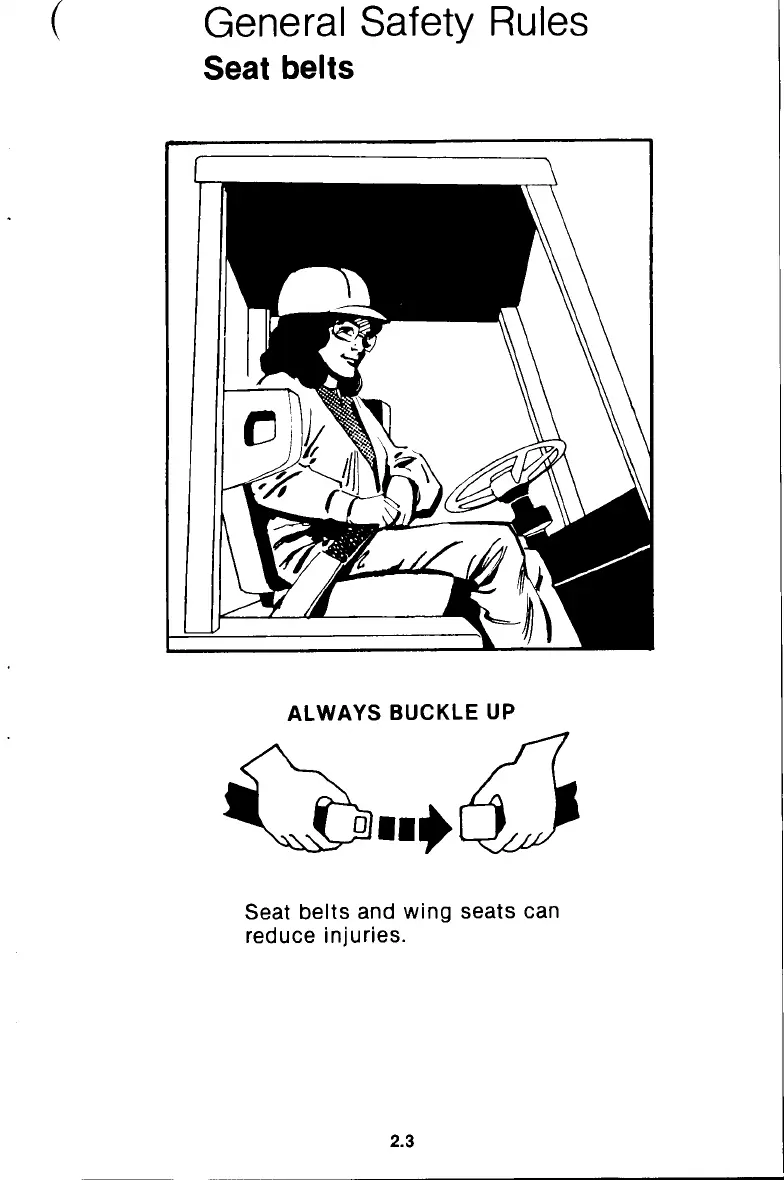
General Safety Rules
Seat
belts
17643
NOTICE:
It is
important
to
make
the
lift
chain
adjustment
check
with
a
rated load
to
make sure
that
the
chains
are
stretched
to
their maximum length.
If
the
chains
show
slack
due to an
increase
in
length they should
be
measured
for
wear. When chains
have
stretched
by
wear more than
3%
of
their
original
length
they
are
not
safe
and
must
be re-
placed.
ALWAYS
BUCKLE
UP
Seat
belts
and
wing seats
can
reduce
injuries.
8.18
2.3


 To Next Page