Know
Your
Truck
Truck
Components
&
Features
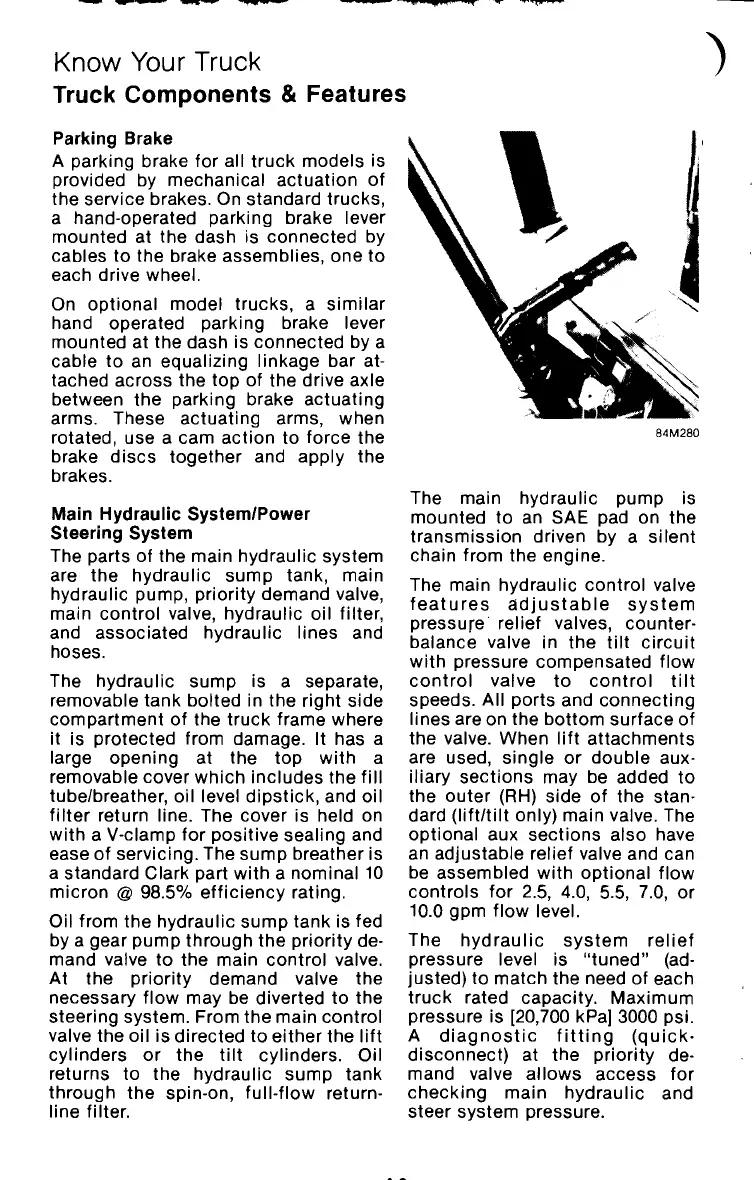
Parking
Brake
A
parking brake
for all
truck models
is
provided
by
mechanical actuation
of
the
service brakes.
On
standard trucks,
a
hand-operated parking brake
lever
mounted
at the
dash
is
connected
by
cables
to the
brake assemblies,
one to
each drive wheel.
On
optional model trucks,
a
similar
hand operated parking brake lever
mounted
at the
dash
is
connected
by a
cable
to an
equalizing linkage
bar at-
tached across
the top of the
drive axle
between
the
parking brake actuating
arms. These actuating arms, when
rotated,
use a cam
action
to
force
the
brake
discs together
and
apply
the
brakes.
Main
Hydraulic
System/Power
Steering
System
The
parts
of the
main hydraulic system
are
the
hydraulic sump tank, main
hydraulic
pump, priority demand
valve,
main control valve, hydraulic
oil
filter,
and
associated hydraulic lines
and
hoses.
The
hydraulic sump
is a
separate,
removable
tank bolted
in the
right side
compartment
of the
truck frame where
it
is
protected from damage.
It has a
large opening
at the top
with
a
removable cover which includes
the
fill
tube/breather,
oil
level dipstick,
and oil
filter return
line.
The
cover
is
held
on
with
a
V-clamp
for
positive sealing
and
ease
of
servicing.
The
sump breather
is
a
standard Clark part with
a
nominal
10
micron
@
98.5% efficiency rating.
Oil
from
the
hydraulic sump tank
is fed
by
a
gear pump through
the
priority
de-
mand valve
to the
main control
valve.
At
the
priority demand
valve
the
necessary flow
may be
diverted
to the
steering system. From
the
main
control
valve
the oil is
directed
to
either
the
lift
cylinders
or the
tilt
cylinders.
Oil
returns
to the
hydraulic sump tank
through
the
spin-on, full-flow return-
line
filter.
84M280
The
main hydraulic pump
is
mounted
to an SAE pad on the
transmission driven
by a
silent
chain from
the
engine.
The
main hydraulic control
valve
features adjustable system
pressure
relief valves, counter-
balance
valve
in the
tilt
circuit
with pressure compensated flow
control
valve
to
control
tilt
speeds.
All
ports
and
connecting
lines
are on the
bottom
surface
of
the
valve. When lift attachments
are
used, single
or
double aux-
iliary sections
may be
added
to
the
outer (RH) side
of the
stan-
dard (lift/tilt only) main valve.
The
optional
aux
sections also have
an
adjustable relief
valve
and can
be
assembled with optional flow
controls
for
2.5, 4.0, 5.5, 7.0,
or
10.0
gpm
flow level.
The
hydraulic system relief
pressure level
is
"tuned"
(ad-
justed)
to
match
the
need
of
each
truck rated capacity. Maximum
pressure
is
[20,700 kPa] 3000 psi.
A
diagnostic
fitting
(quick-
disconnect)
at the
priority
de-
mand valve allows access
for
checking
main hydraulic
and
steer system pressure.
Operation
How To
Operate Your Truck
When driving, always raise
the
forks
slightly
[50 - 100 mm] 2-4
inches above
the
floor
and
tilt
the
upright (forks)
backward slightly.
83M422
Practice
safe operation
every
time
you
use
your lift truck.
During your work, observe
all
functions
of
your lift truck. This will allow
you to
immediately recognize
a
problem
or ir-
regularity
that could
affect
the
safe
operation
of
your truck.
Do not
con-
tinue
to
operate
a
truck
that
has a
malfunction.
Stop
and
have
it
fixed.
Operate
your lift truck safely. Careful
driving
and
operation
is
your respon-
sibility.
Follow
the
instructions
in
this
manual
to
avoid damage
to
your truck
or
the
possibility
of
injury
to
yourself.
WARNING
ALWAYS WEAR YOUR SEAT BELT
WHEN
OPERATING YOUR
LIFT
TRUCK.
WARNING
CARBON
MONOXIDE
INTERNAL
COMBUSTION
ENGINES
GENERATE
TOXIC GASES
*ICH
CAN
CAUSE SERIOUS
INJURY
OR
DEATH
UHEN
INHALED.
BE
SURE
THERE
IS
ENOUGH
VENTILATION.
83M406


 To Next Page
 Loading...