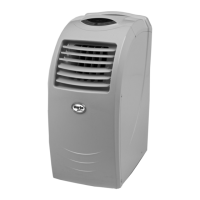
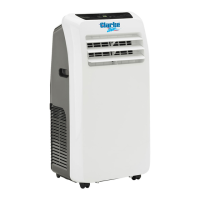
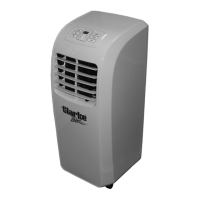
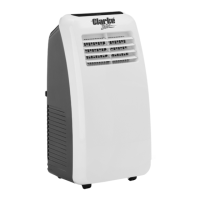
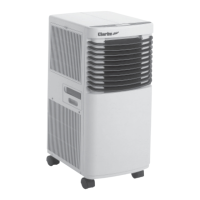
This document describes the Clarke Portable Air Conditioner, Model No: AC13050, Part No: 3230578. It provides comprehensive operation and maintenance instructions, ensuring safe and satisfactory use of the appliance.
Function Description
The Clarke Portable Air Conditioner is designed for indoor use, providing cooling, fan, and dehumidification functions to enhance comfort within a room. It operates on a 230V/50Hz earthed electrical supply. The unit features a control panel and a remote control unit for convenient operation.
Cooling Mode (COOL): In this mode, the air conditioner actively cools the room. Users can select a desired temperature between 16°C and 30°C using the Temp/Time adjustment buttons. The fan speed can also be adjusted to High, Mid, or Low, allowing for customized cooling performance. The swing button can be activated to move the air outlet flaps up and down, ensuring better air circulation throughout the room.
Fan Mode (FAN): When only air circulation is needed without cooling, the unit can be set to Fan Mode. In this mode, the fan speed can be adjusted to High, Mid, or Low. It's important to note that temperature settings are not available in Fan Mode.
Dehumidifying Mode (DRY): This mode is designed to reduce humidity levels in the room. For continuous dehumidification, a drainage hose can be connected to the unit's drain port, directing collected water into a bucket or a plumbing system. The unit will automatically operate the fan at a low speed in this mode, which cannot be adjusted. The temperature setting is also fixed in dehumidifying mode. The unit will turn on the fan if the room temperature is above 17°C (62°F) and turn it off if the temperature drops below 15°C (59°F).
Timer Mode: The air conditioner includes a timer function that allows users to schedule its operation. In standby mode, the "ON" time can be set for 1-24 hours, meaning the unit will automatically turn on after the set duration. When the unit is already on, the "OFF" time can be set for 1-24 hours, causing the unit to automatically turn off after the specified period.
Usage Features
The air conditioner is designed for ease of use with both a control panel on the unit itself and a remote control.
General Operation: To switch the air conditioner On/Off, simply press the Power button. The unit will recall and operate in the last mode used. For optimal performance, it is recommended to draw curtains during the sunniest part of the day if the room is exposed to direct sunlight.
Installation: Proper installation is crucial for the unit's efficiency and safety. The air conditioner should always be transported upright or resting on one side. Before moving, the internal water tank should be drained. The unit must be placed on a level, dry surface, at least 50 cm away from surrounding objects to ensure maximum performance. The flexible exhaust duct, which is variable in length (480mm to 1500mm), is screwed onto the air outlet at the rear of the unit. The other end of the duct is then inserted into a window sealing plate. The window sealing plate is extended and fitted into the window opening, either below or beside the window panel, and secured in position by closing the window or using wedges. It is important to avoid tight curves and kinks in the exhaust duct to prevent poor performance. The length of the duct is specifically designed for this air conditioner, and extensions or changes to its size are not recommended.
Refrigerant Gas (R290): The unit uses R290 refrigerant gas, which complies with European environmental directives. It has a low Global Warming Potential (GWP) of 3 and contains approximately 245g of R290. Due to the nature of the refrigerant, the unit should not be used or stored in unventilated spaces smaller than 25m² per unit. The room must be adequately ventilated to prevent the stagnation of refrigerant gas leaks, which could pose a fire or explosion hazard if they come into contact with ignition sources like electric heaters or stoves. Refrigerant gas is odourless. If any damage occurs to the unit that might compromise the refrigerant system, the product should not be used, and the retailer should be contacted for advice. Any repairs or maintenance involving the refrigerant system must be performed by a suitably qualified engineer following the manufacturer's service manual and safety guidelines. The refrigerant system must not be perforated or punctured.
Electrical Connections: The air conditioner must be connected to a 230V AC 50Hz earthed outlet. Installation must comply with local country regulations. If there is any doubt about the electrical supply, a qualified electrician should be consulted. The unit is equipped with a non-rewireable plug, and if the fuse needs replacement, a 13 Amp BS1363/A approved fuse should be used, ensuring the fuse cover is refitted. If the plug is damaged or unsuitable, it should be replaced by a qualified electrician following the wiring instructions: Blue wire to N (Neutral), Brown wire to L (Live), and Yellow and Green wire to E (Earth) or the earth symbol. It is strongly recommended to connect the machine to the mains supply via a Residual Current Device (RCD).
Fault Codes: The control panel displays fault codes to indicate specific issues:
- E1 (Coil temp is abnormal): Requires return to CLARKE Service Department for repair.
- E2 (Room temp is abnormal): Requires return to CLARKE Service Department for repair.
- E4 (Anti-freezing protection): The unit will recover automatically when the temperature exceeds 8°C; no action is required.
- FL (Water is full inside the machine): Indicates the internal water tank is full and requires manual drainage.
Maintenance Features
Regular maintenance ensures the longevity and efficient operation of the air conditioner.
Draining Off the Water:
- Manual Drainage: When the internal water tank is full, the unit will stop operating and display "FL." To drain, turn off the unit, unplug it from the mains, and place a tray under the drain port at the bottom rear. Remove the drain cap/plug, allow the water to drain, then replace the cap/plug and switch the unit back on. Avoid abrupt movements to prevent water spillage.
- Continuous Drainage: For continuous operation without manual draining, remove the drain cap/plug and connect a suitably sized water pipe to the drain port. This pipe can be plumbed into a current system, led outside, or connected to a water pump. This model features a self-evaporative function, which reuses most of the water to cool condenser coils, with any excess evaporating. Continuous drainage is not recommended if the self-evaporating facility is intended for use.
Cleaning:
- General Cleaning: Before any cleaning or maintenance, the unit must be shut off and unplugged from the mains. The outside surfaces can be cleaned with a duster or a soft, moist cloth. Solvents should not be used as they can damage plastic components.
- Cleaning the Air Filters: The air filters should be cleaned every two weeks, or more frequently depending on air quality, as blocked filters can affect performance. To clean, remove the rear grille and slide out the three air filters (one is attached to the grille). Wash the filters gently in warm water with a mild detergent, rinse them, and dry them gently out of direct sunlight. Ensure the filters are completely dry before clipping them back into position and re-fitting the grille.
End of Season Cleaning: If the air conditioner will not be used for an extended period:
- Drain the internal water tank.
- Run the unit in fan mode for 2 hours to dry out the interior.
- Switch off the unit, disconnect the power cable, coil it around the storage hooks, and secure the plug in the storage socket.
- Clean the air filters.
- Dismantle and safely store the exhaust ducting.
- Remove batteries from the remote control to preserve battery life.
- Cover the air conditioner with a plastic bag and store it in a dry place.
Energy Saving and Unit Safety Protection Tips:
- Do not cover or restrict airflow from the outlet or inlet grills.
- For maximum performance, position the unit at least 50 cm from walls or other objects.
- Keep filters clean.
- For initial start-up, set fan speed to maximum and thermostat 4-5 degrees lower than current temperature, then adjust to desired settings.
- The unit should only be used when room temperature is between 15°C and 35°C to protect it.


 To Next Page
 General