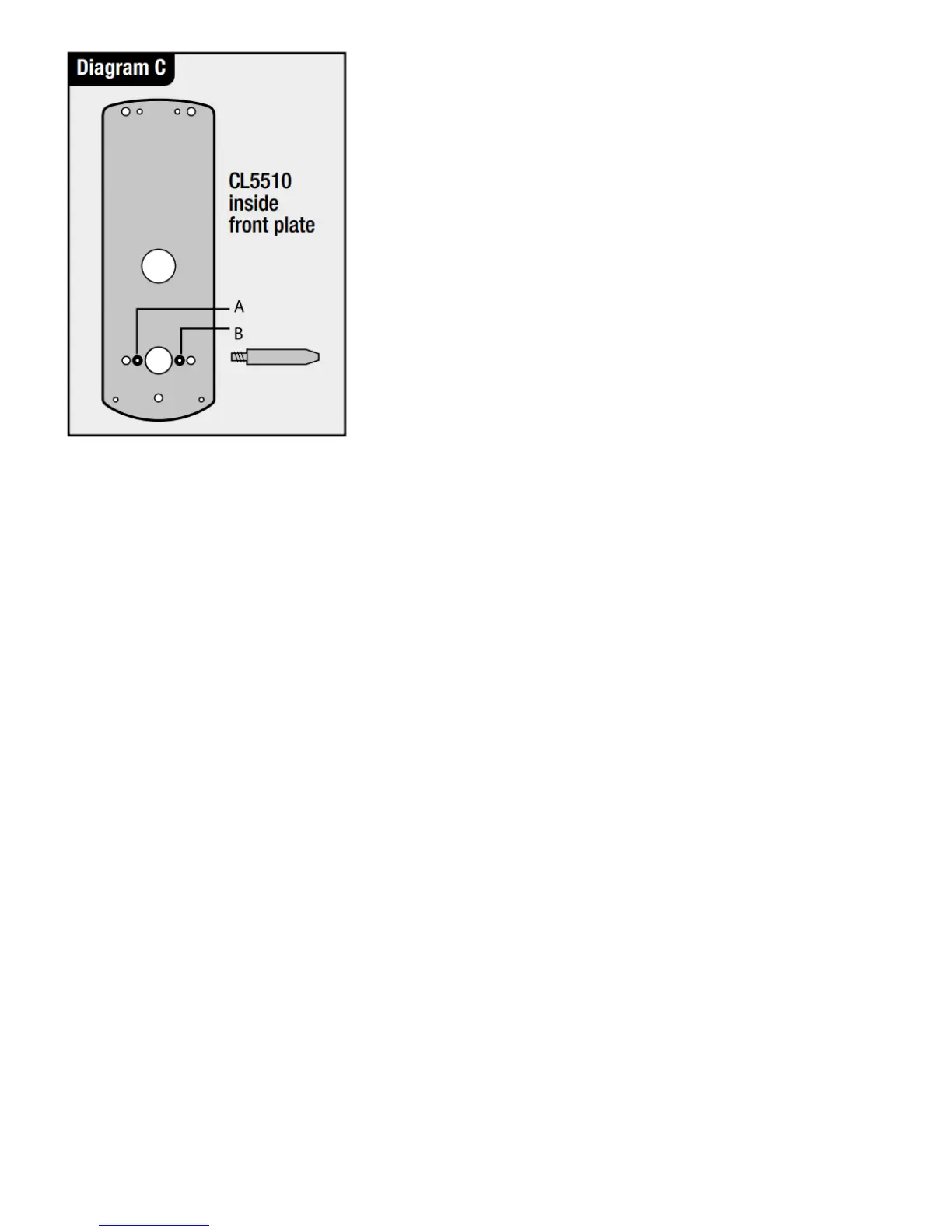
7. Screw the cable tube into the front plate, passing the cable through the tube. For doors less than 45mm
(13 /4”) thick screw the tube all the way to the end of the thread. For doors more than 45mm (1 ⁄”) leave
an appropriate amount of thread showing.
Example: For a 60mm (2 ⁄”) thick door leave 15mm (⁄”) of thread showing.
8. Fit the self-adhesive gaskets to the front and back plates. The gaskets provide friction against the door
so that it is not necessary to over-tighten the fixing bolts to provide stability.
9. Remove the five socket head bolts from the back plate (two are found under the battery cover). This will
release the inside fixing plate.
10. Cut the fixing bolts to correct length. Measured from beneath the bolt head, the length should be the
door thickness, plus approximately 15mm (⁄”) to the nearest cutting point of the bolt.
N.B. Always cut the bolts at one of the cutting points so as not to damage a thread. Use the cutting edges
of pliers to crimp strongly several times around the selected cutting point. The surplus end should break off
quite easily.
11. Put the spindle into the latch with the spring on the front plate side of the door.
12.Apply the front plate over the spindle, passing the cable tube through the door and the latch support
post through the latch. Place the fixing plate over the cable tube and spindle. Screw the ring nut onto the
cable tube until finger tight. Fit the alignment insert over the spindle. Screw the fixing bolts through to the
front plate. (See diagram D)


 To Next Page