EasyManua.ls Logo

Coleman 14'x14' - User Manual

Coleman 14'x14'
2 pages
Print Icon
To Next Page IconTo Next Page
Loading...
Layout & Positioning
of Tent, Pole Assembly
– Layout and position tent with doors
facing desired direction. (illus. 1)
– Stake down tent corners,
using the tent stake loops.
Keep the floor taut. (illus. 2)
Assemble all poles by
interlocking shock-corded poles.
– Insert the longer Center Frame
Poles (black) into Center Pole
Sleeves. The poles should cross
forming an “X” in the middle of tent. (illus. 1)
– Insert the shorter Side Frame Poles (grey)
through the pole sleeves located at the
sides of tent. (illus. 1)
Connect Frame to Tent
– Unzip doors.
– Locate the Pin & Ring Systems
on either side of the front doors
and the corresponding Pin & Ring
on the back side of tent.
– Insert one end of Frame Pole
onto Pin & Ring System on tent
stake loop on either side of
the doors. (illus. 3)
– Go to opposite end of pole diagonally
from starting point and gradually
apply pressure to the pole forming an
arch until you are able to insert the
Pin into pole end.
– Repeat for second pole.
Attach tent frame clips to poles.
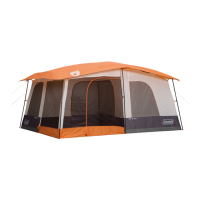
14’x14’ 3-Room Dome Tent
1
2
When You Are Ready
To Set Up Your Tent
– Select a level campsite clear of
rocks, branches and other hard
or sharp objects.
– Do not set up your tent under trees.
For best results in windy conditions,
position the end of tent into the wind.
(2) Side Tent
Poles (Grey)
(2) Rainfly
Poles
Rainfly Part No. 9271A406
(2) Center Tent
Poles (Black)
Door
Door
Instructions apply to Part Number 9271-191
illus. 1
illus. 2 Tent stake
through stake loop
illus. 4
Center section upright
Part No. 9271A402
Part No. 9271A405
Part No. 9271A403
illus. 3
Ring & Pin System
Center poles
Side pole
Side pole
Center poles
Side pole
Side pole
POLE ASSEMBLY PARTS
Question and Answer IconNeed help?

Do you have a question about the Coleman 14'x14' and is the answer not in the manual?

Summary

Tent Setup: Layout and Pole Assembly

Positioning and Initial Stake Down

Position tent with doors facing desired direction and stake down corners, keeping the floor taut.

Center Pole Assembly

Assemble poles by interlocking, insert longer black poles into center sleeves, forming an 'X'.

Side Pole Assembly

Insert shorter grey poles through sleeves located at the sides of the tent.

Connecting Tent Frame

Attaching Poles to Pin & Ring Systems

Insert one end of frame poles onto tent's pin & ring systems on door sides and back.

Forming Tent Arches

Apply pressure to poles to form arches, inserting the opposite end into the pole end pin.

Securing Frame Clips

Attach tent frame clips to the assembled poles.

Raising Tent Ends

Inserting Side Frame Poles

Insert side frame poles onto pin & ring systems and attach frame clips.

Arching Poles for Fit

Apply pressure to pole arches until they fit onto the pin.

Attaching the Rainfly

Rainfly Pole Insertion

Assemble rainfly poles and insert them into sleeves on the underside of the rainfly.

Draping and Securing Rainfly

Drape rainfly over tent, insert ends into grommets, and secure with attachments and S-hooks.

Attaching Guylines

Attach guylines to fabric loops on the rainfly and stake them out at an angle.

Summary

Tent Setup: Layout and Pole Assembly

Positioning and Initial Stake Down

Position tent with doors facing desired direction and stake down corners, keeping the floor taut.

Center Pole Assembly

Assemble poles by interlocking, insert longer black poles into center sleeves, forming an 'X'.

Side Pole Assembly

Insert shorter grey poles through sleeves located at the sides of the tent.

Connecting Tent Frame

Attaching Poles to Pin & Ring Systems

Insert one end of frame poles onto tent's pin & ring systems on door sides and back.

Forming Tent Arches

Apply pressure to poles to form arches, inserting the opposite end into the pole end pin.

Securing Frame Clips

Attach tent frame clips to the assembled poles.

Raising Tent Ends

Inserting Side Frame Poles

Insert side frame poles onto pin & ring systems and attach frame clips.

Arching Poles for Fit

Apply pressure to pole arches until they fit onto the pin.

Attaching the Rainfly

Rainfly Pole Insertion

Assemble rainfly poles and insert them into sleeves on the underside of the rainfly.

Draping and Securing Rainfly

Drape rainfly over tent, insert ends into grommets, and secure with attachments and S-hooks.

Attaching Guylines

Attach guylines to fabric loops on the rainfly and stake them out at an angle.

Overview

This document provides comprehensive instructions for setting up and maintaining a Coleman 14'x14' 3-Room Dome Tent, Part Number 9271-191. The tent is designed for outdoor camping, offering a spacious and multi-room layout suitable for various weather conditions, provided proper setup and care are followed.

Function Description

The Coleman 14'x14' 3-Room Dome Tent serves as a temporary shelter for camping, designed to accommodate multiple occupants with its three-room configuration. Its primary function is to provide protection from the elements, including wind, rain, and sun, while offering a comfortable and organized living space outdoors. The dome structure, supported by a system of interconnected poles, ensures stability and maximizes interior volume. The tent features multiple doors for easy access and egress, enhancing convenience for campers. A key component is the rainfly, which provides an additional layer of weather protection, particularly against rain and strong winds, and helps manage condensation. The tent's design emphasizes ease of assembly and disassembly, making it practical for recreational use.

Usage Features

The setup process for the Coleman 14'x14' 3-Room Dome Tent is broken down into several logical steps, ensuring a straightforward experience for users.

1. Layout & Positioning of Tent, Pole Assembly: Before assembly, users are advised to select a level campsite free of rocks, branches, or other sharp objects to prevent damage to the tent floor. It's also recommended to avoid setting up under trees to minimize debris and potential sap accumulation. For optimal performance in windy conditions, the tent should be positioned with its end facing into the wind.

The initial step involves laying out the tent with its doors facing the desired direction. This allows campers to orient the tent for optimal views, privacy, or sun exposure. Once positioned, the tent corners are staked down using the integrated tent stake loops, ensuring the floor is taut. This tautness is crucial for the tent's structural integrity and to prevent pooling of water underneath.

The pole assembly begins by interlocking the shock-corded poles. The tent utilizes two types of main frame poles:

  • Center Tent Poles (Black): These longer poles are inserted into the Center Pole Sleeves and are designed to cross in the middle of the tent, forming an "X" shape. This "X" configuration is fundamental to the dome tent's stability and shape.
  • Side Tent Poles (Grey): These shorter poles are threaded through the pole sleeves located along the sides of the tent.

The rainfly also has its own set of poles:

  • Rainfly Poles: These poles are assembled by interlocking their shock-corded sections.

2. Connect Frame to Tent: After assembling the main frame poles, the next step is to connect them to the tent body. This involves unzipping the tent doors to access the Pin & Ring Systems. These systems are strategically located on either side of the front doors and at the back of the tent.

One end of a frame pole is inserted onto a Pin & Ring System, which is typically integrated with a tent stake loop. The user then moves to the opposite end of the pole, diagonally across the tent. By gradually applying pressure, the pole is arched until its other end can be inserted into the corresponding Pin. This process is repeated for the second main frame pole. Once the poles are in place, the tent frame clips are attached to the poles, securing the tent fabric to the frame and giving the tent its final shape.

3. Raise Ends of Tent: This step focuses on securing the Side Frame Poles. One end of a Side Frame Pole is inserted onto a Pin & Ring System. The user then moves to the opposite end of this pole, applying gradual pressure to arch it until it can be fitted onto its corresponding pin. This process is repeated for the other Side Frame Pole. Finally, any remaining frame clips on the tent body are attached to these poles, further integrating the tent fabric with the frame.

4. Attach Rainfly: The rainfly is a critical component for weather protection. Its setup involves:

  • Rainfly Pole Assembly: The rainfly poles are assembled by interlocking their shock-corded sections.
  • Insertion into Sleeves: These assembled rainfly poles are then inserted into pole sleeves located on the center edges of the underside of the rainfly.
  • Draping the Rainfly: The rainfly is draped over the tent, ensuring the pole side is down and the Rainfly Poles are positioned over the tent doors.
  • Securing the Rainfly: The ends of the rainfly poles are inserted into grommets on the tent body. The rainfly is then secured to the tent using various attachments located on its underside. "S" hooks are attached to fabric loops near the frame clips on the tent. Guylines, which are pre-attached to fabric loops on the rainfly (two at each end over side windows and three on the rainfly), are staked out away from the tent at an angle. These guylines are adjustable, allowing users to tighten them by sliding a disc up the rope, ensuring the rainfly is taut and stable against wind.

Maintenance Features

Proper maintenance is crucial for extending the lifespan of the Coleman 14'x14' 3-Room Dome Tent. The manual provides several key recommendations:

  • Condensation Management: Users are informed that condensation can form on the inside surfaces of the tent, especially in cold or humid conditions. This is not leakage but rather water vapor from breath, perspiration, or wet clothing. To minimize condensation, users should remove wet clothing from the tent and ensure good ventilation.
  • Drying and Cleaning: It is imperative to never store the tent, even for a short period, without thoroughly drying it and brushing off any caked dirt. Storing a wet or dirty tent can lead to mildew, odors, and fabric degradation. Stakes and poles should not be packed inside the tent; a separate storage bag should be used for them to prevent damage to the tent fabric.
  • Stake Removal: When disassembling, stakes should be removed by pulling on the stake itself, not by pulling on the tent fabric or tent stake loop. Pulling on the fabric can cause tears or damage to the loops.
  • Pole Storage: Tent poles should not be left telescoped together during storage. This can cause them to stick or lose their elasticity over time.
  • Seam Sealing: The manual notes that seam sealer is not provided with the tent. For additional protection against water leakage, it is recommended to seam seal the tent prior to camping. Seam sealer can be purchased from local retailers or sporting goods stores.
  • UV Exposure: Users are warned against leaving the tent set up for weeks at a time, as prolonged exposure to the sun's ultraviolet (UV) rays can seriously damage the material and cause discoloration. UV degradation weakens the fabric over time.
  • Flame and Heat Sources: A critical safety warning emphasizes keeping all flame and heat sources away from the tent fabric. The tent meets CPAI-84 flammability requirements, meaning the fabric will burn if left in continuous contact with a flame source. Applying any foreign substance to the tent fabric may render its flame-resistant properties ineffective, posing a significant safety risk.

By following these detailed instructions for setup and maintenance, users can ensure a safe, comfortable, and long-lasting camping experience with their Coleman 14'x14' 3-Room Dome Tent.

Coleman 14'x14' Specifications

General IconGeneral
Water ResistanceWeatherTec System
Number of Doors1
Warranty1-year limited warranty
Dimensions14 x 14 feet
Center Height6 feet 7 inches
MaterialPolyester
Product TypeTent
RainflyYes
Frame MaterialSteel
Electrical Access PortYes

Related product manuals