Need help?
Do you have a question about the Contec CMS50D and is the answer not in the manual?
Critical safety precautions and potential hazards associated with the device's use.
Legal restriction on device distribution and sale as mandated by federal law.
Guidelines for safe operation, including checks and maintenance procedures to ensure user and equipment safety.
Lists potential hazards and contraindications for using the pulse oximeter.
Details specific operational precautions and environmental considerations for optimal device performance.
Defines the intended medical purpose and scope of application for the pulse oximeter.
Specifies the device's classification under medical device directives for regulatory purposes.
Highlights key operational features and design characteristics of the pulse oximeter.
Outlines the primary applications and suitable environments for using the pulse oximeter.
Specifies the required temperature, humidity, and pressure for storage and operation.
Explains the underlying scientific principle and technology used for measuring SpO2 and pulse rate.
Provides crucial cautions regarding ambient light, patient movement, and testee preparation for accurate readings.
Details clinical limitations, factors affecting accuracy, and specific patient conditions to consider.
Specifies display type, SpO2 and pulse rate measurement ranges, and pulse wave visualization.
Details power source requirements, including battery type and voltage adaptability.
States the device's power consumption rate during operation.
Defines the precision level for SpO2 and pulse rate measurements.
Outlines the accuracy specifications for SpO2 and pulse rate measurements.
Describes performance under low pulse-filling conditions and associated accuracy.
Details the device's resistance to ambient light interference affecting measurement accuracy.
Mentions the auto-power-off function triggered by the absence of a finger.
Provides specifications for the optical sensor, including light wavelengths and power.
Lists the items included with the pulse oximeter package.
Identifies and describes the components visible on the front panel of the device.
Step-by-step instructions for correctly inserting batteries into the device.
Instructions on how to attach the hanging rope to the pulse oximeter.
Detailed steps for operating the pulse oximeter from battery insertion to reading display.
Explains the multiple functions of the device's button for power, screen direction, and brightness.
Describes how to change the screen display mode using the device's button.
Provides solutions for common problems encountered during device operation.
Explains the meaning of various symbols used on the device and in the manual.
Guidance for ensuring immunity to electromagnetic disturbances in various environments.
Guidance on electromagnetic emissions for equipment and systems.
Provides recommended distances for portable and mobile RF communication equipment.
Details the information displayed on the oximeter screen.
Technical specifications for measuring Oxygen Saturation (SpO2).
Technical specifications for measuring Pulse Rate (PR).
Details the specifications for pulse intensity indication.
Specifies battery requirements and display mode capabilities.
Provides the physical dimensions and weight of the pulse oximeter.
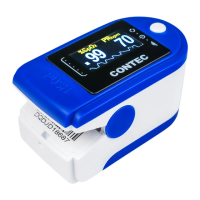
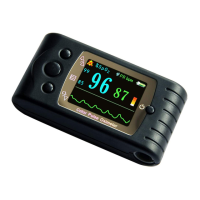
The CONTEC CMS50D Pulse Oximeter is a non-invasive medical device designed for spot-checking oxygen saturation of arterial hemoglobin (SpO2) and pulse rate in both adults and pediatric patients. It is suitable for use in various environments, including homes and hospitals (such as in internist/surgery, anesthesia, and intensive care settings). This device is not intended for continuous monitoring.
The Pulse Oximeter measures the percentage of oxyhemoglobin (HbO2) in the total hemoglobin in the blood, which is referred to as O2 concentration or SpO2. This is a crucial bio-parameter for respiration. Simultaneously, the device also measures the pulse rate. The operating principle is based on the Lambert-Beer Law, utilizing the spectrum absorption characteristics of deoxyhemoglobin (Hb) and oxyhemoglobin (HbO2) in the red and near-infrared light spectrums. It employs Photoelectric Oxyhemoglobin Inspection Technology and Capacity Pulse Scanning & Recording Technology. Two beams of different wavelengths are focused onto the human fingertip through a clamp-type sensor. The measured signal is then processed by a photosensitive element and displayed on the screen after electronic circuit and microprocessor treatment. The device indicates pulse intensity through a bar display.
The CMS50D Pulse Oximeter is characterized by its small volume, light weight (approximately 50g including batteries), and portability, making it convenient for users. Operation is straightforward: the patient simply places one finger into the fingertip photoelectric sensor for diagnosis, and the measured hemoglobin saturation and pulse rate values are directly shown on the display screen.
The device is powered by two 1.5V AAA alkaline batteries (or rechargeable batteries) and has low power consumption, allowing for continuous operation for up to 20 hours with the originally equipped batteries. It features an automatic power-off function, activating when no signal is detected within 5 seconds. The display offers four direction modes without a waveform, and the waveform can be shown as either a line drawing or a filling manner.
For accurate measurements, the finger must be positioned correctly within the sensor. The SpO2 sensor and photoelectric receiving tube should be aligned with the subject's arteriole. It is crucial to avoid using the sensor on a location or limb with an arterial canal, blood pressure cuff, or receiving intravenous injection. The optical path must be clear of any obstructions, such as rubberized fabric. Excessive ambient light (fluorescent lamps, dual ruby lights, infrared heaters, direct sunlight) and strenuous subject movement or electrosurgical interference can affect measurement accuracy. Patients should not wear enamel or other makeup on their fingernails during use.
The device is suitable for children above four years old and adults, with a weight range of 15kg to 110kg. It may not work for all patients, and if stable readings cannot be achieved, use should be discontinued. The data update period is less than 5 seconds, varying with the individual pulse rate. The displayed waveform is normalized, and the measured value is considered optimal when the waveform on the screen is steady and even. If abnormal conditions appear during testing, the finger should be removed and reinserted to restore normal operation.
The device has a normal useful life of three years from its first use. A hanging rope made from non-allergy material is provided; users sensitive to the rope should discontinue its use. Care should be taken not to wear the rope around the neck to avoid harm. The instrument does not have a low-voltage alarm function but indicates low voltage, prompting battery replacement when energy is depleted. It also lacks an alarm function for specific parameters, so it should not be used in situations where alarms are required.
Regular checks of the main unit and all accessories are recommended to ensure no visible damage that could affect patient safety or monitoring performance, particularly regarding cables and transducers. It is advised to inspect the device at least once a week. If obvious damage is present, the monitor should be stopped from use.
Maintenance should only be performed by qualified service engineers; users are not permitted to maintain the device themselves. Only accessories appointed or recommended by the manufacturer should be used with the device. The product is calibrated before leaving the factory.
For cleaning, the surface of the device should be wiped with medical alcohol and then allowed to air dry or cleaned with a dry fabric. Disinfecting the product with medical alcohol after use helps prevent cross-infection. The device should not be immersed in liquid, and high-pressure steam disinfection is not permitted. When cleaning with water, the temperature should be below 60°C.
Batteries should be removed if the device is to be stored for more than one month to prevent leakage. The best storage environment for the device is an ambient temperature of -40°C to +60°C and relative humidity not higher than 95%. Users are advised to calibrate the device periodically (or according to hospital calibration programs), which can be done through a state-appointed agent or by contacting the manufacturer. The device should be kept in a dry environment, as humidity can reduce its useful life or even damage it.
 General
| Display Type | OLED |
|---|---|
| SpO2 Accuracy | ±2% (70% - 100%) |
| Pulse Rate Measurement Range | 30-250 bpm |
| Pulse Rate Accuracy | ±2 bpm or ±2% (whichever is greater) |
| Power Consumption | Less than 30mA |
| Resolution | 1% for SpO2, 1 bpm for Pulse Rate |
| Weight | 50g (including batteries) |
| Power Supply | 2 AAA batteries |
| Operating Temperature | 5°C - 40°C |
| Relative Humidity | 15% - 80% non-condensing |
| Altitude | Up to 4000 meters |
| Battery Life | Approximately 30 hours |
| Dimensions | 57mm × 31mm × 32mm |
| Storage Temperature | -10-40°C |


 To Next Page