Need help?
Do you have a question about the Contec CMS50F and is the answer not in the manual?
Details the pulse oximeter's features, intended use, and environmental requirements for operation and storage.
Covers essential precautions, attention points, and clinical restrictions for safe and effective use of the device.
Explains the photoelectric oxyhemoglobin inspection technology and data processing based on Lambert-Beer Law.
Lists the core functions of the pulse oximeter, including SpO2/PR display, battery indication, and data upload.
Describes the device's appearance, interfaces, probe installation, USB cable connection, and structure.
Guides users on how to perform measurements, use the measurement interface, and navigate menu operations.
Details how to configure sound prompts, manage data storage, set the clock, and adjust system parameters.
Provides detailed technical specifications, including performance data, accuracy, and environmental limits.
Offers guidance on device troubleshooting, cleaning, disinfection, and maintenance procedures.
Outlines FCC compliance requirements, labeling, user information, and RF exposure guidelines.
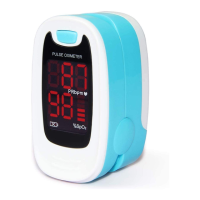
The device is a PULSE OXIMETER, a portable, non-invasive device intended for spot-checking the oxygen saturation of arterial hemoglobin (SpO2) and pulse rate of adult and pediatric patients in home and hospital environments. It is not intended for continuous monitoring.
The pulse oximeter measures SpO2 and pulse rate. SpO2 is the percentage of oxygenated hemoglobin relative to the total hemoglobin (oxygenated + deoxygenated) in the blood. It is a vital physiological parameter that reflects cardiorespiratory function. The device uses a photoelectric oxyhemoglobin inspection technology, combining a volume pulse scanning and recording capacity technology. Two beams of light of different wavelengths (red light 660nm and infrared light 905nm) are directed through the fingertip. The photodetector measures the amount of light absorbed by the pulsatile blood. The ratio of the absorbed red light to infrared light is then used to calculate SpO2. The pulse rate is determined by counting the number of pulsations per minute.
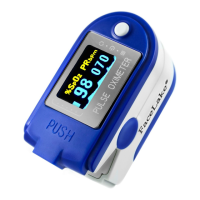
The device is designed for ease of use. To operate, simply insert two AAA batteries into the battery compartment, ensuring correct polarity. Place one of your fingers into the rubber opening of the oximeter, making sure the nail is facing upwards. Press the switch button on the front panel. The oximeter will automatically turn off after 8 seconds if there is no finger in the device.
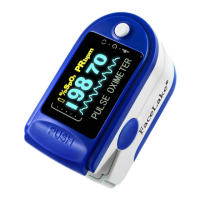
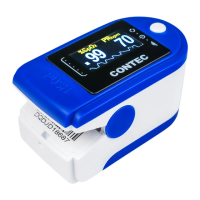
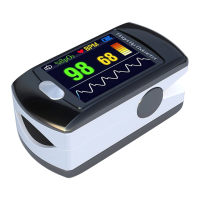
The device features a color OLED display, which shows SpO2, pulse rate, pulse waveform, and battery indicator. The display has four directions and six display modes, which can be changed by pressing the power button. The brightness of the display can also be adjusted. The pulse waveform is displayed as a plethysmogram, providing a visual representation of the blood flow.
The device includes an alarm function. When the measured SpO2 or pulse rate exceeds the preset limits, an alarm will sound. The alarm limits can be adjusted through the device's menu. This feature is particularly useful for indicating potential physiological distress.
The device also offers a Bluetooth connectivity feature. This allows the oximeter to transmit data wirelessly to a smartphone or other compatible device. This can be useful for tracking trends over time or sharing data with healthcare professionals.
The device has a menu system that allows users to customize various settings. These include alarm limits for SpO2 and pulse rate, display brightness, and Bluetooth settings. The menu is accessed by long-pressing the power button.
The device is designed to be portable and lightweight, making it convenient for use at home, during travel, or in clinical settings. The compact size allows it to be easily carried in a pocket or bag.
The device provides various indicators to ensure proper operation. The battery indicator shows the remaining battery life. A "Finger out" indicator appears if the finger is not correctly placed or removed. A "Signal weak" indicator may appear if the signal quality is poor, which can be caused by movement or improper finger placement.
The device is suitable for both adult and pediatric patients, making it versatile for family use. However, it is important to note that the device is not intended for continuous monitoring and should not be used as the sole basis for medical decisions.
The device requires minimal maintenance. The batteries should be replaced when the low battery indicator appears. It is recommended to remove the batteries if the device is not used for a long period to prevent leakage.
The device should be cleaned regularly to ensure hygiene and proper functioning. Before cleaning, ensure the device is powered off. The surface of the device should be wiped with a medical alcohol solution (75% ethanol) using a dry cloth. Do not immerse the device in water or any other cleaning solution. Avoid using strong cleaning agents or abrasive materials.
The sensor area, where the finger is placed, should also be cleaned with alcohol. After cleaning, allow the device to air dry completely before use.
The device should be stored in a cool, dry place, away from direct sunlight, high temperatures, humidity, and corrosive gases. Avoid strong electromagnetic interference.
Regular checks should be performed to ensure the device is in good working order. If any damage is observed, such as cracks in the casing or display issues, the device should not be used and should be sent for repair by qualified personnel.
The device is designed with a low power consumption, which helps extend battery life. The automatic power-off feature further conserves battery power.
The device is built to be durable, but care should be taken to avoid dropping or subjecting it to strong impacts, as this could damage the internal components.
 General
| Type | Pulse Oximeter |
|---|---|
| Measurement Parameters | SpO2, PR, PI |
| PR Accuracy | ±2 bpm or ±2% (whichever is greater) |
| Resolution SpO2 | 1% |
| Resolution PR | 1 bpm |
| Resolution PI | 0.1% |
| Display | OLED |
| Measurement Performance in Weak Filling Condition | Yes |
| Resistance to surrounding light | Yes |
| PR Measuring Range | 30 bpm - 250 bpm |
| SpO2 Accuracy | ±2% (70% - 100%) |
| Power Supply | 2 AAA batteries |
| Battery Life | Approximately 30 hours |
| Operating Temperature | 5°C to 40°C |
| Humidity | 15% - 80% (non-condensing) |
| Weight | Approx. 50g |
| SpO2 Measuring Range | 0%~100% (resolution is 1%) |

 To Next Page