34
Kyle Form 4C Microprocessor-Based Recloser Control Programming Guide
Digital Communications (cont’d)
Security Limits
Access Factory
Code Write Read Scroll High Low Incr Parameter Settings
84 0 0 NO 10 0 1 Number of Line Sync Characters 1
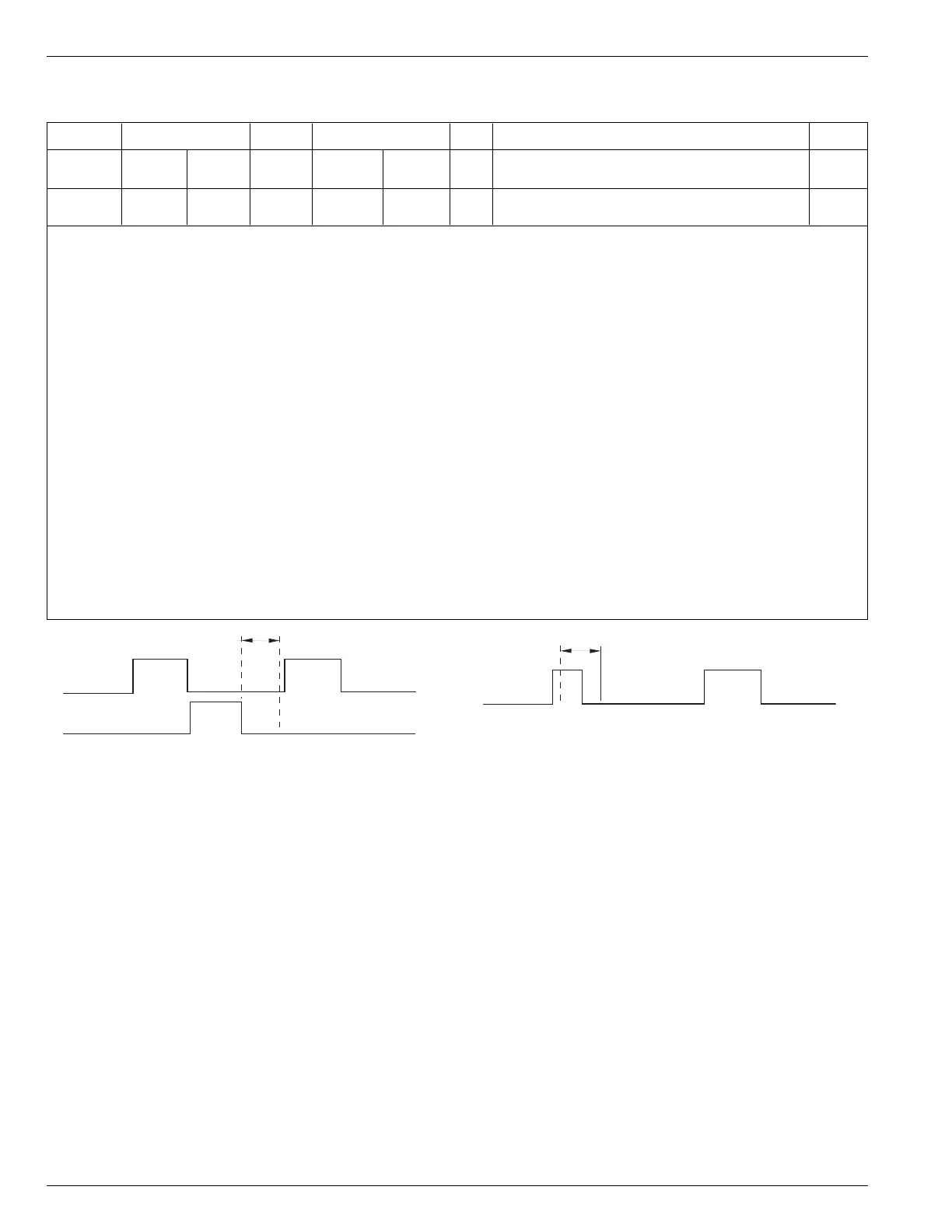
• Defines the period of time the receive must idle to
assume the start of a request message. Dead-line
sync is used to determine the start of the request
message. When used on a ring-configured or
broadcast communication system, the control
“hears” messages for devices at other nodes on the
received data line. By reading the address, the con-
trol determines if the message is intended for it and
ignores the remaining bytes if it is not.
A period of time, during which the received data line
is inactive, defines the end of the previous mes-
sage. This inactive time is the dead-line sync peri-
od. The control is now synchronized so that the
next byte received is considered the beginning of a
new message.
The value programmed is the equivalent number of
characters that the receive line must remain inac-
tive to be considered the end of a message. The
control determines the actual time delay internally,
taking into account baud rate and the number of
bits in the character.
For example:
Baud = 4800
Dead-line sync character = 5 characters
Dead time = 5 characters x
10 bits
/
character
*= 50 bits
50 bits ÷
4800 bits
/
second
= 10.4 mS dead-line sync
time
*
10 bits
/
character
applies to Protocol 2179, 8 data
bits, 1 start bit, 1 stop bit.
11 bits
/
character
applies to protocol 2200, 8 data bits,
1 start bit, 1 stop bit, 1 parity bit.
See Figures 8 and 9.


 To Next Page