9
~(j'(Q)(!J1!)Ull
_
____
'!.D:c-75:.;p~O:!W~E"R~A~Mc:PL~
/
F~/E"R~
_
_____
___
_'
R"'E'_'V"'-
0
with
on
c
fu
se
on
ea
ch driver.
Fu
ses
he
lp prevent damage
du
e
to
prolonged overload.
but provide essentially no protection against damage
from
l
arg
e transients. To minimize this problem, use
high
-
speed
in
strumem
fu
ses
suc
h
as
th
e Liulc
fu
se
36
1000
se
ri
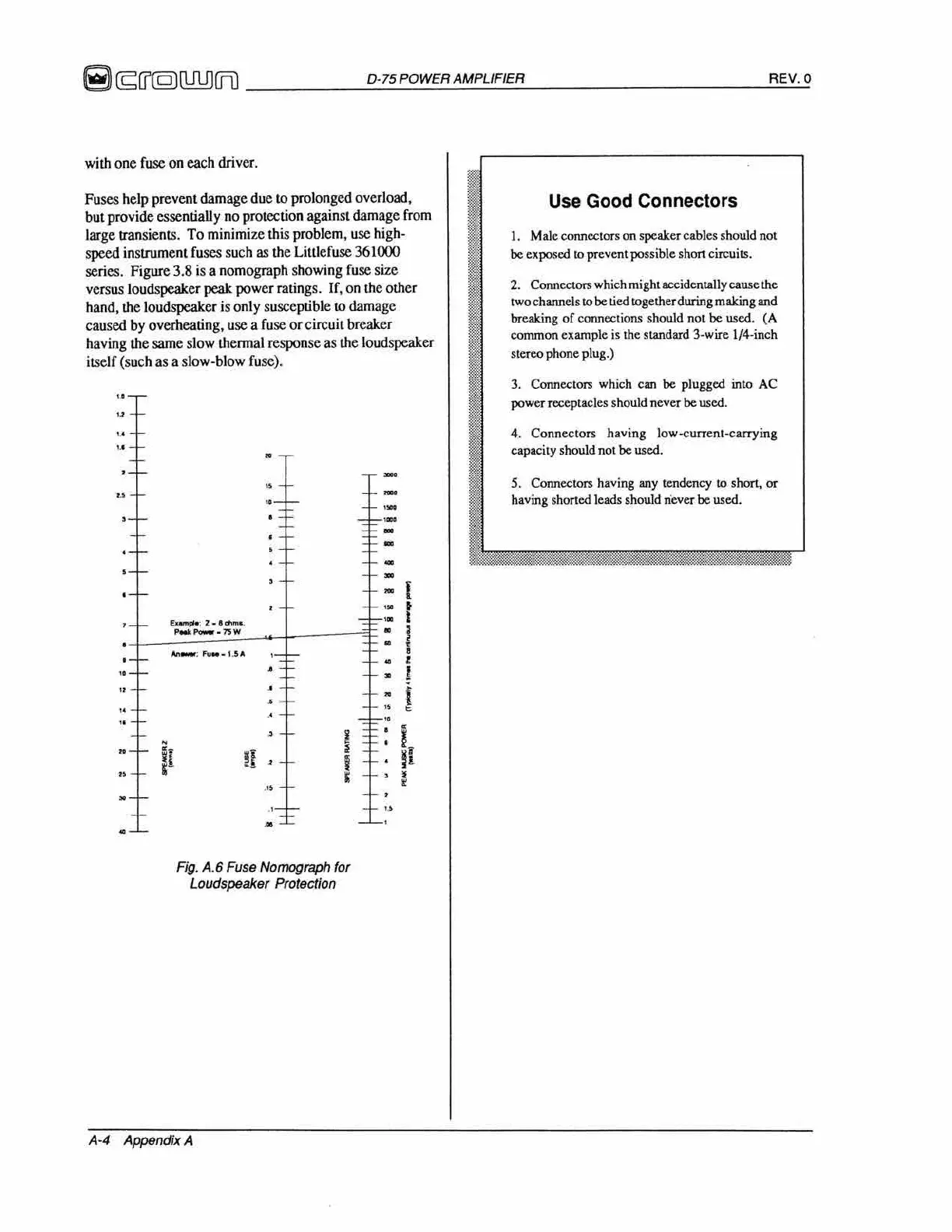
es. Figure 3.8 is a nomograph showing fuse size
versus
loudspeaker
peak
power ralings. If.
on
th
e other
hand,
me loudspeaker is only susceptible
to
dama
ge
ca
u
sed
by
overheating,
use
a
fuse
or circuit breaker
having
the
sam
e s
low
Lhennal
response as the loudspeaker
its
elf (such as a slow-bl
ow
fuse).
"
..
..
"
"
"
"
"
•
"
•
•
•
"
"
~
:
Z
.
'_
.
__
.
7SW
_ :
__
UA
•
•
•
"
!
II
!I
•
•
I
I
"
-,
•
Fig
. A.6
Fuse
Nomograph
for
Loudspeaker
Protection
A·4 Appendix A
-
-
,.
,.
-
•
-
-
-
[
'.
r
,.
•
I
•
•
•
•
f
•
I
"
<
,
I,
I,
•
•
..
Use Good Connectors
I. Male connectors on speaker cables shou
ld
not
be
exposed 10 prevent possible short circuits.
2.
ConncctOTS
which m
ightacdde
ntall
yeausethe
twocharmels to be tied togetherduring making and
breaking
of
connections should not be used. (A
common example is the standard 3·wire l/4-inch
stereo phone plug.)
3. Connectors
which can be plugged into AC
power receptacles should never be used.
4. Connectors having low-current-carrying
capacity should
nOI
be used .
5.
Connectors having any tendency to short,
or
having shorted leads should n·ever be used.


 To Next Page