~RE~V~.~O
____
________________
~D~·
7~
5~P~O~W~E~R~A~M~PL~~
~JE=R~
_________
~~~~~~
M'4
n
Appendix B: Operation
B.1 Precautions
Allhough your amplifier
is
well
proteCted
from
any external
faults,
we recommend the followi
ng
precautions
be
taken
ior
safe
operation:
1.
When using input sources
of
uncenain level or
2.-1y
audio components which have
not
previously
been
used
with
your amplifier.
alwa
ys
begin
wilh
the
level
controls
at
a minimum and gradually increase them
while monitoring
the audio output level
to
I!void
suddenly blasting
!h
e loudspeakers.
2.
Always tum
lhe
level
conltOls
down before
insc.,"ting
a
headphone
sct
into
me
output monitor jack
on
t
he
front panel. This
will
elim
in
ate
the
risk of damaging
the headset or your
cars willi
high
so
und
levels.
3. Tum
the ampiifier off
and
unplug j!
from
the
AC
line
before replacing
lhe
fuse.
(The unil must
be
totally
disccnn~led
[;om
Ii'l
l.!
AC
pow
er source because tile
fuse
soc
ket
is
slill powered even when the unit is
turned off.)
4.
Operate
Ihe
amp
with
the
correct fuse (2 amp for 100
or 120
VAC;
1 amp for 200, 220 or 240 VAC).
5.
Never drive a traflsformer-couplcd device (s
uch
as
an
electrostatic loudspeaker) or any other device
wh
icb
appears
as
a low-frequency short (less than 3 ohms)
without a series isolating capacitor. Such
~...ra
t
ion
m
ay
damage tbe load and/or needlessly activate the
amplifier's
VI
limiting.
6.
Operate
lhe
amplifier
from
AC
mains of
no
t more than
10%
above lhe selected
line
voltage
and
only!h~
specified line frequency
(50/60
Hz).
F~ilu.e
10
comply wi
th
these limits
will
invalidate
the
warranty.
7.
Never connect the output
to
a power supply output,
battery, or power main. Damage
incurred by sucb a
hookup
is
not covered
by
me
warran
ty.
8.
Do not expose the amplifier
to
corrosive chemicals
such
as
soft drinks, l
ye
, sall water, ete.
9.
Do
nOi
tamper
with
lhecircuiuy. Circuit changes
made
by
unauthorized personnel, or unauthorized
circuit modifications,
will
invalidate
the
warranty.
B.2
Controls
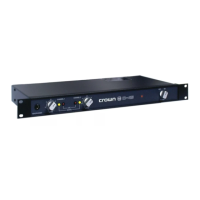
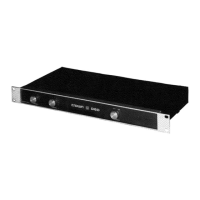
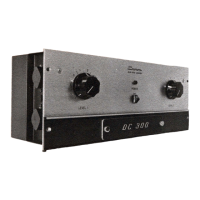
Independent level controls
and
a power switch and power
indicator are located on
the
front panel.
Bom
level controls
are
used
in
STEREO mode, but only theChanncll control
sho
uld
be
used
in
MONO
mode.
They areused to
adjuSt
the
desired output level (both
the
monilOr
output and
t.h~
main
outputs) and have thirty one detents for precise adjustment.
The openttion
mode
is
sw
itched between
SlEREO
and
MONO
by
the
St
ereo-Mono
sw
itch
loc
a
ted
on
the
ba
ck
pa
nel. Also located
on
the
back panel
is
an
AC
line
fuse.
In addition to the above essential conrrols, your high-
pe
rf
ormance amplifier has
an
IOC (Input/Output
Compa.rilOr)
indicator and a Signal ?resence
indicalOr
for
each channel.
The red iOC LEOs are located
on
the f
rom
panel above the
lev
el comrois. They
will
flash
or glow whenever t
he
distortion
speciflC2.tions
of the amplifier
are
being exceeded.
Note: The I
CC
indicators also double as STAND-BY
indicators and
wiil
glow every time
this
feature
is
ac
t
ive
(tum-on delay, Low-Freque
ncy
Imerrupt and
tem
perature
over
load
).
It
is also normal for
them
to
glow
momentarily
when
the
AC
power
is
turned off.
Tne
;;reen
Signal Przscnce LEDs
are
located on
the
from
pane.:.
retweeo
the
level controls. They blink or glow any
time
!
.b.e:-e
is
more
!.h2.n
0.6
V
RMS
at
the
outDUlof
the
Q-7.'i.
(Ii
JoesignaJ
level
is
very l
ow
they
may
notilluminatc.) This
provides a eonvcnientme
thod
of
observing whemer or n
Ot
a
signal
has
been
inte
rrupted somewhere
in
bet
.....
een tbe input
and
tile OUtpUL
B.3 Protection
Crown
p::lwcr
amplifiers are widely kno
.....
n
for
their qual
it
y
construction, high reliabili
ty
and extensive internal
pro
tec
tion
circuitry. The
D-75
is
no
e"ception. It
is
prot.ected
against
all
the common hazards which plague
high-powered
amplifiers,
inclueling:
shorted,
open
and
mismatched loads (load impedance 100 low
):
overloaded
power supplies: er.cessi
ve
temperature; chain destruction
phenomena;
inpm
overload damage; and,
high
frequency
overi
ood
blowups.
PrOl.ection
against shoned and low impedance loads
is
provided
by
a fast-acting limiter circuit
wh
i
ch
in
s
tanUlllcously
limits the
ou
tput power
to
a maximum safe
stress value.
It functions automatically
as
a current limiter
at
audio frequencies whose current limiting threshold is
depcndenl
on
t
he
hi
story
of
theoutput signal. Output curre
nt
causes
the
threshold to increase. The no-signal threshold
is
high
enough
LO
allow
lOne
bursting (even into 4 ohms)
without premature limiting,
as
is
found
in
some recent
products or other manufacturers.
Since
!.he
Iimiler
h2.S
no
instantaneous response to output
voltage.
Oybac
k transients
do
not appear
in
the outpul
when
limiting occu
rs
on inductive loads. (Flyback transients are
a normal
by-pr
od
uct
of
VI
limiting, also called "Ener
gy
Limiter,"
with
an
i
ndu
ctive load. The amplifier yields
to
the
Appendix 8
8-1


 To Next Page