MICRO-TECH SERIES
T
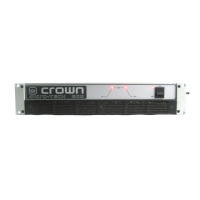
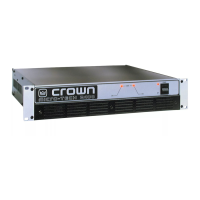
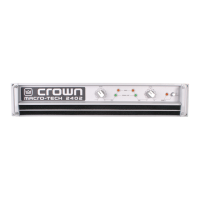
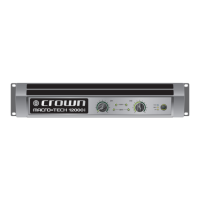
he Crown
®
Micro-Tech
®
600, 1200 and
2400 are the original industry standards
for touring amplifi ers. Micro-Tech am-
plifi ers are known around the world as the
benchmark for high-density, ultra-pure power
in a compact package. In addition, each model
gives you Crown’s legendary ODEP
®
protection
to keep the show going long after other ampli-
fi ers would fail.
Micro-Tech amplifi ers use proven technol-
ogy and a miniaturized design to deliver
terrifi c value for their size, weight and price.
Crown’s patented ODEP protection circuitry
and Grounded Bridge
™
output stages combine
to provide performance and reliability that
surpass traditional designs. Micro-Tech ampli-
fi ers also have an independent high-voltage
power supply for each channel. This approach
results in extremely low crosstalk and makes
it possible to use each channel as a separate
amplifi er.
Plus, your investment in a Micro-Tech ampli-
fi er is backed by Crown’s unequaled Three-
Year, No-Fault, Fully Transferable Warranty that
covers everything.
For more details about the Crown Micro-Tech
Series, contact the Crown Technical Support
Group at 800-342-6939 or 574-294-8200.
Also, visit the Crown Audio website at www.
crownaudio.com.
Specifi cations
The following applies to 120 VAC, 60 Hz units in Stereo mode
with both channels driven into 8 ohm loads and an input
sensitivity of 26 dB unless otherwise specifi ed. Specifi cations
for units supplied outside the USA may vary slightly at differ-
ent AC voltages and frequencies.
Power
Output Power: See power charts below.
Load Impedance: Safe with all types of loads.
Rated for 2 to 16 ohms in Stereo mode, 4 to
16 ohms in Bridge-Mono mode, and 1 to 4
ohms in Parallel-Mono mode.
Voltage Gain (at maximum level setting):
MT-600: 20:1 ±6% or 26 dB ±0.5 dB at 26
dB gain setting. 55:1 ±6% or 35 dB ±0.5 dB
at 0.775 volt sensitivity; 31:1 ±6% or 30 dB
±0.5 dB at 1.4 volt sensitivity.
MT-1200: 20:1 ±6% or 26 dB ±0.5 dB at 26
dB gain setting. 64:1 ±6% or 36 dB ±0.5 dB
at 0.775 volt sensitivity; 34:1 ±6% or 31 dB
±0.5 dB at 1.4 volt sensitivity.
MT-2400: 20:1 ±6% or 26 dB ±0.5 dB at 26
dB gain setting. 83:1 ±6% or 38 dB ±0.5 dB
at 0.775 volt sensitivity; 46:1 ±6% or 33 dB
±0.5 dB at 1.4 volt sensitivity.
Required AC Mains: 100, 120, 220 and
240VAC (±10%), 50 and 60 Hz units are avail-
able.
AC Line Current:
AC mains current, frequency and voltage
requirements are provided on the unit’s back
panel.
At Idle: All amps draw no more than
90 watts.
AC Line Connector: All units are shipped with
an appropriate plug and cord for the required
AC voltage.
Performance
Frequency Response: ±0.1 dB from 20 Hz to
20 kHz at 1 watt.
Phase Response: ±10 degrees from 20 Hz to
20 kHz at 1 watt.
Signal to Noise Ratio:
A-Weighted:
Better than 105 dB below full bandwidth
power.
20 Hz to 20 kHz:
Better than 100 dB below full bandwidth
power.
Total Harmonic Distortion (THD): Less than
0.5% at full bandwidth power from 20 Hz to 1
kHz increasing linearly to 0.1% at 20 kHz.
Intermodulation Distortion (IMD): (60 Hz and
7 kHz at 4:1) Less than 0.05% from 163 mil-
liwatts to full bandwidth power.
Damping Factor: Better than 1,000 from 10 Hz
to 400 Hz.
Common Mode Rejection (CMR): At rated full
bandwidth power, better than 70 dB from 20
Hz to 1 kHz falling linearly to better than 50 dB
at 20 kHz.
DC Output Offset (shorted input): < ±10 mV.
Features
• Crown’s Grounded Bridge™ design delivers
large voltage swings without using easily
stressed output-transistor confi gurations
like conventional amplifi ers; the results are
lower distortion and superior reliability
• Patented ODEP
®
(Output Device Emulation
Protection) circuitry compensates for over-
heating and overload to keep the amplifi er
working when others would fail
• High damping factor provides superior
motion control over low-frequency drivers
for clean, accurate low end
• Full protection against shorted outputs,
open circuits, DC, mismatched loads, gen-
eral overheating, high-frequency overloads
and internal faults
• 1/4-inch and balanced XLR input connec-
tors
• Ground lift switch to isolate chassis and
phone jack audio grounds
• Internal three-position input sensitivity
switch provides settings of 0.775 and 1.4
volts for standard 1 kHz power, and 26 dB
voltage gain
• Three-Year, No-Fault, Fully Transferable
Warranty completely protects your invest-
ment and guarantees its specifi cations
MT-600
MT-1200
MT-2400
8 ohm Stereo (per channel)
1 kHz
Power
225W
325W
400W
655W
750W
4 ohm Bridge-Mono
8 ohm Bridge-Mono
2 ohm Stereo (per channel)
4 ohm Stereo (per channel)
MT 600
*1 kHz Power: refers to maximum average power in watts
at 1 kHz with 0.1% THD.
*
8 ohm Stereo (per channel)
1 kHz
Power
520W
800W
1,050W
1,585W
2,070W
4 ohm Bridge-Mono
8 ohm Bridge-Mono
2 ohm Stereo (per channel)
4 ohm Stereo (per channel)
MT 2400
*1 kHz Power: refers to maximum average power in watts
at 1 kHz with 0.1% THD.
*
8-ohm Stereo (per channel)
1 kHz
Power
310W
480W
675W
970W
1,300W
4-ohm Bridge-Mono
8-ohm Bridge-Mono
2-ohm Stereo (per channel)
4-ohm Stereo (per channel)
MT 1200
*1 kHz Power: refers to maximum average power in watts
at 1 kHz with 0.1% THD.
*

 Need help?

 To Next Page


 General