EasyManua.ls Logo

Crown Micro-Tech 1200 - Service Manual

Crown Micro-Tech 1200
4 pages
Print Icon
To Next Page IconTo Next Page
Loading...
Micro-Tech 1200 Amplifier Service Manual
13
Electrical Checkout Procedures
GENERAL INFORMATION
The following test procedures are to be used to verify
operation of this amplifier. DO NOT connect a load or
inject a signal unless directed to do so by the proce-
dure. These tests, though meant for verification and
alignment of the amplifier, may also be very helpful in
troubleshooting. For best results, tests should be
performed in order.
All tests assume that AC power is from a regulated 120
VAC source. Test equipment includes an oscilloscope,
a DMM, a signal generator, loads, and I.M.D. and
T.H.D. noise test equipment.
STANDARD INITIAL CONDITIONS
Level controls fully clockwise.
Stereo/Mono switch in Stereo.
Sensitivity switch in 26 dB fixed gain position.
It is assumed, in each step, that conditions of the
amplifier are per these initial conditions unless other-
wise specified.
TEST 1: DC OFFSET
Spec: 0 VDC, ±10 mV.
Initial Conditions: Controls per standard, inputs shorted.
Procedure: Measure DC voltage at the output connec-
tors (rear panel). There is no adjustment for output
offset. If spec is not met, there is an electrical malfunc-
tion. Slightly out of spec measurement is usually due to
U104/U204 out of tolorance.
TEST 2: OUTPUT BIAS ADJUSTMENT
Spec: 300 to 320 mVDC.
Initial Conditions: Controls per standard, heatsink tem-
perature less than 40°C.
Procedure: Measure DC voltages on the output module
across R02, adjust R26 if necessary. Measure DC
voltages on the output module across R21, adjust R23
if necessary. Repeat for second channel.
TEST 3: ODEP VOLTAGE ADJUSTMENT
Spec: Bias Per Chart, ±0.1V DC.
Initial Conditions: Controls per standard, heatsink at
room temperature 20 to 30°C (68 to 86°F). Note: This
adjustment should normally be performed within 2
minutes of turn on from ambient (cold) conditions. If
possible measure heatsink temperature, if not measure
ambient room temperature. Use this information when
referencing the following chart. The following is a list of
ODEP bias voltages VS. temperature.
°F °C V
–ODEP
V
+ODEP
66 18.9 –10.31 11.41
68 20.0 –10.26 11.36
70 21.1 –10.20 11.30
72 22.2 –10.14 11.24
74 23.3 –10.09 11.19
76 24.4 –10.03 11.13
77 25.0 –10.00 11.10
78 25.6 –9.97 11.07
80 26.7 –9.91 11.01
82 27.8 –9.86 10.96
84 28.9 –9.80 10.90
86 30.0 –9.74 10.84
88 31.1 –9.69 10.79
90 32.2 –9.63 10.73
92 33.3 –9.57 10.67
94 34.4 –9.51 10.61
–ODEP Procedure: Measure pin 6 of U100 and, if neces-
sary, adjust R121 to obtain V
–ODEP
as specified above.
Measure pin 6 of U200 and, if necessary, adjust R221
to obtain V
–ODEP
as specified above.
+ODEP Procedure: Measure pin 6 of U103 and, if neces-
sary, adjust R132 to obtain V
+ODEP
as specified above.
Measure pin 6 of U203 and, if necessary, adjust R232
to obtain V
+ODEP
as specified above.

Other manuals for Crown Micro-Tech 1200

Questions and Answers

Summary

General Information and Initial Conditions

Standard Initial Conditions

Defines the standard conditions for amplifier testing, including control settings and assumptions.

Electrical Checkout Procedures

DC Offset Test

Measures DC voltage at the output connectors to check for offset.

Output Bias Adjustment

Measures and adjusts DC bias voltages on the output module.

ODEP Voltage Adjustment

Adjusts ODEP bias voltage based on a temperature-dependent chart.

AC Power Draw Test

Measures maximum quiescent AC line wattage draw with no load or signal.

Common Mode Rejection Test

Tests the amplifier's ability to reject common mode signals at specified frequencies.

Voltage Gain Test

Verifies voltage gain across different sensitivity switch positions.

Phase Response Test

Checks phase shift between input and output signals at 1 Watt output.

Level Controls Test

Verifies gain reduction as level controls are rotated counterclockwise.

Current Limit Test

Measures the amplifier's current limit point with a 1 Ohm load.

Slew Rate & 10 kHz Square Wave Test

Measures slew rate and verifies the integrity of a 10 kHz square wave.

Crosstalk Test

Measures signal leakage between channels at 20 kHz.

Output Power Test

Measures output power at 8, 4, and 2 Ohm loads with specified THD.

Reactive Loads Test

Tests amplifier stability and safety with capacitive, inductive, and shorted loads.

ODEP Limiting Test

Verifies ODEP limiting waveform and operation in Parallel Mono Mode.

LF Protection Test

Checks if the amplifier mutes for low frequency signals.

Signal to Noise Ratio Test

Measures signal-to-noise ratio at specified conditions and bandpass filter.

Turn On Transients Test

Monitors the output for dangerous transients during amplifier turn on.

Turn Off Transients Test

Monitors the output for dangerous transients during amplifier turn off.

Intermodulation Distortion Test

Measures intermodulation distortion at different output levels using SMPTE standard.

Clipping Test

Verifies that no protective circuits activate during a clipping test.

Post Testing Procedures

Summary

General Information and Initial Conditions

Standard Initial Conditions

Defines the standard conditions for amplifier testing, including control settings and assumptions.

Electrical Checkout Procedures

DC Offset Test

Measures DC voltage at the output connectors to check for offset.

Output Bias Adjustment

Measures and adjusts DC bias voltages on the output module.

ODEP Voltage Adjustment

Adjusts ODEP bias voltage based on a temperature-dependent chart.

AC Power Draw Test

Measures maximum quiescent AC line wattage draw with no load or signal.

Common Mode Rejection Test

Tests the amplifier's ability to reject common mode signals at specified frequencies.

Voltage Gain Test

Verifies voltage gain across different sensitivity switch positions.

Phase Response Test

Checks phase shift between input and output signals at 1 Watt output.

Level Controls Test

Verifies gain reduction as level controls are rotated counterclockwise.

Current Limit Test

Measures the amplifier's current limit point with a 1 Ohm load.

Slew Rate & 10 kHz Square Wave Test

Measures slew rate and verifies the integrity of a 10 kHz square wave.

Crosstalk Test

Measures signal leakage between channels at 20 kHz.

Output Power Test

Measures output power at 8, 4, and 2 Ohm loads with specified THD.

Reactive Loads Test

Tests amplifier stability and safety with capacitive, inductive, and shorted loads.

ODEP Limiting Test

Verifies ODEP limiting waveform and operation in Parallel Mono Mode.

LF Protection Test

Checks if the amplifier mutes for low frequency signals.

Signal to Noise Ratio Test

Measures signal-to-noise ratio at specified conditions and bandpass filter.

Turn On Transients Test

Monitors the output for dangerous transients during amplifier turn on.

Turn Off Transients Test

Monitors the output for dangerous transients during amplifier turn off.

Intermodulation Distortion Test

Measures intermodulation distortion at different output levels using SMPTE standard.

Clipping Test

Verifies that no protective circuits activate during a clipping test.

Post Testing Procedures

Overview

This document outlines the electrical checkout procedures for the Micro-Tech 1200 Amplifier, a device designed for audio amplification. The procedures are intended to verify the amplifier's operation, assist with alignment, and aid in troubleshooting. For optimal results, these tests should be performed in the specified order.

The amplifier's primary function is to amplify audio signals. Its operation is verified through a series of tests that assess various electrical characteristics, ensuring it meets performance standards. The tests cover aspects such as DC offset, output bias, ODEP voltage adjustment, AC power draw, common mode rejection, voltage gain, phase response, level control functionality, current limiting, slew rate, square wave response, crosstalk, output power, reactive load handling, ODEP limiting, LF protection, signal-to-noise ratio, turn-on transients, turn-off transients, intermodulation distortion, and clipping behavior.

Usage Features:

The amplifier is designed for use in a stereo configuration, with a Stereo/Mono switch allowing for selection between stereo and mono operation. It features level controls for adjusting the output gain, which are typically set to a fully clockwise position for most tests to ensure full gain. A sensitivity switch allows for selection between different fixed gain positions, such as 26 dB, 0.775V, and 1.4V, to accommodate various input signal levels.

Input signals are connected to the amplifier's input channels, and the amplified output is delivered through output connectors on the rear panel. The amplifier is designed to operate from a regulated 120 VAC source.

During normal operation, the amplifier is expected to handle various types of loads, including resistive, capacitive, and inductive loads, without oscillation or damage. It incorporates protective features such as ODEP (Output Device Emulation Protection) limiting, which prevents damage to the output stage under high stress conditions, and LF (Low Frequency) protection, which mutes the amplifier when low-frequency signals could cause damage.

The amplifier's current limiting feature ensures that the output current does not exceed a safe threshold, protecting both the amplifier and connected speakers. The slew rate and square wave response tests verify the amplifier's ability to accurately reproduce fast-changing audio signals without distortion.

Maintenance Features:

The checkout procedures serve as a crucial part of the amplifier's maintenance. They allow technicians to identify and address potential issues, ensuring the amplifier performs reliably over time.

For instance, the DC offset test checks for unwanted DC voltage at the output, which could indicate a malfunction if it exceeds the specified tolerance. While there is no direct adjustment for output offset, a measurement outside the spec suggests an electrical fault, possibly related to specific integrated circuits (U104/U204).

The output bias adjustment involves measuring and adjusting DC voltages on the output module across specific resistors (R02, R21) using potentiometers (R26, R23). This ensures the output transistors are properly biased for optimal performance and longevity.

The ODEP voltage adjustment is a critical maintenance step that ensures the ODEP circuit functions correctly. This adjustment, performed within a few minutes of turning on the amplifier from a cold state, involves measuring voltages at specific pins of integrated circuits (U100, U200, U103, U203) and adjusting corresponding potentiometers (R121, R221, R132, R232) to match a temperature-dependent bias chart. This ensures the ODEP system accurately emulates the thermal behavior of the output devices, providing effective protection.

Common mode rejection (CMR) can be calibrated by adjusting potentiometers (N100, N200, R921, R1021) on the main modules, particularly for older board revisions. This ensures the amplifier effectively rejects common-mode noise on its inputs.

The AC power draw test helps identify excessive power consumption, which could indicate a fault such as high bias voltage or other electrical malfunctions.

The ODEP limiting test involves intentionally obstructing the fan to simulate overheating and observing the ODEP limiting waveform. This verifies that the protection circuit engages correctly under stress, preventing damage to the amplifier.

After all tests are completed and if the amplifier meets all specifications, the controls are returned to factory default settings or customer-specified positions. These settings typically include level controls at a specific clock position, sensitivity switch at a default voltage, stereo/mono switch in stereo, ground lift in the "lift" position, and power off. This ensures the amplifier is ready for use or storage in a known, safe configuration.

The procedures emphasize the use of specific test equipment, including an oscilloscope, DMM (Digital Multimeter), signal generator, loads, and IMD/THD (Intermodulation Distortion/Total Harmonic Distortion) noise test equipment, highlighting the precision required for proper maintenance and verification.

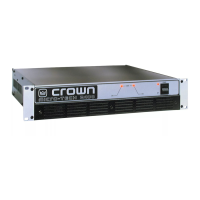
Crown Micro-Tech 1200 Specifications

General IconGeneral
Power Output per Channel (2 ohms)600W
THD< 0.05%
Input Impedance20k ohms balanced, 10k ohms unbalanced
Bridged Mono Output (4 ohms)1200W
Frequency Response20Hz - 20kHz
Input Sensitivity1.4V
Voltage Gain26dB
Dimensions19" x 3.5"
Signal to Noise Ratio>100dB
CoolingFan-cooled

Related product manuals