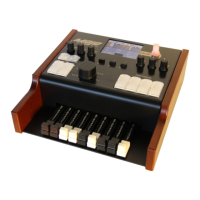
Crumar Seven User s Manual '
STRING DAMPING: Set the amount of damping of all strings, i.e. the loss of higher harmonics during the decay phase.
STRING DETUNING: This parameter adjusts the slight detuning between the strings. In a real grand piano, the three strings of a
note should have the exact same pitch, which however is impossible to obtain so there will always be a slight detuning between
them. This also affects the voicing, adjust it at small steps.
DIRECT SOUND: Adjusts the balance between the sound coming directly from the strings and that coming from the piano
cabinet. A lower value will result in slower loss of amplitude giving the effect of a longer decay, i.e. a nearer sound like putting
your ears directly on the strings; a higher value results in a quicker loss of amplitude, even if the decay time remains unchanged.
RELEASE LENGTH: Adjusts the amount of residual string vibration after each note-off (key is released, damper is off).
HARP HI-PASS: this is an high-pass filter applied to the whole harp, needs to be adjusted in case the voicing tends to give a sound
too resounding.
STRETCH TUNING: Set the amount of stretch tuning. The middle position corresponds to the original tuning table as
recommended by the piano manufacturer.
SYMPATHETIC RESONANCES: Set the amount of sympathetic resonances spread over the whole harp.
KEY NOISE LEVEL: Adjusts the volume of all key noises generated by the hammers.
RELEASE NOISE LEVEL: Adjusts the volume of the noises caused by the dampers muting the strings when a key is released.
PEDAL NOISE LEVEL: Adjusts the volume of the noises generated by the pedals.
FUNDAMENTAL LEVEL: Adjusts the volume of the first harmonic (fundamental) of each note over the rest of the harmonic
content.
CABINET PRESENCE: Adjusts the volume of the resonances and reverberations produced inside the piano cabinet.
CABINET TIMBRE: Adjusts the timbre of the cabinet sound, like modifying its structure and materials.
LID POSITION: Adjusts the position of the piano lid. Lower values correspond to lid completely closed; higher values correspond
to a lid completely removed. The center position corresponds to the lid half open.
DYNAMICS: Adjusts the dynamic response, i.e. the ratio between MIDI velocity and note velocity.
Crumar Seven User's Manual - Page 34


 To Next Page