The lamp goes out when the driver and pas-
senger seat belts are fastened with the ignition
switched on.
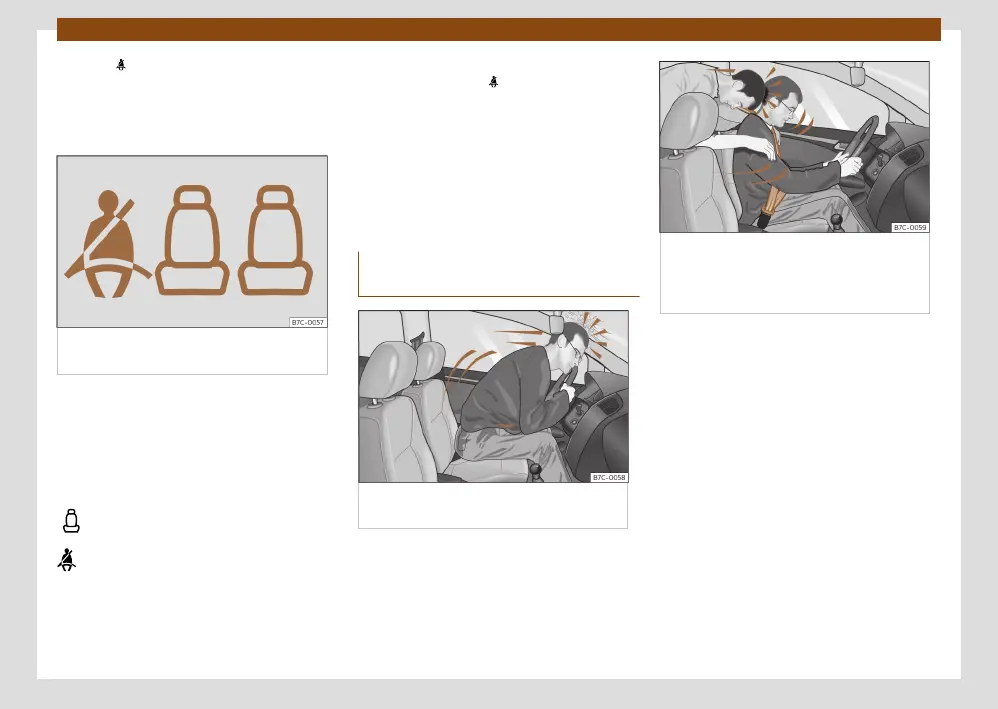
Rear seat belts fastened display
Fig.16 Instrument cluster: indication of
the status of the rear seat seat belts.
Depending on the version of the model, when
the ignition is switched on, the status display
of the belts ›››Fig.16 informs the driver on
the instrument panel display whether the oc-
cupants of the rear seats have their seat belts
fastened.
It indicates that the corresponding seat is
empty.
Indicates that the seat is occupied and the
occupant is wearing the seat belt.
If a rear seat occupant unfastens his/her seat
belt while driving, the symbol lights up for
a maximum of 60 seconds. If you drive faster
than approx. 25 km/h (15 mph), an audio signal
sounds for a few seconds.
If a seat belt is fastened or unfastened while
driving in some of the rear seats, the seat belt
status is displayed for approximately 30 sec-
onds.
Head-on collisions and the laws of
physics
Fig.17 A driver not wearing a seat belt may
be thrown forward violently.
Fig.18 Any rear seat occupants not
wearing a seat belt may be thrown forward
violently, hitting the driver who is wearing
the seat belt.
The eects of the laws of physics in the case
of a head-on collision are easy to explain: the
moment a vehicle starts moving, a type of en-
ergy called “kinetic energy” starts acting on
both the vehicle and its passengers.
The amount of “kinetic energy” depends on
the speed of the vehicle and on the weight of
the vehicle and of its passengers. The higher
they are, the more energy there is to be “ab-
sorbed” in the event of an accident.
The most signicant factor, however, is the
speed of the vehicle. If the speed doubles from
25 km/h (15mph) to 50 km/h (30mph), for
example, the corresponding kinetic energy is
multiplied by four.



 To Next Page