
 Need help?
Do you have a question about the CUSHCRAFT R7 and is the answer not in the manual?
Critical safety warnings regarding electrical hazards and RF exposure during installation and operation.
Guidance on site selection, mast requirements, and coordinating helpers for antenna installation.
Instructions for secure mast mounting and essential system grounding for protection.
Detailed steps for assembling counterpoise brackets using provided hardware and figures.
Procedure for attaching the impedance matching assembly and base components to the radiator bracket.
Instructions for assembling the vertical elements, traps, and tubes according to figure 5.
Steps to attach X-hats, counterpoise rods, and warning labels to the antenna structure.
Guidance on connecting the coaxial feedline, weatherproofing, and attaching the connector boot.
Guidelines for placing the antenna in its final operating location after assembly.
Tips for optimizing performance, avoiding interference, and troubleshooting common issues.
Procedure for tuning the antenna for optimal VSWR on all bands.
Key performance parameters and physical characteristics of the R7 antenna.
Charts showing expected VSWR across frequency bands for tuning reference.
Details of the manufacturer's warranty terms, conditions, and limitations.
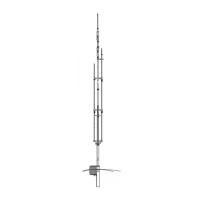
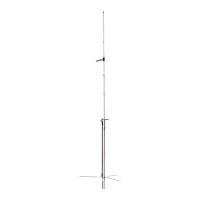
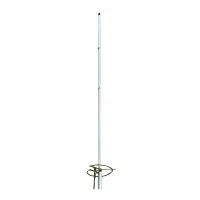
The Cushcraft R7 is a vertical antenna designed for multi-band operation, covering 10, 12, 15, 17, 20, 30, and 40 meters. It is engineered to provide reliable performance for amateur radio enthusiasts, offering an automatic frequency selection feature that simplifies operation across its supported bands. The antenna's design emphasizes ease of assembly and installation, with clear instructions provided to guide users through the setup process.
The primary function of the Cushcraft R7 antenna is to enable radio communication across multiple amateur radio bands. As a vertical antenna, it provides a 360-degree horizontal radiation pattern, making it effective for omnidirectional communication. The antenna utilizes a series of traps and tubing sections to achieve multi-band operation, with each section tuned to a specific set of frequencies. An Impedance Matching Assembly (MN7) is integrated into the base section to ensure efficient power transfer between the transceiver and the antenna, minimizing signal loss and optimizing performance.
The R7's design incorporates counterpoise rods, which are crucial for its electrical operation. These rods act as a ground plane, enhancing the antenna's efficiency and radiation characteristics. The antenna's automatic frequency selection means that users do not need to manually tune the antenna when switching between the supported bands, providing a seamless operating experience. This is achieved through the resonant properties of its various sections and traps, which automatically present a low Standing Wave Ratio (VSWR) to the transceiver on the designated frequencies.
The antenna is designed to handle significant power levels, making it suitable for a wide range of amateur radio transceivers and amplifiers. Its robust construction aims to withstand various environmental conditions, ensuring long-term reliability. The inclusion of warning labels on the counterpoise rods highlights the presence of potentially deadly voltages and currents during operation, emphasizing safety as a critical aspect of its design and usage.
The Cushcraft R7 is designed for straightforward use once installed and adjusted. Its multi-band capability allows operators to access several popular amateur radio bands without the need for multiple antennas or complex tuning procedures. The automatic frequency selection is a key convenience feature, enabling quick band changes from the transceiver.
For optimal performance, the antenna should be mounted vertically and in a clear area, away from obstructions such as buildings, trees, power lines, and other metallic objects. This placement helps prevent degradation of performance, detuning, and increased VSWR. The mast used for mounting should be rigid and straight, with specific diameter requirements (1.5 to 1.75 inches or 3.8 to 4.5 cm) to ensure stability and proper electrical connection. Non-conducting guy wires are recommended if the mast requires additional support.
System grounding is a critical usage feature for both safety and performance. Direct grounding of the antenna mast to one or more ground rods using a #10 AWG ground wire and non-corrosive hardware is essential. This protects against lightning strikes, static buildup, and high voltages. The use of a coaxial lightning arrestor is also recommended for further protection of connected equipment.
The manual provides detailed instructions for adjusting the antenna's VSWR, which is crucial for maximizing efficiency and minimizing power reflected back to the transceiver. Adjustments are made from the bottom sections upwards, as changes in lower sections affect the tuning of higher sections. Users can measure VSWR using their transceiver's built-in meter or a dedicated VSWR bridge. The adjustment process involves lengthening or shortening specific tubing dimensions to shift the frequency of lowest VSWR to the desired operating frequency.
Safety is paramount during operation. Users are warned to ensure that people and pets cannot come into contact with any part of the antenna, including the counterpoise rods, due to the presence of deadly voltages and currents. Long-term exposure to intense RF fields is also discouraged, reflecting general safety guidelines for radio operation.
The Cushcraft R7 is designed for trouble-free service, with several features contributing to its low maintenance requirements. The antenna's construction uses durable materials, such as aluminum tubing and stainless steel hardware, which are selected for their resistance to corrosion and environmental wear.
The manual suggests considering a clear marine varnish or equivalent coating for the antenna if it is installed in a salty or corrosive environment. This proactive measure can help protect the antenna's components from degradation and extend its lifespan, reducing the need for frequent repairs or replacements due to corrosion.
The matching network, housed in a protective box, is designed to be weather-sealed. A large hole near the coax connector allows air circulation to prevent humidity and condensation buildup, which could otherwise affect the internal components. Users are advised to keep this hole clear to maintain proper ventilation.
During assembly, careful attention to tightening all fasteners is emphasized. This ensures secure connections and prevents components from loosening over time due to wind or vibration, which could lead to performance issues or structural failure. Regular checks of these fasteners are recommended as part of routine maintenance.
The counterpoise rods, which are critical for the antenna's performance, require proper installation and secure tightening of their machine screws and nuts. Ensuring good contact between the matching network and these rods is important, and users are advised to check for corrosion on jumper strap terminals if high VSWR is observed.
In cases where RF interference (RFI) is experienced in the shack, the manual suggests simple maintenance-related solutions, such as lengthening the feedline, adding an RF ferrite bead, or winding the feedline into a coil. These steps can help mitigate common RFI issues without requiring complex antenna modifications.
The antenna's design also accounts for potential issues with poor contact between the matching network and counterpoise rods, advising users to check for corrosion on jumper strap terminals and ensure hardware tightness. This highlights the importance of maintaining clean and secure electrical connections throughout the antenna system.
Overall, the Cushcraft R7 is built to be a robust and reliable antenna, with maintenance focused on proper installation, environmental protection, and periodic checks of connections to ensure continued optimal performance.
 General
| Input Impedance | 50 ohms |
|---|---|
| Element Material | Aluminum |
| Type | Vertical |
| Radials | None required |
| Wind Survival | 80 mph (128 km/h) |
| Bandwidth | 300 kHz |
| Wind Surface Area | 5.5 ft² (0.5 m²) |


 To Next Page