Need help?
Do you have a question about the Daewoo KOR-6C0B5S and is the answer not in the manual?
This document is a service manual for a Daewoo Microwave Oven, model KOR-6C0B5S, published in February 2003. It provides comprehensive information for servicing and understanding the device.
The microwave oven is designed for counter-top use only. It operates on a 230V-50Hz single-phase power supply with earthing, consuming 1200W of power. Its microwave energy output is 800W, and it operates at a microwave frequency of 2450MHz. The external dimensions are 465 x 279 x 365 mm (18.3 x 11.0 x 14.4 in), with a cavity measuring 290 x 220 x 306 mm (11.4 x 8.7 x 12.0 in). The net weight is approximately 12.7 kg (27.9 lbs.). The timer can be set for up to 59 minutes and 90 seconds. It offers "MICROWAVE" as a function selection and provides 10 power levels. The cavity volume is 0.7 Cu. Ft.
The manual begins with crucial safety precautions for both operation and servicing. For safe operation, it warns against operating the oven with a broken door hinge, viewing screen, front panel, oven cavity, or a loosened/broken door lock. It emphasizes keeping the door gasket plate and oven cavity clean and not attempting to operate the appliance with the door open or to defeat the concealed switches. For safe service procedures, it mandates a microwave emission check before servicing, especially if the oven is operative or found to be leaking. Any defective interlock, monitor, door seal, or microwave generation/transmission systems must be repaired or replaced according to the manual's procedures. A microwave leakage check is required on each oven before release to the owner.
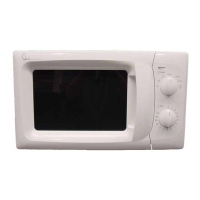
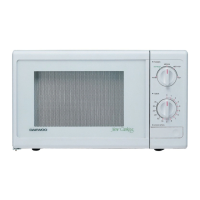
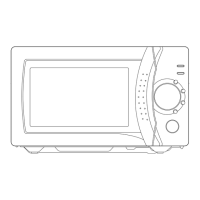
The external view of the oven highlights several key features:
The control panel features:
The wattage output chart details the power levels: P-HI (100%), P-90 (90%), P-80 (80%), P-70 (70%), P-60 (60%), P-50 (50%), P-40 (40%), P-30 (30%), P-20 (20%), P-10 (10%), and P-00 (0%).
Installation guidelines emphasize a steady, flat counter-top location, adequate clearance for air vents, and distance from radios, TVs, heating appliances, and water taps. The power supply requires approximately 6 amperes, 230 Volts, 50 Hz, with a 0.8-meter cord. It warns against using higher voltages and specifies that the cable, if damaged, must be replaced by a qualified person using a DAEWOO-supplied cable. Earthing instructions are provided, stressing the importance of a properly earthed 3-wire extension cord if needed.
Disassembly and assembly procedures are detailed with cautions regarding high-voltage, high-current components. Technicians are advised to always remove the power plug, use insulated tools, discharge the high voltage capacitor, and check grounding. Specific steps are provided for removing the cabinet, door assembly, door parts, and control panel parts. Methods to reduce gaps between the door seal and oven front surface are also described. Removal instructions for high voltage capacitor, magnetron, wind guide assembly, and H.V. transformer are included, with warnings about microwave leakage and high potential parts.
The interlock mechanism and adjustment section explains how the primary and secondary interlock switches, along with the interlock monitor switch, ensure safety by cutting power when the door is opened. Adjustment steps for these switches are provided, emphasizing that a microwave emission test must be performed after adjustment.
The troubleshooting guide covers various scenarios:
Measurement and test procedures include:
The wiring diagram and printed circuit board (PCB) information are also provided. The PCB circuit diagram shows the layout of components, and a circuit check procedure includes low voltage transformer checks and voltage checks at key points (IC1 PIN 14, IC1 PIN 22, IC1 PIN 1 OR 2). Troubleshooting steps related to microwave oscillation and digital clock operation are linked to specific points on the circuit diagram.
The exploded view and parts list provide a detailed breakdown of the oven's components, including door assembly, control panel assembly, and total assembly, with part codes, names, descriptions, and quantities.
Overall, this manual serves as a critical resource for technicians, ensuring safe and effective servicing of the Daewoo KOR-6C0B5S microwave oven.
 General
| Brand | Daewoo |
|---|---|
| Model | KOR-6C0B5S |
| Category | Microwave Oven |
| Language | English |

 To Next Page