
 Need help?
Do you have a question about the Dahua VTH5422HW and is the answer not in the manual?
Introduces the manual's scope and purpose.
Lists the different types of VTH devices covered.
Explains the meaning of various safety signal words used in the manual.
Provides details on past versions and updates of the manual.
Advises users on handling personal data and privacy compliance.
Details critical guidelines for safe and proper device operation.
Outlines essential safety precautions for device installation.
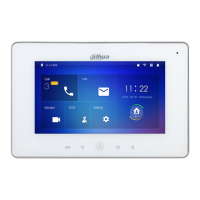
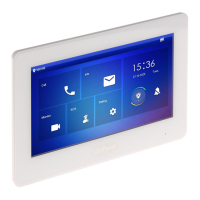
Describes the physical layout and components of the VTH's front interface.
Details the ports and connections available on the 2-wire VTH rear panel.
Details the ports and connections available on the non-2-wire VTH rear panel.
Lists the necessary steps and checks before commencing the installation process.
Provides a step-by-step guide for mounting the VTH onto a wall.
Introduces the software utility used for configuring VTO devices.
Guides users through the initial setup and login process for the VTO.
Explains how to assign a unique identifying number to each VTO.
Explains how to set up network connectivity settings for the VTO.
Describes the process of setting up the SIP server for inter-device communication.
Covers the setup of call numbers and the group call feature for VTOs.
Provides instructions on how to register VTO devices with the SIP server.
Explains how to configure room numbers for VTHs to establish connections.
Lists essential prerequisites and checks before configuring the VTH.
Guides users through a streamlined initial setup process for the VTH.
Details how to manually adjust various configuration parameters for the VTH.
Explains how to set up network parameters for the VTH via WLAN or LAN.
Guides on configuring the SIP server settings for the VTH.
Provides specific steps for configuring the VTH itself.
Details how to configure associated VTO devices within the VTH settings.
Describes the procedure for initiating a call from the VTO to the VTH.
Explains how to use the VTH to monitor the video feed from the VTO.
Covers essential security measures like strong passwords and firmware updates.
Covers optional but beneficial practices like physical protection and secure protocols.
This document serves as a Quick Start Guide for the Digital Indoor Monitor (Model H), referred to as "VTH" throughout the manual. It outlines the basic operations, safety instructions, and configuration procedures for the device, aiming to facilitate a smooth setup and initial use. The VTH is designed to function as an indoor monitor within a digital intercom system, enabling communication and monitoring capabilities.
The Digital Indoor Monitor (VTH) is a core component of an intercom system, primarily designed for indoor use. Its main function is to facilitate communication within a building or complex, allowing users to interact with other VTOs (Villa Door Stations) and VTHs connected to the same SIP server. The VTH supports both 2-wire and non-2-wire configurations, catering to different wiring infrastructures.
One of the primary functions of the VTH is to receive calls from VTOs. When a visitor dials a room number on a VTO, the VTH associated with that room number will receive the call, allowing the resident to answer and communicate with the visitor. This call-receiving capability is central to its role in access control and visitor management.
Beyond receiving calls, the VTH also offers monitoring capabilities. Users can monitor the VTO (door station) from their indoor monitor, providing visual surveillance of the entrance area. This feature enhances security by allowing residents to see who is at the door before granting access. The manual indicates that if an SD card is inserted into the VTH, recording and snapshot functions become available, further augmenting its surveillance capabilities.
The VTH operates within a network environment, connecting to a SIP server that manages communication between all connected VTOs and VTHs. This network integration allows for a comprehensive intercom system where multiple devices can interact seamlessly. The device can be configured to connect to the network via either WLAN (Wi-Fi) or LAN, offering flexibility in installation and connectivity.
Another key function is the ability to configure various parameters of the intercom system directly from the VTH. This includes setting network parameters, configuring SIP server details, and managing VTO and VTH settings. The quick configuration option simplifies the initial setup process, allowing users to configure the VTO, VTH, and SIP server parameters simultaneously. For more advanced or specific adjustments, manual configuration options are available.
The VTH also supports group call functionality when enabled on the SIP server. This means that when a main VTH is called, all extension VTHs will also receive the call, which can be useful in multi-resident units or larger households.
The VTH is designed for user-friendly operation, with a focus on ease of installation and configuration. The quick start guide emphasizes a step-by-step approach to setting up the device, making it accessible even for users with limited technical expertise.
For initial setup, the VTH requires initialization, which involves setting a password for the device. The password policy is robust, requiring a minimum length of 8–32 non-blank characters and a combination of uppercase, lowercase, numbers, and special characters. This ensures a secure initial configuration. The device also allows for an email address to be set for password recovery, adding a layer of convenience and security.
The device's interface, as depicted in the manual's screenshots, appears to be graphical and intuitive, with clear menus for "Local Settings," "Household Setting," "Network," and "Search Log." This structure helps users navigate through the various configuration options efficiently.
Installation of the VTH is designed to be wall-mounted, with a bracket system that simplifies the physical attachment to a wall. The process involves drilling holes, fixing the bracket, and then attaching the VTH to the bracket. This method ensures a secure and stable installation.
Connectivity options are flexible, supporting both Wi-Fi and wired LAN connections. For Wi-Fi, the VTH can either obtain IP information automatically via DHCP (if a router with DHCP function is available) or be configured with a static IP address. Similar options are available for LAN connections. This adaptability allows the VTH to integrate into various existing network infrastructures.
The VTH's ability to act as a SIP server, or connect to an external SIP server, provides versatility in system architecture. When the VTH itself functions as the SIP server, it can manage calls between other VTOs and VTHs, creating a self-contained intercom network. The configuration process for the SIP server involves setting parameters such as IP address, port, username, password, and SIP domain.
Adding room numbers to the SIP server is a crucial step for enabling calls to specific VTHs. The system supports room numbers of up to 6 digits (numbers or letters) and allows for up to 9 extension VTHs for one main VTH, indicated by suffixes like #0 for the main VTH and #1, #2, etc., for extensions. This hierarchical numbering system facilitates organized communication within multi-unit dwellings.
The commissioning section of the manual highlights the core usage scenarios: VTO calling VTH and VTH monitoring VTO. The process of answering a call from a VTO is straightforward, involving a simple tap on the VTH screen. Monitoring a VTO also involves navigating to a "Monitor" section on the VTH's home screen and selecting the "Door" option to view the video feed.
The manual provides several recommendations for maintaining the security and optimal performance of the VTH. These "Important Safeguards and Warnings" and "Cybersecurity Recommendations" are crucial for the long-term reliability and safety of the device.
Regular firmware and client software updates are strongly recommended. The manual advises keeping the device's firmware up-to-date to ensure it has the latest security patches and fixes. For devices connected to a public network, enabling an "auto-check for updates" function is suggested to receive timely information about new releases from the manufacturer. Users are also encouraged to download and use the latest version of client software.
Password management is a key maintenance aspect. The manual stresses the importance of using strong passwords that meet specific criteria (length, character types, avoidance of common patterns) and changing them regularly to mitigate the risk of unauthorized access. The device's password reset function, which can be linked to an email address or security questions, is a useful feature for recovery, provided the information is kept up-to-date and secure.
Physical protection of the device, especially storage devices, is also highlighted. Recommendations include placing the device in a secure location like a computer room or cabinet and implementing access control to prevent unauthorized physical contact, which could lead to hardware damage or unauthorized connection of removable devices.
Network security is extensively covered. The manual advises disabling unnecessary services (e.g., SNMP, SMTP, UPnP) to reduce potential risks and, if necessary, using secure modes for essential services (e.g., SNMP v3 with strong encryption, TLS for SMTP, SFTP for FTP, WPA2-PSK for AP hotspot). Encrypted transmission for audio and video data is recommended for sensitive content, though it might cause some loss in transmission efficiency.
Secure auditing features are available, allowing users to check online users and device logs. Regularly reviewing online users helps identify unauthorized logins, while checking device logs provides insights into IP addresses used to access the device and key operations performed. For long-term log storage, enabling the network log function to synchronize critical logs to a network log server is suggested.
Finally, constructing a safe network environment is crucial. Recommendations include disabling port mapping on routers to prevent direct external access to intranet devices, partitioning and isolating networks using VLANs or network gaps, establishing 802.1x access authentication, and enabling IP/MAC address filtering to restrict device access to authorized hosts. These measures collectively contribute to a robust and secure operational environment for the VTH.
 General
| Video Compression | H.264 |
|---|---|
| Display | 7-inch touchscreen |
| Resolution | 1024 x 600 pixels |
| Connectivity | Wired |
| Audio | Built-in speaker and microphone |
| Power Supply | DC 12V |
| Ethernet | 10/100Mbps |
| Operating Temperature | -10°C to +55°C |
| Operating Humidity | 10%–95% (RH) |
| Network Interface | RJ45 |
| Supported Protocols | TCP/IP |
| Audio Compression | G.711 |
| OSD Language | Multi-language |
| Certifications | CE, FCC |


 To Next Page