OMM 1130 79
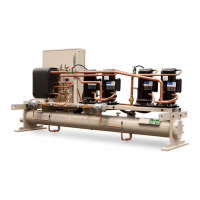
All tandem and triple compressors on WGZ units come equipped with oil equalization lines connecting
the crankcase of each set of compressors in each refrigerant circuit. This allows the oil to move from one
compressor crankcase to the other during normal operation, and balance between the two when the
compressors are off. The oil sight glass is located in the equalization line on one circuit of the WGZ070
and both circuits of WGZ080 through WGZ100. All other models have the oil sight glass in the
compressor body. In either case, the oil level should be 1/4 to 1/3 of the glass.
The units are factory-charged with lubricant and one of the following lubricants must be used if lubricant
is to be added to the system:
Copeland Ultra 22 CC
Mobil EAL Arctic 22 CC
ICI EMKARATE RL RL 32CF
Since POEs are very hygroscopic, they will quickly absorb moisture if exposed to air. Pump the lubricant
into the unit through a closed transfer system. Avoid overcharging the unit.
Oil can be added to the Copeland compressor through the oil fill hole in the crankcase. Special
equipment is required to add oil and the work should be done by qualified refrigeration technicians with
the proper training and equipment.
!
WARNING
This unit contains POE lubricants that must be handled carefully and the proper protective equipment (gloves,
eye protection, etc.) must be used when handling POE lubricant. POE must not come into contact with any
surface or material that might be harmed by POE, including certain polymers (e.g. PVC/CPVC and
polycarbonate piping).
Sightglass and Moisture Indicator
The refrigerant sight glasses should be observed periodically. A monthly observation should be
adequate. A clear glass of liquid indicates that there is adequate refrigerant charge in the system to
provide proper feed through the expansion valve. The sight glass should be clear when:
Ambient temperature is above 75F (23C)
Both compressors on a circuit are running
All fans on a circuit are running
Bubbling refrigerant in the sight glass may occur at other conditions and may indicate that the system
is short of refrigerant charge. Refrigerant gas flashing in the sight glass could also indicate an
excessive pressure drop in the line, possibly due to a clogged filter-drier or a restriction elsewhere in
the system. An element inside the sight glass indicates what moisture condition corresponds to a given
element color. If the sight glass does not indicate a dry condition after about 12 hours of operation, the
unit should be pumped down and the filter-driers changed.
If the system is suspected of being short of refrigerant, a qualified service technician with EPA
certification should be contacted to thoroughly check out the unit and add refrigerant if necessary.
Crankcase Heaters
The compressors are equipped with crankcase heaters. The function of the heater is to keep the
temperature in the crankcase high enough to prevent refrigerant from migrating to the crankcase and
condensing in the oil during off-cycle. When a system is to be started up initially, the power to the
heaters should be turned on for at least 12 hours before the compressors are started. The crankcase
should be up to about 80°F (26.7°C) before the system is started up, to minimize lubrication problems
or liquid slugging of compressor on start-up.
If the crankcase is cool (below 80°F) (26.7°C) and the oil level in the sight glass is full to top, allow
more time for oil to warm before starting the compressor. The crankcase heaters are on whenever
power is supplied to the unit and the compressor is not running.


 To Next Page