16
When the heat pump is in the cooling cycle, it operates
exactly as a Summer Air Conditioner unit. In this mode,
all the charts and data for service that apply to summer
air conditioning apply to the heat pump. Most apply on
the heating cycle except that “condenser” becomes
“evaporator”, “evaporator” becomes “condenser”, “cooling”
becomes “heating”.
The heat pump operates in the heating cycle by redirecting
refrigerant ow through the refrigerant circuit external to
the compressor. This is accomplished with through the
reversing valve. Hot discharge vapor from the compressor
is directed to the indoor coil (evaporator on the cooling
cycle) where the heat is removed, and the vapor
condenses to liquid. It then goes through the expansion
device to the outdoor coil (condenser on the cooling cycle)
where the liquid is evaporated, and the vapor goes to the
compressor.
When the solenoid valve coil is operated either from
heating to cooling or vice versa, the piston in the reversing
valve to the low pressure (high pressure) reverse positions
in the reversing valve.
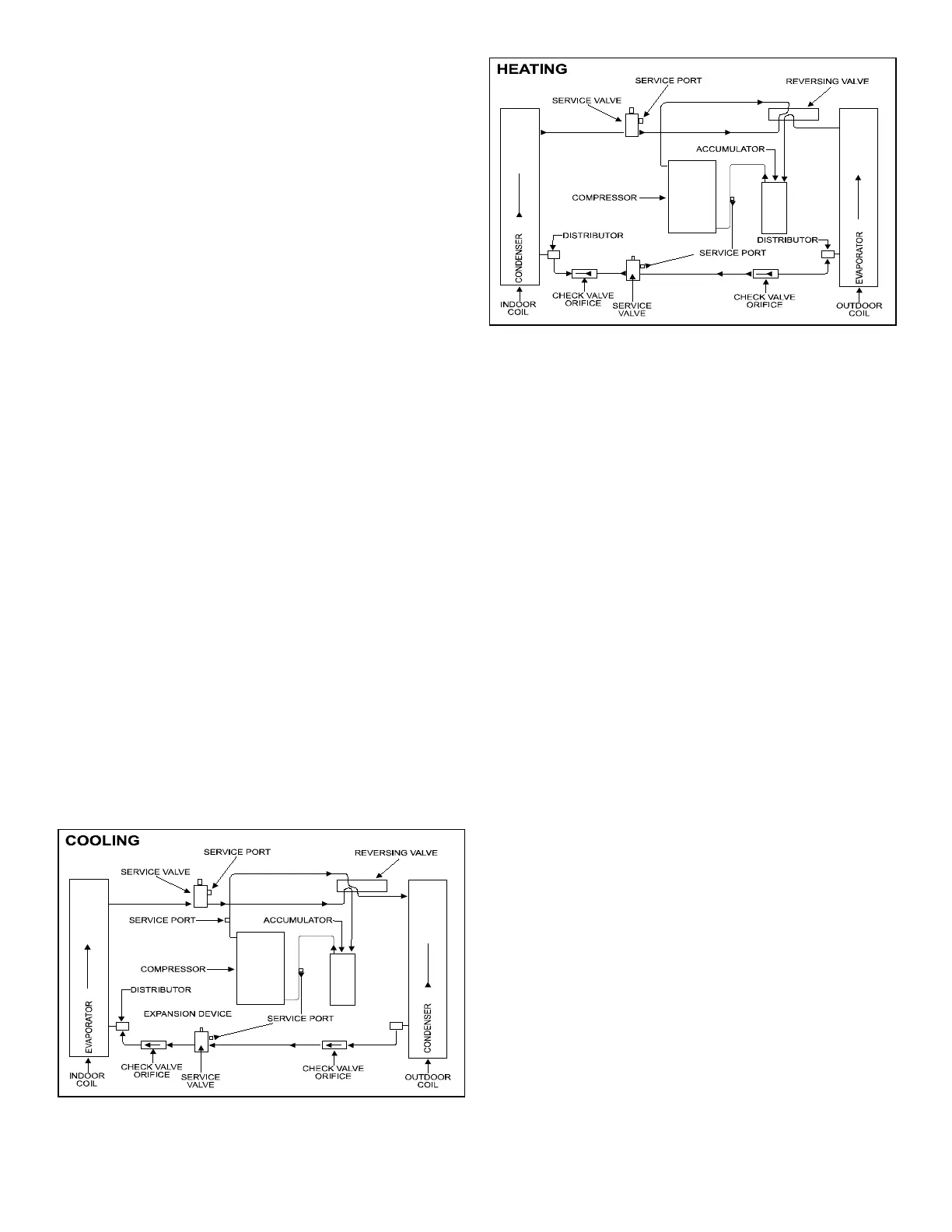
The following gures show a schematic of a heat pump
on the cooling cycle and the heating cycle. In addition
to a reversing valve, a heat pump is equipped with an
expansion device and check valve for the indoor coil, and
similar equipment for the outdoor coil. It is also provided
with a defrost control system.
The expansion devices are owrator distributors and
perform the same function on the heating cycle as on the
cooling cycle. The owrator distributors also act as check
valves to allow for the reverse of refrigerant ow.
When the heat pump is on the heang cycle, the outdoor
coil is funconing as an evaporator. The temperature
of the refrigerant in the outdoor coil must be below
the temperature of the outdoor air in order to extract
heat from the air. Thus, the greater the dierence in the
outdoor temperature and the outdoor coil temperature,
the greater the heang capacity of the heat pump. This
phenomenon is a characterisc of a heat pump. It is
a good pracce to provide supplementary heat for all
heat pump installaons in areas where the temperature
drops below 45° F. It is also a good pracce to provide
sucient supplementary heat to handle the enre heang
requirement should there be a component failure of the
heat pump, such as a compressor, or refrigerant leak, etc.
Since the temperature of the refrigerant in the outdoor
coil on the heang cycle is generally below freezing point,
frost forms on the surfaces of the outdoor coil under
certain weather condions of temperature and relave
humidity. Therefore, it is necessary to reverse the ow
of the refrigerant to provide hot gas in the outdoor coil
to melt the frost accumulaon. This is accomplished by
reversing the heat pump to the cooling cycle. At the same
me, the outdoor fan stops to hasten the temperature
rise of the outdoor coil and lessen the me required for
defrosng. The indoor blower connues to run and the
supplementary heaters are energized.
Note: DBH models have one stage of mechanical heang.
The defrost accumulaon period will start when either
rst or second stage defrost thermostat closes. Defrost
terminaon occurs when both thermostats open or the 10
minute cycle has completed.



 To Next Page