www.DaikinApplied.com 87 IM 1287-6 • REBEL APPLIED ROOFTOP
R-32 Guidelines (R-32 Units
Only)
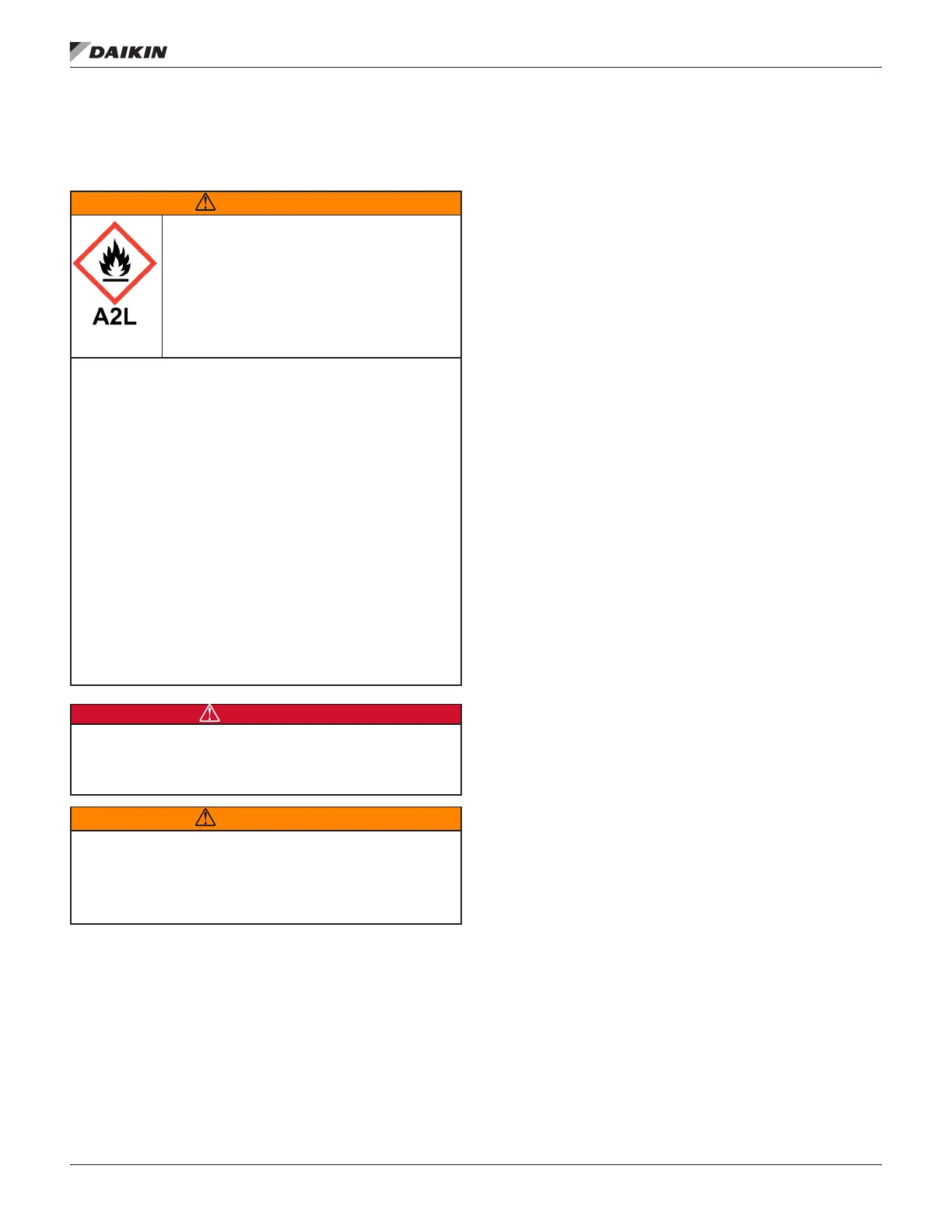
WARNING
This unit contains R-32, a class A2L refrigerant that is
ammable. This unit should only be installed, serviced,
repaired, and disposed of by qualied personnel
licensed or certied in their jurisdiction to work with R-32
refrigerant. Installation and maintenance must be done
in accordance with this manual. Improper handling of
this equipment can cause personal injury or equipment
damage.
Be aware that R-32 refrigerant may not contain an odor. Place in a well
ventilated area to prevent accumulation of refrigerant. Excessive refrigerant
leaks, in the event of an accident in a closed ambient space, can lead to
oxygen deciency.
Do not pierce or burn this unit.
Never use an open ame during service or repair. Never store in a room
with continuously operating ignition sources (for example: open ames, an
operating gas appliance, or and operating electric heater), where there is
ignitable dust suspension in the air, or where volatile ammables such as
thinner or gasoline are handled.
Only use pipes, nuts, and tools intended for exclusive use with R-32
refrigerant in compliance with national codes (ASHRAE15 or IRC).
Do not mix air or gas other than R-32 in the refrigerant system. If air enters
the refrigerant system, an excessively high pressure results, which may
cause equipment damage or injury.
Do not use means to accelerate the defrosting process or to clean, other
than those recommended by the manufacturer.
DANGER
LOCKOUT/TAGOUT all power sources prior to servicing the unit or opening
any panels or doors. This Appliance is equipped with a Refrigerant Leak
Detection system and the system components such as supply fans may
begin operation unexpectedly and without warning.
WARNING
The appliance is designed to activate leak mitigation airow in the event a
refrigerant leak is detected. This is required to ensure dilution and prevent
stagnation of any leaked refrigerant. Always ensure the supply fans are able
to operate freely. Always maintain proper airow and do not allow lters, air
inlets, or air outlets to become blocked.
Safety Considerations
This unit is equipped with an A2L (R32) refrigerant and
a Refrigerant Leak Detection and Mitigation system. In
the unlikely event of a refrigerant leak the unit may take
mitigation actions such as activating dilution airow or
disabling certain unit functions. For full details on the
mitigation modes and sequence of operation please
refer to the literature for the unit controller and A2L
mitigation control board. For connection to customer
control systems or a Building Management System a
eld connection is provided with the unit controls. Please
refer to the unit specic electrical schematic for the
connection details.
Maintaining and servicing R-32 refrigerant should only
be performed as recommended by this manual and by
personnel licensed or certied in their jurisdiction to
handle A2L refrigerants under a controlled procedure.
Dismantling the unit and treatment of the refrigerant, oil,
and additional parts must be done in accordance with
the relevant local, state, and national regulations.
Only use tools meant for use on R-32 refrigerant, such
as a gauge manifold, charge hose, gas leak detector,
reverse ow check valve, refrigerant charge base,
vacuum gauge, or refrigerant recovery equipment.
Field Installation Considerations
All Field installed or modied refrigerant containing
pipe-work including piping material, pipe routing,
and installation shall include protection from physical
damage in operation and service, and be in compliance
with national and local codes and standards, such as
ASHRAE 15, ASHRAE 15.2, IAPMO Uniform Mechanical
Code, ICC International Mechanical Code, or CSA B52.
All eld joints shall be accessible for inspection prior to
being covered or enclosed.
After completion of any eld installed piping for split
systems the pipework shall be pressure tested with an
inert gas and vacuum tested prior to being charged with
refrigerant per the following procedure:
1. The minimum test pressure for the low side of the system
shall be the low side design pressure and the minimum
test pressure for the high side of the system shall be
the high side design pressure, unless the high side of
the system, cannot be isolated from the low side of the
system in which case the entire system shall be pressure
tested to the low side design pressure.
2. Field-made refrigerant joints indoors shall be tightness
tested. The test method shall have a sensitivity of 5
grams per year of refrigerant or better under a pressure
of at least 0.25 times the maximum allowable pressure.
No leak shall be detected.


 To Next Page
 Loading...