7 | Piping installation
Installer reference guide
39
RXTJ-A_RXTA-C_RXTM-A_RXTP-A
R32 split series
4P728168-1 – 2023.03
NOTICE
▪ Connect the vacuum pump to the service port of the gas stop valve.
▪ Make sure that the gas stop valve and liquid stop valve are firmly closed before
performing the leak test or vacuum drying.
7.3.3 To check for leaks
NOTICE
Do NOT exceed the unit's maximum working pressure (see "PS High" on the unit
name plate).
NOTICE
ALWAYS use a recommended bubble test solution from your wholesaler.
NEVER use soap water:
▪ Soap water may cause cracking of components, such as flare nuts or stop valve
caps.
▪ Soap water may contain salt, which absorbs moisture that will freeze when the
piping gets cold.
▪ Soap water contains ammonia which may lead to corrosion of flared joints
(between the brass flare nut and the copper flare).
1 Charge the system with nitrogen gas up to a gauge pressure of at least
200kPa (2bar). It is recommended to pressurize to 3000kPa (30bar) in order
to detect small leaks.
2 Check for leaks by applying the bubble test solution to all connections.
3 Discharge all nitrogen gas.
7.3.4 To perform vacuum drying
DANGER: RISK OF EXPLOSION
Do NOT open the stop valves before the vacuum drying is finished.
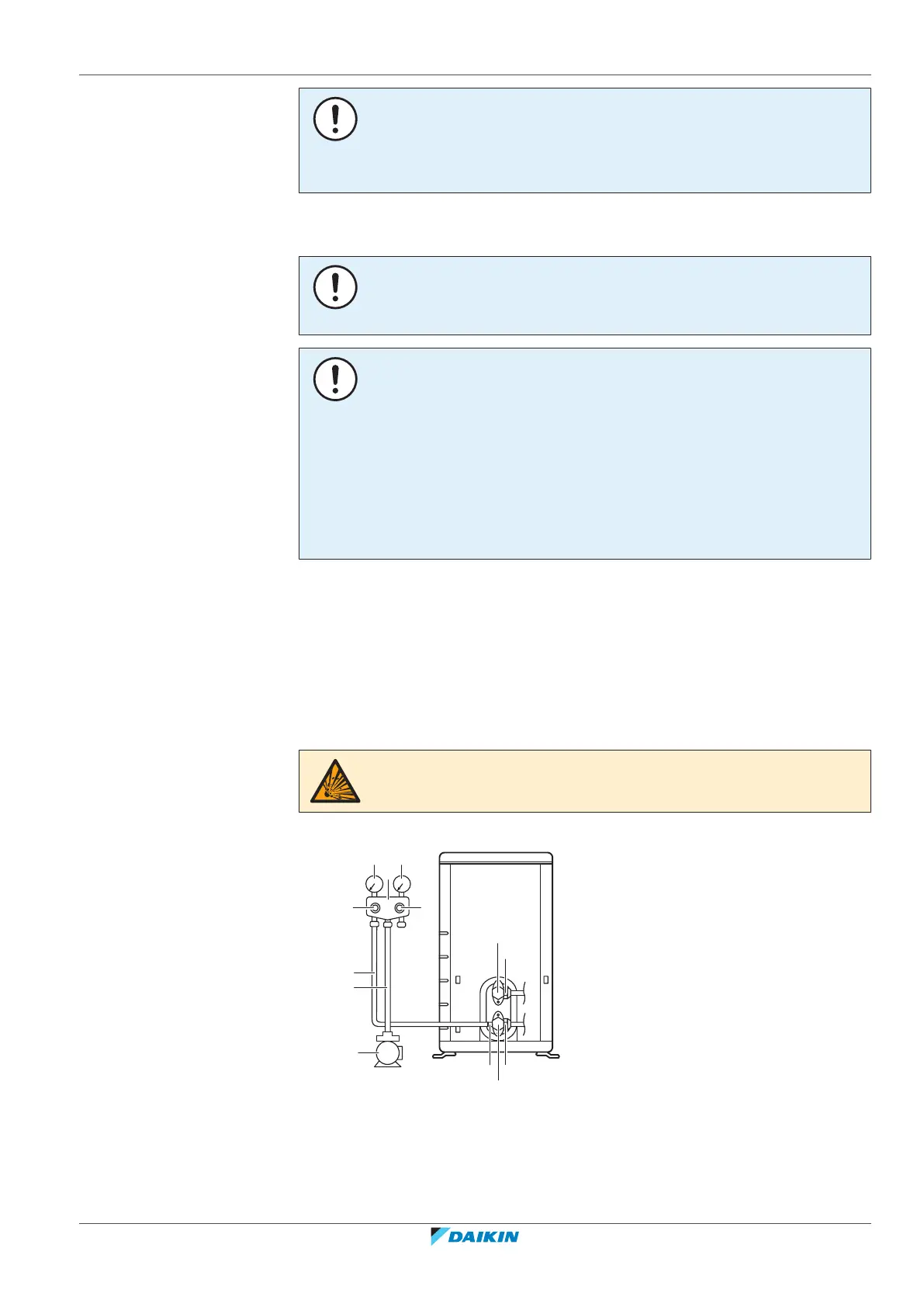
Connect the vacuum pump and manifold as follows:
a Low pressure gauge
b Gauge manifold
c High pressure gauge
d Low-pressure valve (Lo)
e High-pressure valve (Hi)
f Charging hoses





 To Next Page