IOM 1322 • WATER-COOLED SCROLL COMPRESSOR 12 www.DaikinApplied.com
Condenser Water Piping
Arrange the condenser water so the water enters the bottom
connection of the condenser. The condenser water will
discharge from the top connection. Failing to arrange the
condenser water as stated above will negatively aect the
capacity and eciency.
Water ow through the condenser should only be during
compressor operation. Pumps may be enabled by the chiller or
BAS.
Field installed water piping to the condenser must include:
• Install a cleanable strainer with perforations no larger
than 0.125” (3.2 mm) diameter in the inlet piping .
• Install pressure gauges in the inlet and outlet water lines
to the condenser. Pressure drop through the condenser
should be measured to determine ow on the pressure
drop/ow curves beginning on page 19.
It is recommended that the eld installed water piping to the
chiller include:
• Vibration eliminators are recommended in both the supply
and return water lines to reduce vibration and noise
transmissions to the building.
• A preliminary leak check of the water piping should be
made before lling the system.
• Shuto valves to isolate the unit from the piping system
during unit servicing.
• Regular water analysis and chemical water treatment
on the condenser is recommended immediately upon
equipment start-up.
Condensers are drained of water in the factory and are shipped
with the condenser drain plugs in the heads removed and
stored in a bag in the control panel. Be sure to replace plugs
prior to lling the vessel with uid.
Water-cooled condensers can be piped for use with cooling
towers, well water, or heat recovery applications. Cooling
tower applications must be made with consideration of freeze
protection and scaling problems. Contact the cooling tower
manufacturer for equipment characteristics and limitations
for the specic application. Head pressure control must
be provided if the entering condenser water can fall below
60°F. The WGZ condenser has two refrigerant circuits with a
common condenser water circuit. This arrangement makes
head pressure control with discharge pressure actuated control
valves dicult.
If the tower water temperature cannot be maintained at a
60°F minimum, or when pond, lake, or well water that can fall
below 60°F (15°C) is used as the condensing medium, special
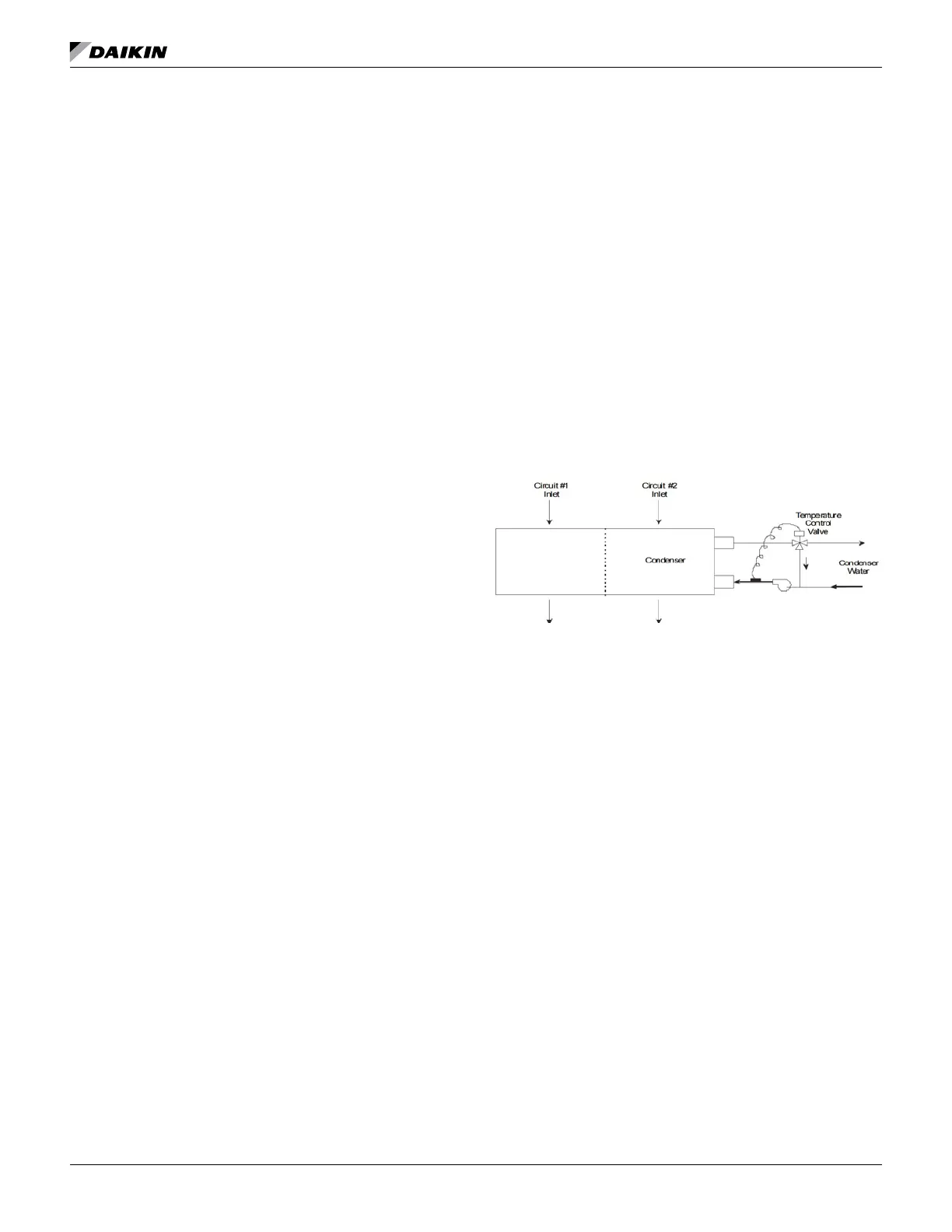
discharge pressure control must be used. A water recirculating
system with recirculating pump as shown in Figure 5:
Recirculating Discharge Water System is recommended. This
system also has the advantage of maintaining tube velocity to
help prevent tube fouling. The pump must cycle with the chiller.
Figure 5: Recirculating Discharge Water System


 To Next Page