Need help?
Do you have a question about the Datum Systems M7LT Series and is the answer not in the manual?
Explains M7, M7L, M7LT designations and EIA vs RS standards.
Details safety testing compliance and power requirements.
Lists EMC standards (FCC, ETSI) and required precautions.
Describes the M7 series modems, their capabilities, modular design, and chassis.
Discusses Point-to-Point, Point-to-Multipoint, and Mesh network configurations.
Details the two IF variations (50-180MHz and L-Band) for the M7 series.
Overview of available interface cards like Serial, IP, Ethernet, G.703, HSSI.
Describes the standard baseband interface supporting multiple serial standards.
Explains the IP interface card with an embedded Linux computer for routing.
Details the Layer 2 Gigabit Ethernet bridged interface with multiple ports.
Describes the legacy interface for Telephony and Cellular Backhaul applications.
Covers the HSSI card for high-speed synchronous serial data rates.
Explains the Automatic Uplink Power Control channel for maintaining Eb/No.
Details Viterbi, TCM, TPC, and LDPC FEC types and their characteristics.
Describes the built-in 1:1 redundancy mode for automatic backup protection.
Instructions for carefully unpacking the modem and checking contents.
Guidance on rack mounting, ventilation, and ambient temperature.
Details rear panel connectors for power, IF, and data interfaces.
Information on installing and configuring various data interface cards.
Procedure for installing or replacing interface option cards.
Describes the installation of the Turbo Product Codes FEC option card.
Explains how to operate and monitor the modem using control interfaces.
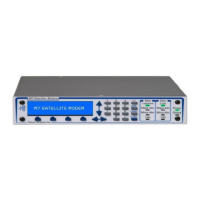
Overview of the front panel layout including LEDs, keypad, and LCD display.
Explains how to navigate and control modem parameters via the front panel.
Guide to operating the modem using a web browser interface.
Details the parameter matrices available on the front panel for monitoring and control.
Explains controlling the modem via a packet-based message protocol using RS-485/RS-232.
Essential steps for configuring modem operating parameters before service.
Describes the built-in Automatic Uplink Power Control modes and functions.
Details the setup and operation of the 1:1 redundancy mode for automatic backup.
States that the modem requires no mandatory periodic field maintenance.
Procedures for initial modem checkout and testing after installation.
Explains built-in test modes like Loopback and BERT for verifying performance.
Lists common problems, symptoms, possible causes, and actions for resolution.
Instructions on how to update the M7 modem firmware via Web Browser or SD card.
Process for upgrading the modem's capabilities using a feature code.
Provides answers to common questions regarding setup, operation, and compatibility.
 General
| Brand | Datum Systems |
|---|---|
| Model | M7LT Series |
| Category | Modem |
| Language | English |


 To Next Page