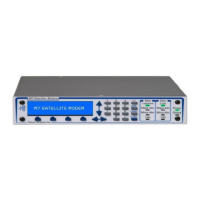
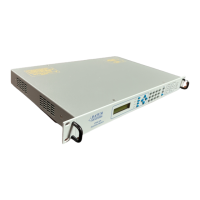
M7/M7L/M7LT Modular Satellite Modem Maintenance
M7/M7L/M7LT - Rev. 0.05 4-7
4.4.2. Symptom: The Modem acquires a carrier but loses lock intermittently.
Possible Cause: Receive acquisition range set too narrow. When the carrier drifts outside of the
acquisition range the demodulator loses lock until the carrier returns inside the acquisition range.
Action: Check the actual receive carrier frequency and the receive offset at the front panel and
set the acquisition range appropriately.
Possible Cause: Receive level varying out of AGC range.
Action: Check the actual receive input level at the front panel. Change the carrier input level to
within the correct range. In Ku–Band systems, please note that rain fade can cause significant
receive level variance.
Possible Cause: Transmit or Receive Converter equipment noisy.
Action: The dependence up good phase noise in converter equipment is especially noticeable at
low data rates and when using QPSK modulation. Very low frequency phase noise on the
converter oscillators is very difficult to see or measure, but is detrimental to proper low data rate
performance. Substitution of another modem will verify the correct modem functioning.
4.4.3. Symptom: The Modem output data is corrupted.
Possible Cause: Receive data or clock inverted.
Action: Check the current state of the Demod Clock and Data Phase. Try inverting the phase.
Possible Cause: Receive Carrier signal Eb/No is too low resulting in poor BER performance.
Action: Ensure that the transmit end is properly set and that the receive subsystems are all
operating correctly. In a small station ensure that the antenna is “peaked” on the satellite. In a Ku-
Band station, intense rain can cause poor receive performance.
Possible Cause: Transmit and Receive scrambler or differential encoder options do not match or
not enabled. Note – The differential encoder in the M7 is under processor control only, but this
cause could apply to a mixed system linked to another modem.
Action: Check the current state of the Scrambler and differential encoder. In all operating
systems the differential encoder/decoder and one of the available scramblers must be enabled.
4.4.4. Symptom: The Modem receive FIFO buffer indicates “Slip”.
Possible Cause: The FIFO automatically re-centers when an overrun or under-run condition
occurs.
Action: Check that the proper clocking options are used and the FIFO buffer is set large enough
to handle the expected satellite Doppler shift over a 24 hour period. No amount of buffering will
correct for different clocks on the input and output of the FIFO.
4.4.5. Symptom: Receive DTE equipment indicates “clock slip” or “sync lost”.
Possible Cause: The FIFO automatically re-centers when an overrun or under-run condition
occurs.
Action: Check that the proper clocking options are used and the FIFO buffer is set large enough
to handle the expected satellite Doppler shift over a 24 hour period. No amount of buffering will
correct for different clocks on the input and output of the FIFO.
Possible Cause: Receive signal or clock inverted.
Action: Check the current state of the Demod Clock Phase. Try inverting the phase.



 To Next Page