
 Need help?
Do you have a question about the Davey Silensor SLS100 and is the answer not in the manual?
Highlights quiet operation, water-cooled motor, overload protection, and testing.
Mount on a firm, well-drained base, accessible for service, close to water.
The pump should be protected from the weather.
Connect to 240V 50Hz supply via 3-pin plug; use RCD protection; avoid extension cords.
Adhere to AS3000 wiring; check ABS compatibility; ensure isolation switch.
Use specified PVC pipes and hand-tighten barrel unions. Ensure suction piping is air-tight.
Prime by filling the strainer basket with water before initiating operation.
Maintain water level, ensure strainer is full, and avoid running the pump dry.
Steps for safely switching off, opening, emptying, and reassembling the strainer basket.
Failure to perform regular maintenance may lead to damage not covered by warranty.
Diagnose and resolve problems related to reduced or no water flow.
Troubleshoot issues where the pump fails to start or operate.
Instructions for safely disconnecting the pump from the plumbing system.
Guidelines for maintaining optimal pool/spa water chemistry for pump health.
Connect to 400V supply using specific overloads; check motor rotation direction.
Emphasizes that power connections and wiring must be performed by an authorised electrician.
Covers hazardous suction, chemical use, child safety, and suction entrapment risks.
Check gauges, inlets, skimmers, drains, and wiring condition as part of routine care.
Pool pumps must be installed according to AS3000 wiring rules or equivalent.
A damaged supply cord must be replaced by the manufacturer or qualified personnel.
Details coverage for faulty materials/manufacture within three years, excluding wear, misuse, and negligence.
Instructions on how to claim under warranty and contact customer service for support.
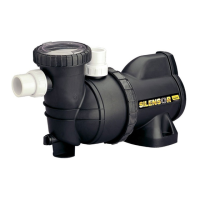
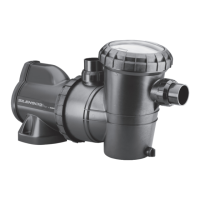
This document provides installation and operating instructions for the Davey Silensor pool and spa pump, available in single-phase and 400V three-phase models. The Silensor is designed to circulate swimming pool and spa water, adhering to Australian Standard AS 3633 or equivalent water quality conditions.
The Davey Silensor pump is engineered for quiet operation and maximum water flow. It features a water-cooled motor with built-in manual overload protection and an automatic thermostat to prevent overheating and 'dry run' damage. The pump is double insulated to the water circuit, and an equipotential bonding point is provided if required by local wiring standards.
The pump's design ensures efficient performance, with the motor and pumping end matched for optimal quietness. Its innovative water-cooled motor contributes to its longevity and reliability. The Silensor incorporates dry run protection, which requires a power supply reset if activated, helping to prevent potential damage from running without water.
For three-phase models, the pumps are designed for connection to a nominal 400V power supply and must be wired with a contactor with 'quick-trip' overloads set at 4.3 amps. Davey recommends using overloads capable of detecting "single phasing" or "dropped phase" conditions in the power supply. These three-phase motors do not include capacitors in the capacitor cover.
The Silensor is suitable for connection to a nominal 240 volt 50Hz power supply for single-phase models, equipped with a flex lead and a 3-pin plug. If a power outlet is not within 3 meters, an electrician should install one in a safe, dry location. Extension cords are not recommended around pools.
The pump should be located as close to the water as practicable, on a firm, well-drained base, elevated to prevent flooding. It is crucial for the installer/owner to ensure the nameplate is easily readable and the pump is accessible for service. Weather protection for the pump is also recommended.
Before starting the pump, ensure all pipework is correctly sealed, the pool/spa water level is at the correct height, and all appropriate valves are open, allowing free water flow. To prime the pump, remove the strainer basket lid, fill the basket area with water, and replace the lid, ensuring a seal on the large O-ring. After connecting to the power supply and switching on, allow the pump to run to expel trapped air. If prime is not established within two minutes, switch off the pump and repeat the procedure. Persistent air under the strainer basket lid indicates an air leak in the suction piping, which must be rectified to prevent pump damage.
For optimal performance, the strainer basket housing should always be full of water and free of air bubbles. The pool's water level should be maintained at least halfway up the skimmer box to ensure the pump always contains water. Re-priming may be necessary from time to time.
When connecting pipes, the pump uses applicable barrel unions designed to accept PVC pipes, fitting either inside or outside the union tail. Barrel unions should be hand-tightened without sealants, glues, or silicones. Using pipes smaller than specified is not recommended, and suction piping should be free of air leaks, humps, and hollows. The discharge piping connects to the swimming pool filter's inlet.
For three-phase models, ensure correct wiring into the mains 3-phase power. Check the pump's rotation by removing the bolt and washer from the rear, then the rear pump cover. Connect to power briefly to confirm the motor shaft turns clockwise, indicated by an arrow on the rear end shield. If rotation is incorrect, change any two power leads at the motor terminals. Carefully reassemble the wiring and covers, ensuring no wires are pinched.
Regular maintenance is crucial for the pump's longevity and personal safety. A weekly checklist includes:
The strainer basket should be inspected frequently through its transparent lid and emptied when debris accumulates. To do this, switch off the pump, close all pipework valves, unscrew the strainer basket lid anti-clockwise, and remove it. Lift the basket from its housing, empty trapped refuse, and hose it out. Check the basket for cracks before replacing it. Replace the lid, ensuring it seals on the large rubber O-ring; firm hand tightness is sufficient. The O-ring and thread can be lubricated with Hydra slip or equivalent products. Finally, open all valves in the pipework.
Maintaining balanced water chemistry is vital for the pump's life. The pump is designed for use with pool and spa water balanced according to the Langlier Saturation Index, with a pH level between 7.2 and 7.8. It should be regularly treated with a chlorine sanitizing agent, with levels not exceeding 3000ppm. Salt levels should be maintained between 4000ppm and 6000ppm. Regular water testing by a local pool shop is recommended.
If the pump needs to be removed from pipework, first switch off the power and unplug it. If wired into a time clock or automatic control, a qualified electrician must remove the wiring. Close water valves on the pool return and pump inlet pipework. Remove discharge and suction barrel unions, taking care not to lose the O-rings. Move the pipework with the barrel unions attached until the pump can be pulled clear. When making inquiries about the Silensor, always quote the model number from the nameplate on the motor.
 General
| Model | SLS100 |
|---|---|
| Category | Swimming Pool Pump |
| Application | Residential and commercial swimming pools |
| Power | 0.75kW |
| Horsepower | 1 HP |
| Voltage | 220-240V |
| Frequency | 50Hz |
| Inlet Size | 50mm |
| Outlet Size | 50mm |
| Inlet/Outlet Size | 50mm |
| Noise Level | 55 dBa |




 To Next Page