
 Need help?
Do you have a question about the DaytonAudio SA70 and is the answer not in the manual?
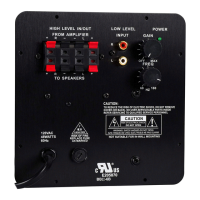
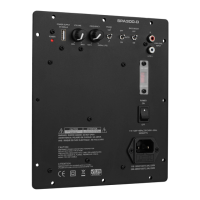
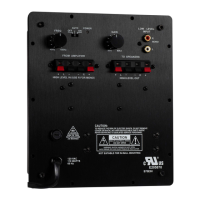
RCA jacks for standard line level stereo inputs, combined internally to mono.
Speaker level inputs using spring clip jacks for bare wire connection.
Speaker level passthrough outputs for connecting to main speakers.
Hardwired AC power cable and externally-accessible fuse for 120 VAC, 60 Hz.
Adjusts amplifier input sensitivity to match the pre-amp source for optimal level.
Sets the highest frequency for subwoofer reproduction (60-180 Hz).
Controls power modes (On, Off, Auto) and indicates operational status.
Connects amplifier output to the subwoofer driver with color-coded wires.
Precautions against electric shock, including not removing covers or exposing to moisture.
Ensures proper airflow and placement away from heat sources and potential cord damage.
The Dayton Audio SA70 Subwoofer Plate Amplifier is a robust and versatile audio component designed to enhance the low-frequency performance of home stereo, home theater, and multimedia audio systems. This amplifier is engineered to deliver high-quality sound reproduction, providing years of reliable operation for compact subwoofers.
The primary function of the SA70 is to power a subwoofer driver, integrating it seamlessly into an existing audio setup. It takes audio signals from various sources, amplifies them, and outputs the amplified signal to the subwoofer, thereby extending the system's bass response. The amplifier is designed to handle both line-level and speaker-level inputs, offering flexibility in connection to almost any audio system. It features a built-in low-pass crossover, which is crucial for ensuring a smooth and clean transition between the subwoofer's output and the main speakers' frequency response. This prevents the subwoofer from reproducing frequencies that should be handled by the main speakers, resulting in a more coherent and balanced soundstage.
A key feature of the SA70 is its comprehensive internal protection circuitry. This includes safeguards against common issues such as shorted speaker loads, thermal faults, and overload conditions. These protection mechanisms ensure the longevity and reliability of the amplifier, preventing damage to both the amplifier itself and the connected subwoofer driver. The amplifier also incorporates an auto-on/off circuit, which is activated by the presence or absence of an input signal. This intelligent power management feature conserves energy by automatically placing the amplifier in standby mode when no audio signal is detected for a period, and then powering it on instantly when a signal is present.
The SA70 utilizes a robust TDA7294 IC-based Class AB topology, which is known for its efficiency and sound quality. This design choice contributes to the amplifier's ability to deliver powerful and clear bass without excessive heat generation.
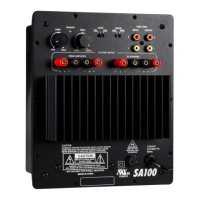
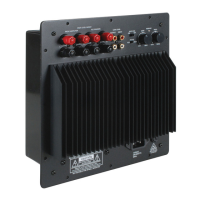
The SA70 offers a variety of input and output options, making it adaptable to different system configurations.
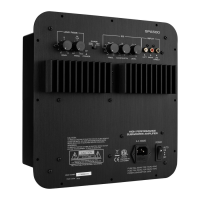
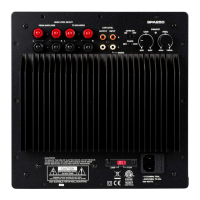
The amplifier's front panel (when mounted) features several controls and indicators for user adjustment and monitoring:
Gain Knob ("Gain"): This control adjusts the amplifier's input sensitivity to match the output level of the pre-amp source. Users can fine-tune this knob to achieve the best balance between low noise, linear level control, and sufficient output to drive the subwoofer effectively. It essentially acts as the "volume control" for the subwoofer system.
Frequency Knob ("Freq"): This control sets the highest frequency the subwoofer will reproduce, with a range typically between 60 Hz and 180 Hz and a 24 dB per octave slope. For music systems with main speakers capable of good bass, a lower setting (e.g., 60-100 Hz) might be appropriate. For smaller main speakers with limited bass output, a higher setting may be preferred. Experimentation is encouraged to find the optimal "overlap" for seamless integration with the main speakers and the room acoustics. When using an LFE (Low Frequency Effects) output from a home theater receiver, the frequency control should be set to maximum (180 Hz) to bypass the SA70's internal low-pass filter, allowing the receiver to manage the crossover frequency.
Power Switch (On, Off, Auto): This switch controls the amplifier's power state. In the "On" position, the amplifier is continuously active. In the "Auto" position, the amplifier enters a standby mode and will automatically power on when an input signal of approximately 10 millivolts or greater is detected. If no input signal is detected for 10-15 minutes, the amplifier will return to standby mode, conserving power.
Power LED: This indicator provides visual feedback on the amplifier's status. It illuminates green when the amplifier is in "On" mode or when an input signal is detected in "Auto" mode. If the protection circuit detects a short circuit or thermal overload, the LED will turn red, indicating a fault condition and that the unit has shut down for safety.
Output Lead for Subwoofer Driver: A rear-mounted, color-coded output lead (approximately 12" long) connects the amplifier to the subwoofer driver. The red wire (positive) uses an insulated .250" quick disconnect, and the black wire (negative) uses an insulated .205" quick disconnect. These connectors can be removed if the driver requires a different size or type, but proper polarity must be observed during connection (red = positive, black = negative).
The SA70 is designed for high reliability and minimal user maintenance. However, some aspects are important for its long-term performance and safety:
 General
| Frequency Response | 20 Hz - 20 kHz |
|---|---|
| Damping Factor | > 100 |
| Total Harmonic Distortion | < 0.1% |
| Power Supply | 60Hz |
| Power Output | 70W RMS per channel at 4Ω |

 To Next Page