EasyManua.ls Logo

dbx 128 - SYSTEM PERFORMANCE; Audible Spectrum Response

dbx 128
42 pages
Print Icon
To Next Page IconTo Next Page
To Previous Page IconTo Previous Page
Loading...
28
nel
187
and
the
16-channel
216,
many
home
recording
en-
thusiasts
sought
better
quality
tapes.
In
response
to
the
de-
mands
of
consumers
and
small
studios,
dbx
introduced
a
variety
of
semi-professional
units
(the
150
series).
These
units
utilize
the
same
signal
processing
as
the
professional
recording
studio
models,
so
tapes
made
with
the
professional
series
may
be
decoded
with
the
semi-professional
series,
and
vice-versa.
Broadcasters
realized
the
potential
for
improved
signal
quality
if
they
could
use
dbx
processing.
However,
broadcast
cartridges
and
telephone
transmission
lines
do
not
offer
the
excellent
frequency
response
available
in
professional
re-
cording
studios
and
better
hi-fi
tape
machines;
the
low
and
high
end
of
the
frequency
spectrum
often
fall
off
consider-
ably.
Poor
frequency
response
in
a
tape
recorder
can
cause
mistracking
of
the
RMS
detection
circuitry
in
the
dbx
pro-
fessional
system.
The
rumble
and
low
frequency
errors
of
warped
discs,
or
the
limited
low
and
high
frequency
response
of
telephone
and
microwave
transmission
lines
would
create
mistracking
of
the
RMS
detection
circuitry.
Therefore,
the
dbx
II
system
was
developed,
represented
by
dbx
models
122, 124,
128
and
the
142.
The
basic
principle
of
operation
of
dbx
professional
and
dbx
II
are
identical,
and
the
amount
of
noise
reduction
is
the
same,
yet
the
two
systems
are
not
compatible.
A
tape
encoded
with
either
system
cannot
be
decoded
by
the
other.
Similarly,
a
dbx
encoded
disc
(dbx
II
processed)
cannot
be
decoded
with
the
original
dbx
profes-
sional
system.
The
two
systems
were
designed
for
different
applications.
The
bandpass
filter
in
the
signal
path
in
the
dbx
I!
system
is
slightly
more
restrictive,
rolling
off
1
dB
at
30
Hz.
In
addition,
the
RMS
detection
circuitry
in
dbx
II
units
is
sensitive
only
up
to
10
kHz,
so
high
frequency
losses
on
the
tape
or
trans-
mission
lines
will
not
create
encode/decode
mistracking.
THE
dbx
Type
|
dbx
Type
It
#49
am
tis
H
LH
+5
+10
+8
|
Zo
t|
a
Cen]
Zo
kd
verti
_
78
FT
Hit
46
aN
5K
10K
20K
~10
99
50
(100
500
1K
SK
10K
20K
20
«50
«(100
500
1K
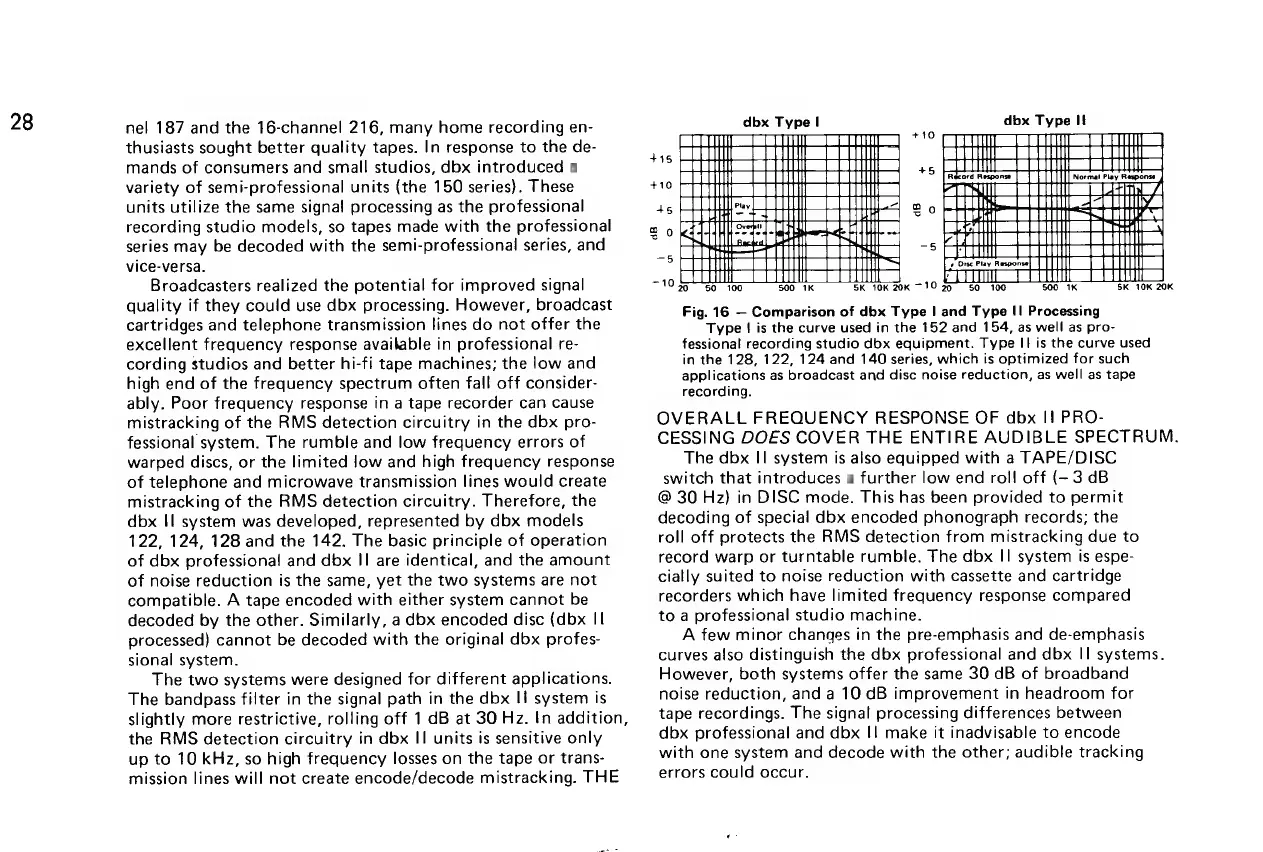
Fig.
16
Comparison
of
dbx
Type
|
and
Type
II
Processing
Type
|
is
the
curve
used
in
the
152
and
154,
as
well
as
pro-
fessional
recording
studio
dbx
equipment.
Type
II
is
the
curve
used
in
the
128, 122,
124 and
140
series,
which
is
optimized
for
such
applications
as
broadcast
and
disc
noise
reduction,
as
well
as
tape
recording.
OVERALL
FREQUENCY
RESPONSE
OF
dbx
I!
PRO-
CESSING
DOES
COVER
THE
ENTIRE
AUDIBLE
SPECTRUM.
The
dbx
II
system
is
also
equipped
with
a
TAPE/DISC
switch
that
introduces
a
further
low
end
roll
off
(-
3
dB
@
30
Hz)
in
DISC
mode.
This
has
been
provided
to
permit
decoding
of
special
dbx
encoded
phonograph
records;
the
roll
off
protects
the
RMS
detection
from
mistracking
due
to
record
warp
or
turntable
rumble.
The
dbx
II
system
is
espe-
cially
suited
to
noise
reduction
with
cassette
and
cartridge
recorders
which
have
limited
frequency
response
compared
to
a
professional
studio
machine.
A
few
minor
changes
in
the
pre-emphasis
and
de-emphasis
curves
also
distinguish
the
dbx
professional
and
dbx
II
systems.
However,
both
systems
offer
the
same
30
dB
of
broadband
noise
reduction,
and
a
10
dB
improvement
in
headroom
for
tape
recordings.
The
signal
processing
differences
between
dbx
professional
and
dbx
Il
make
it
inadvisable
to
encode
with
one
system
and
decode
with
the
other;
audible
tracking
errors
could
occur.

Related product manuals