EasyManua.ls Logo

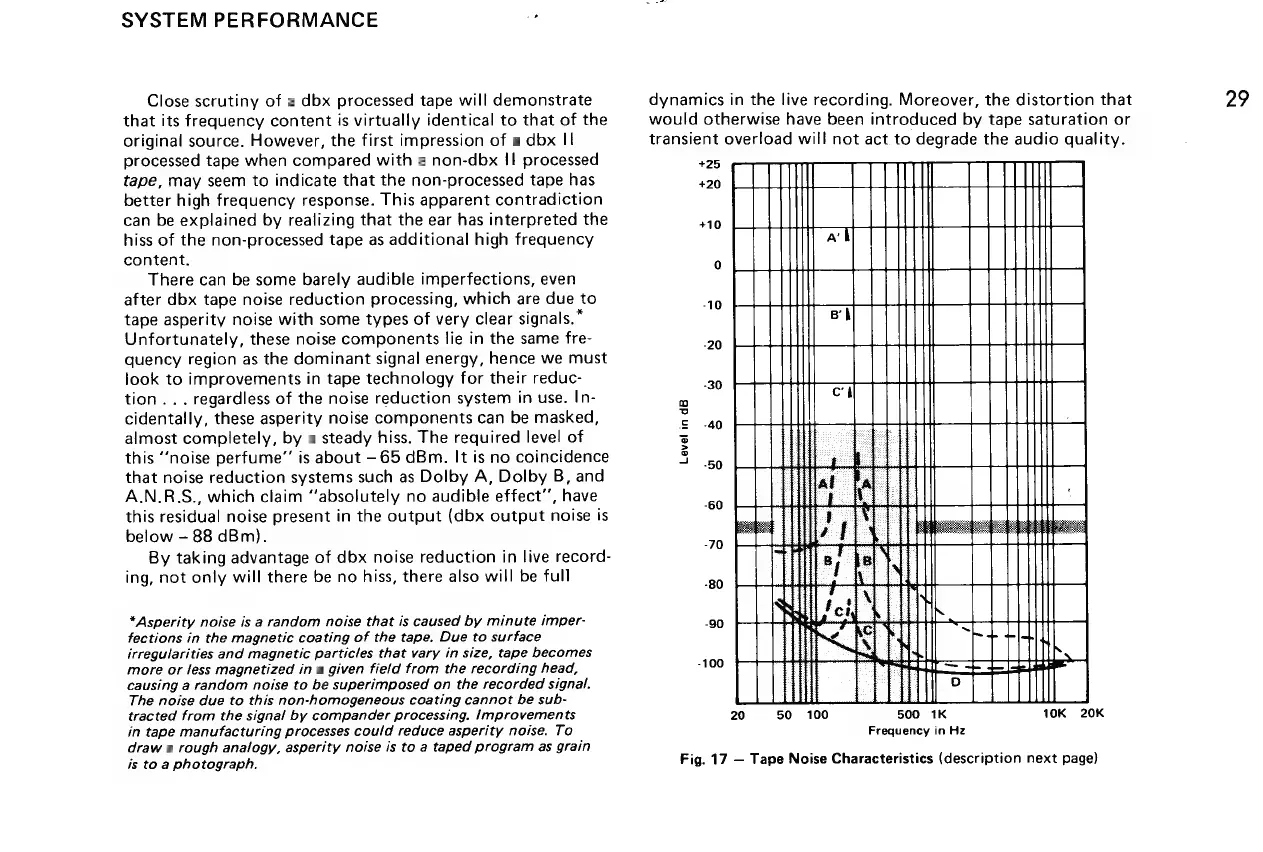
dbx 128 - Tape Noise Characteristics

dbx 128
42 pages
Print Icon
To Next Page IconTo Next Page
To Previous Page IconTo Previous Page
Loading...
SYSTEM
PERFORMANCE
Close
scrutiny
of
a
dbx
processed
tape
will
demonstrate
that
its
frequency
content
is
virtually
identical
to
that
of
the
original
source.
However,
the
first
impression
of
a
dbx
II
processed
tape
when
compared
with
a
non-dbx
I!
processed
tape,
may
seem
to
indicate
that
the
non-processed
tape
has
better
high
frequency
response.
This
apparent
contradiction
can
be
explained
by
realizing
that
the
ear
has
interpreted
the
hiss
of
the
non-processed
tape
as
additional
high
frequency
content.
There
can
be
some
barely
audible
imperfections,
even
after
dbx
tape
noise
reduction
processing,
which
are
due
to
tape
asperity
noise
with
some
types
of
very
clear
signals.”
Unfortunately,
these
noise
components
lie
in
the
same
fre-
quency
region
as
the
dominant
signal
energy,
hence
we
must
look
to
improvements
in
tape
technology
for
their
reduc-
tion...
.
regardless
of
the
noise
reduction
system
in
use.
In-
cidentally,
these
asperity
noise
components
can
be
masked,
almost
completely,
by
a
steady
hiss.
The
required
level
of
this
‘‘noise
perfume”
is
about
—65
dBm.
It
is
no
coincidence
that
noise
reduction
systems
such
as
Dolby
A,
Dolby
B,
and
A.N.R.S.,
which
claim
“absolutely
no
audible
effect’,
have
this
residual
noise
present
in
the
output
(dbx
output
noise
is
below
88
dBm).
By
taking
advantage
of
dbx
noise
reduction
in
live
record-
ing,
not
only
will
there
be
no
hiss,
there
also
will
be
full
*Asperity
noise
is
a
random
noise
that
is
caused
by
minute
imper-
fections
in
the
magnetic
coating
of
the
tape.
Due
to
surface
irregularities
and
magnetic
particles
that
vary
in
size,
tape
becomes
more
or
less
magnetized
in
a
given
field
from
the
recording
head,
causing
a
random
noise
to
be
superimposed
on
the
recorded
signal.
The
noise
due
to
this
non-homogeneous
coating
cannot
be
sub-
tracted
from
the
signal
by
compander
processing.
Improvements
in
tape
manufacturing
processes
could
reduce
asperity
noise.
To
draw
a
rough
analogy,
asperity
noise
is
to
a
taped
program
as
grain
is
to
a
photograph.
dynamics
in
the
live
recording.
Moreover,
the
distortion
that
29
would
otherwise
have
been
introduced
by
tape
saturation
or
transient
overload
will
not
act
to
degrade
the
audio
quality.
25
ao
(TM
TT
nt
ena
Conc
a
OT
CME
CFT
Lae
AUR
|
TTI
Sa
20
50
100
500
1K
10K
20K
Frequency
in
Hz
+10
-10
-20
-30
-40
Level
in
dB
-50
-60
-70
-80
-90
-100
Fig.
17
Tape
Noise
Characteristics
(description
next
page)

Related product manuals