Broadcasting
A preemphasis filter
network placed in the sidechain of a 1
66
processing
preemph-
asized audio
permits higher average signal levels to be
run witiiin the headroom limits of
the broadcast
chain.
Filtering
Narrow-band ("notch") filtering for rumble,
feedback, equipment noise (e.g.,
cameras) may be put in the sidechain to make
the compressor less sensitive to such
problems.
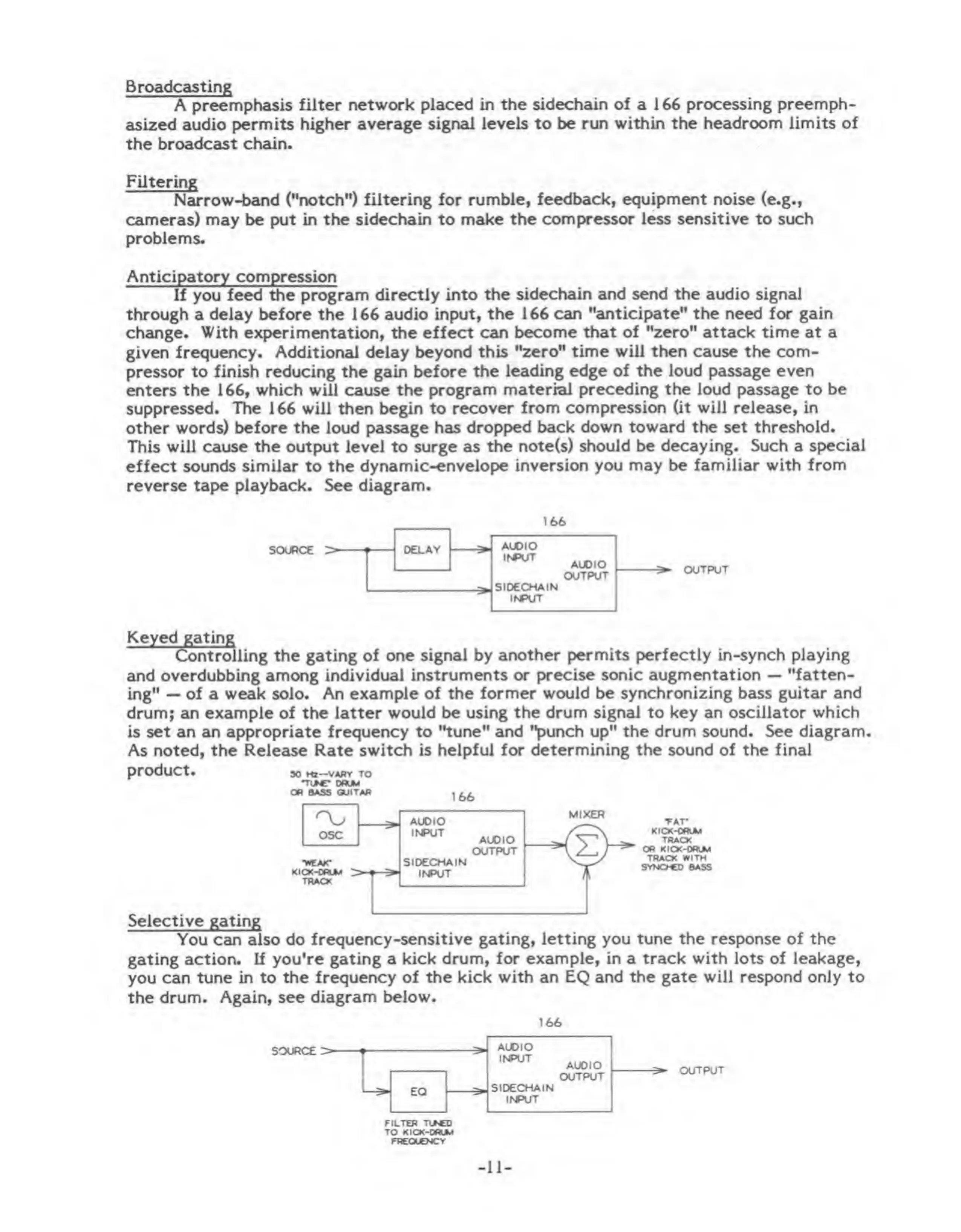
Anticipatory
compression
If
you
feed the program directly
into the sidechain and send the audio signal
through a delay
before
the 1 66 audio
input, the 1 66 can "anticipate" the
need
for
gain
change. With experimentation, the effect can
become that of "zero" attack time at a
given frequency. Additional delay
beyond this "zero" time will then cause the com-
pressor to finish reducing the gain
before the leading edge
of the loud
passage
even
enters the
166,
which will cause the
program material preceding the loud passage to be
suppressed. The
1 66 will then
begin to recover
from compression (it will release, in
other
words) before the loud passage has
dropped back down toward the set threshold.
This will cause the output level to surge as the
note(s) should be decaying. Such a
special
effect sounds similar to the
dynamic-envelope inversion you
may
be
familiar
with
from
reverse
tape playback.
See
diagram.
166
SOURCE
OUTPUT
Keyed gating
Controlling the gating of one signal by
another permits perfectly in-synch playing
and overdubbing
among individual instruments or
precise
sonic
augmentation
—
"fatten-
ing"
—
of a weak solo. An
example of the former would be synchronizing baiss guitar
and
drum; an example of the latter would be using the
drum signal to
key an
oscillator which
is set an an appropriate frequency to "tune" and '^unch up"
the drum sound. See diagram.
As noted, the Release Rate switch is
helpful for determining the sound of the final
product.
90 TO
TLftC* DAUU
Ofi a*SS OUITA^
166
TAr
ICICK-CAUM
TRACK
OR KICK-0R(M
TRACK WITH
STWCO eASS
Selective gating
You can also do
frequency*sensitive gating, letting you
tune
the response
of
the
gating action*
If
you're
gating a kick drum, for
example,
in a
track with lots of leakage,
you
can tune in to the frequency
of
the
kick with an EQ and the gate will respond only to
the
drum. Again, see
diagram below*
166
SOURCE
,
AUDIO
AUDIO
SIDECHAIN
OUTPUT
IhPUT
OUTPUT
FILTER TiACD
TO KICK*0«UA
PREQCENCV
-
11
-


 To Next Page