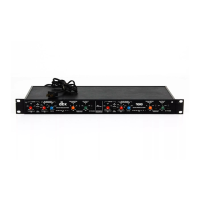
The
Ratio
knob
controls how much the signal will be
compressed
once it's
well
above the threshold, in the straight-line section
of the OverEasy curve. The ratio
is the
change
in
input level divided by the change in output level, e.g., a 4:1 setting
means that for a
4-dB
increase in input level
the output will increase
by
only
1
dB.
At Infinity:!, the output will remain at a
constant level irrespective of input dyna-
mics
(as
long as the input is above threshold)
—
in other words, full limiting.
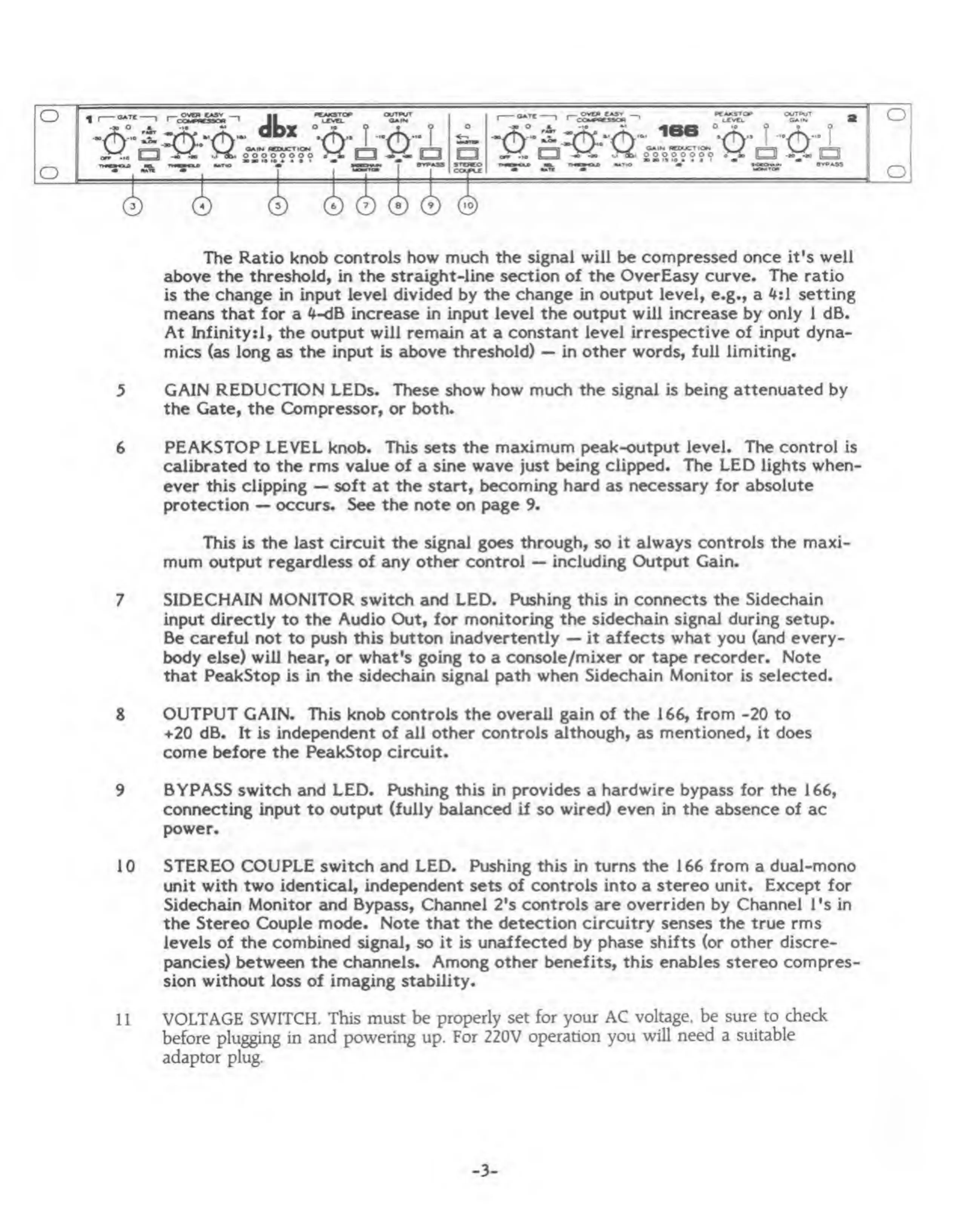
5
GAIN
REDUCTION
LEDs. These show
how
much
the signal is being attenuated by
the
Gate, the Compressor,
or
both.
6 PEAKSTOP LEVEL knob. This sets the
maximum peak-output level. The control is
calibrated to the
rms value of a sine wave just being clipp^.
The LED
lights
when-
ever this clipping
—
soft at the start,
becoming hard
as
necessary for absolute
protection
—
occurs. See the note on page
9.
This is the last circuit the signal goes through, so it always controls the maxi-
mum
output
regardless of any other control
—
including Output Gain.
7
SIDECHAIN MONITOR switch and LED. Pushing this in connects the
Sidechain
input directly to the
Audio Out, for monitoring the sidechain signal during setup.
Be careful not
to push
this button inadvertently
—
It affects what you (and every-
body else) will hear, or what's going to a console/mixer or tape recorder. Note
that PeakStop
is in
the sidechain signal path when Sidechain Monitor is selected.
8
OUTPUT GAIN. This
knob controls
the overall gain of the
166,
from
-20
to
+20 dB. It is independent of all other controls although, as mentioned, it does
come before the ^akStop circuit.
9
BYPASS switch and LED. Pushing this in provides a
hardwire
bypass for the 166,
connecting
input
to
output (fully balanced if
so
wired) even in the absence of
ac
power.
10 STEREO COUPLE switch and LED. Pushing this in
turns
the 166
from
a
dual-mono
unit with two identical,
independent
sets
of controls into a stereo unit. Except for
Sidechain
Monitor
and Bypass, Channel 2's
ccxitrols
are
overriden
by
Channel I's in
the Stereo Couple
mode. Note that the detection circuitry senses the true rms
levels of the combined signal, so it is unaffected by phase
shifts
(or other
discre-
pancies) between the channels. Among other benefits, this enables stereo
compres-
sion
without
loss of imaging stability.
1 1
VOLTAGE SWITCH.
This must be
properly set for your AC
voltage, be
sure to check
before
plugging in and
powering up. For 220V
operation you
will need a
suitable
adaptor plug.
-
3
-


 To Next Page