
 Need help?
Do you have a question about the Dell D2721H and is the answer not in the manual?
Cautionary statement regarding servicing units with high voltages and requiring familiarity with chassis.
Step-by-step instructions for disassembling the monitor, including screw types and torque specifications.
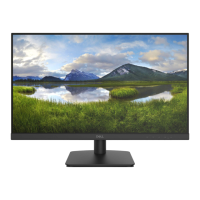
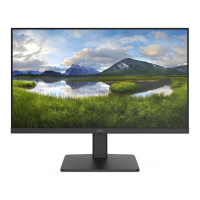
This document describes the Dell D2721H 27" LCD Color Monitor, providing detailed instructions for its disassembly, which implicitly reveals its design and maintenance features. The manual is structured to guide service personnel through the process of taking apart the monitor for repair or component replacement, emphasizing safety and proper handling at each stage.
The monitor's design incorporates several features that facilitate both its assembly and disassembly. For instance, the initial steps involve simply turning off the power and unplugging external cables, indicating a user-friendly approach to basic interaction. The rear cover, which houses the internal components, is secured by a combination of screws and interlocking mechanisms. The use of Philips-head screws for most components, along with specific torque values provided for each screw type, suggests a standardized and controlled assembly process, ensuring consistent build quality. The inclusion of hexagon screws for certain parts, such as the main board and power board, might indicate areas requiring higher security or specific tools for access, potentially for more specialized repairs.
The disassembly process highlights the modular nature of the monitor's internal structure. Components like the stand, rear cover, bracket chassis module, and various PCBs (Printed Circuit Boards) are designed to be removed in a sequential manner. The stand, for example, can be detached by pushing a button, suggesting a quick-release mechanism for easy setup or transport. The rear cover is secured by both screws and interlocking clips, requiring a specific technique (wedging fingers or plastic picks) to release it, which helps maintain a clean aesthetic by minimizing visible fasteners while still allowing for service access.
Internally, the monitor features a bracket chassis module that houses the panel, main board, and power board. This module is designed to be lifted out as a single unit after disconnecting cables and removing screws. The instructions emphasize the importance of ESD (Electrostatic Discharge) protection when handling these components, indicating the presence of sensitive electronics that require careful handling to prevent damage. The cables connecting the backlight, LVDS (Low-Voltage Differential Signaling) to the panel, and those between the main board and power board are designed for disconnection, allowing for individual component replacement or repair. The key board, likely referring to the control buttons or OSD (On-Screen Display) controls, is also detachable, suggesting that these user interface components can be serviced independently.
The use of tapes and aluminum foil, as mentioned in the instructions for the panel and cables, points to measures taken for insulation, EMI (Electromagnetic Interference) shielding, or securing components in place. The instruction to tear off these materials during disassembly implies they are part of the original manufacturing process and may need to be reapplied or replaced during reassembly to maintain the monitor's intended performance and safety standards.
A critical safety notice is prominently displayed at the beginning of the manual, warning against high voltages and emphasizing the need for a separate isolation transformer when servicing the unit. This underscores the potential electrical hazards associated with internal components and the importance of professional servicing. The warning also stresses that any person attempting to service the chassis must be familiar with it and aware of necessary safety precautions, reinforcing that this manual is intended for trained technicians rather than end-users.
The overall design, as inferred from the disassembly steps, prioritizes serviceability while maintaining a streamlined external appearance. The sequential removal of components, clear identification of screw types and torque values, and emphasis on careful handling of sensitive parts all contribute to a structured maintenance approach. This allows for targeted repairs, component upgrades, or recycling of individual parts, extending the product's lifespan and reducing electronic waste. The detailed instructions, including specific screw sizes and torque requirements, are crucial for ensuring that the monitor can be reassembled correctly, maintaining its structural integrity and operational performance after servicing.
 General
| Pixel pitch | 0.3114 x 0.3114 mm |
|---|---|
| Screen shape | Flat |
| Pixel density | 81 ppi |
| Backlight type | LED |
| Display diagonal | 27 \ |
| Display technology | LCD |
| Native aspect ratio | 16:9 |
| Vertical scan range | 50 - 75 Hz |
| Maximum refresh rate | 60 Hz |
| Response time (fast) | 8 ms |
| Horizontal scan range | 30 - 83 kHz |
| Supported video modes | 480i, 480p, 576i, 576p, 720p, 1080i, 1080p |
| Viewable size diagonal | 686 mm |
| NTSC coverage (typical) | 83 % |
| Viewable size, vertical | 336.31 mm |
| Contrast ratio (typical) | 1000:1 |
| Display number of colors | 16.78 million colors |
| Viewable size, horizontal | 597.89 mm |
| Display brightness (typical) | 250 cd/m² |
| Supported graphics resolutions | 640 x 480 (VGA), 720 x 400, 800 x 600 (SVGA), 1024 x 768 (XGA), 1152 x 864 (XGA+), 1280 x 1024 (SXGA), 1600 x 900, 1920 x 1080 (HD 1080) |
| Tilt angle range | -5 - 20 ° |
| Panel mounting interface | 100 x 100 mm |
| HDMI version | 1.4 |
| DisplayPorts quantity | 0 |
| Operating altitude | 0 - 5000 m |
| Non-operating altitude | 0 - 12192 m |
| Storage temperature (T-T) | -20 - 60 °C |
| Operating temperature (T-T) | 0 - 50 °C |
| Storage relative humidity (H-H) | 5 - 90 % |
| Operating relative humidity (H-H) | 20 - 90 % |
| Sustainability certificates | RoHS |
| Power consumption (off) | 0.5 W |
| Annual energy consumption | 52 kWh |
| Power consumption (standby) | - W |
| Power consumption (typical) | 25 W |
| NVIDIA G-SYNC | - |
| Product color | Black |
| Market positioning | Home |
 Weight and Dimensions
| Bezel width (side) | 6.98 mm |
|---|---|
| Depth (with stand) | 236.9 mm |
| Width (with stand) | 611.8 mm |
| Height (with stand) | 478.5 mm |
| Weight (with stand) | 4500 g |
| Bezel width (bottom) | 20.9 mm |
| Depth (without stand) | 47.6 mm |
| Height (without stand) | 364.2 mm |
| Weight (without stand) | 4000 g |



 To Next Page