Need help?
Do you have a question about the Delta 40-680 and is the answer not in the manual?
Assemble the scroll saw stand using provided hardware and ensuring correct leg positioning.
Securely attach the scroll saw to the assembled stand using the specified screws and washers.
Includes rear leg extension, holddown foot, table rotation, and table insert assembly.
Guidance on extension cords and essential grounding instructions for safe operation.
Operation of the power switch and adjusting cutting speeds via pulley system.
Adjust blade tension and position the dust blower for optimal performance.
Adjust blade holders, holddown, and perform blade replacement.
Procedure for tilting the table for bevel cuts and setting angles.
Setting and adjusting positive stops for 90 and 45-degree table angles.
Checking blade holder alignment and performing lubrication.
Using dust collection and performing inside cutting techniques.
Troubleshooting blade breakage and choosing the right blade and speed.
Examples and illustrations of various scroll saw applications and workpiece sizes.
Using table inserts and finding the serial number for reference.
Information on available accessories, parts, service, and warranty details.
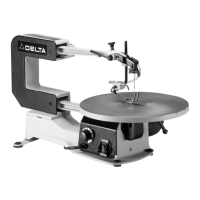
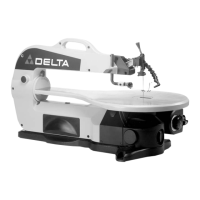
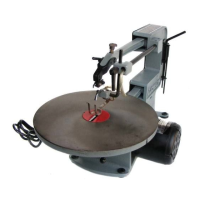
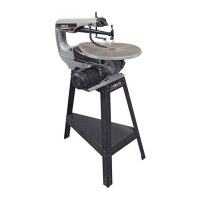
This document serves as an instruction manual for the Delta 20" Scroll Saw, Model 40-680, also known as the P-20. It provides comprehensive guidance on the assembly, operation, and maintenance of the scroll saw, emphasizing safety procedures throughout.
The Delta 20" Scroll Saw is designed for intricate cutting operations in various materials, including wood and metal. Its primary function is to allow users to make precise, detailed cuts, often in curved or complex patterns, that would be difficult or impossible with other types of saws. The scroll saw is particularly well-suited for tasks such as fretwork, intarsia, and marquetry, where fine detail and smooth edges are paramount. It achieves this by using a thin, reciprocating blade that moves up and down through the workpiece.
The scroll saw offers a range of features designed to enhance its versatility and ease of use.
Adjustable Cutting Speeds: The saw provides six different cutting speeds: 400, 700, 1200, 1400, 1600, and 2000 strokes per minute. This allows the operator to select the optimal speed for the specific material and type of cut being performed. Changing speeds involves rotating a knob to disengage a latch, lifting the top cover, and then manually moving the belt to the desired pulleys. Slower speeds are generally recommended for thin blades and intricate cuts, while faster speeds are suitable for coarser blades and thicker materials.
Tilting Table: The table can be tilted to accommodate bevel cutting operations. It can tilt 45 degrees to the right and 15 degrees to the left. A lock handle secures the table at the desired angle, and a scale with a pointer helps determine the exact tilt angle. The manual provides instructions for adjusting 90 and 45-degree positive stops for precise angle settings.
Holddown Foot: A holddown foot is integrated into the design to secure the workpiece firmly against the table during cutting. This feature is crucial for accuracy and safety, preventing the material from lifting or vibrating. The holddown foot can be adjusted vertically to match the thickness of the workpiece and can also be tilted to align with the table's angle during bevel cuts. The prongs of the holddown foot are designed to straddle the blade.
Blade Tension Adjustment: Proper blade tension is critical for effective and safe operation, as well as for preventing blade breakage. The saw features a blade tension lever that, when moved to the up position, applies tension, and when moved forward, releases it. A tension knob allows for fine-tuning the blade tension. The manual suggests a method of "plucking" the blade like a guitar string to achieve proper tension, noting that thicker blades require more tensioning (a higher-pitched sound) and finer blades require less.
Blade Holders and Clamping Action: The scroll saw uses upper and lower blade holders to secure the blade. The clamping action of these holders can be adjusted to accommodate different blade widths. The manual emphasizes that very little adjustment and clamping force are typically needed. Blade locking levers are used to open and close the blade holders, facilitating quick blade changes.
Dust Blower: A dust blower is provided to direct air onto the cutting line, keeping it clear of sawdust. This improves visibility and allows the operator to follow the cutting pattern more accurately. The dust blower can be moved to direct air to the most effective point.
Inside Cutting Capability: The Delta scroll saw is designed to perform inside cuts efficiently. This involves threading the blade through a pre-drilled hole in the workpiece. The process is streamlined by the ability to quickly release blade tension, open the upper blade holder, raise the upper arm, insert the blade, and then re-tension and secure the blade.
Zero-Clearance Table Insert: A blank table insert is supplied, which can be customized by cutting a slot only as wide as the blade. This "zero-clearance" insert provides maximum support to the bottom of small workpieces, preventing tear-out and improving cut quality.
Stand and Height Extension: The scroll saw comes with a stand, which should be fastened to the floor for stability during operation. A height extension bracket is also provided for the rear leg of the stand, allowing the operator to tilt the saw forward if desired, with five holes for varying degrees of tilt.
On-Off Power Switch with Lockout: The power switch is conveniently located on the top of the arm. For safety, the switch can be locked in the "OFF" position using a padlock, preventing unintentional starting.
Regular maintenance is essential for ensuring the longevity and optimal performance of the scroll saw.
Cleaning: Before initial use, the protective coating on the saw table surface must be removed using a soft cloth moistened with kerosene (avoiding acetone, gasoline, or lacquer thinner). After cleaning, the table surface should be waxed with a good quality paste wax and buffed thoroughly.
Lubrication: To maintain peak efficiency, the scroll saw requires lubrication approximately every 20 hours of use. This involves opening the caps of the oil cups and applying a few drops of light machine oil into each cup.
Blade Alignment Check: The lower blade holder is factory-set for alignment with the upper blade holder. The manual provides a procedure to check and adjust this alignment if necessary, using a straight edge and adjusting a screw to ensure the blade consistently contacts the straight edge throughout its stroke.
Blade Selection Guidance: The manual offers guidelines for choosing the appropriate blade and speed based on the workpiece material and desired cut. Finer blades are recommended for thin workpieces, hard materials, or smoother cuts, while coarser blades are for thick workpieces, straight cuts, or medium to soft materials. It also advises ensuring at least two teeth are in the workpiece at all times and considering the minimum radius a blade can cut.
Troubleshooting Blade Breakage: The manual identifies common causes of blade breakage, such as improper installation, incorrect tension, unsuitable blade selection, forcing the workpiece, cutting too sharp a turn, or incorrect blade speed. It also describes the automatic positioning of the upper arm when a blade breaks and how to release it.
Grounding Instructions: Detailed instructions are provided for properly grounding the scroll saw to protect the operator from electric shock. This includes using 3-wire extension cords with 3-prong grounding plugs and ensuring the outlet is properly grounded. The use of temporary adapters is explained, with a specific note for Canada where they are not permitted.
The manual strongly advises reading and understanding all instructions before operating the tool and emphasizes the importance of safety rules, including wearing eye protection, keeping guards in place, and disconnecting power before servicing or changing accessories. It also provides contact information for parts, service, or warranty assistance, and outlines the two-year limited new product warranty.
 General
| Type | Scroll Saw |
|---|---|
| Table Size | 16 in |
| Stroke Length | 3/4" |
| Thickness Capacity | 2" |
| Bevel Capacity | 45 degrees left and right |
| Cutting Capacity at 90 Degrees | 2" |

 To Next Page