13
o
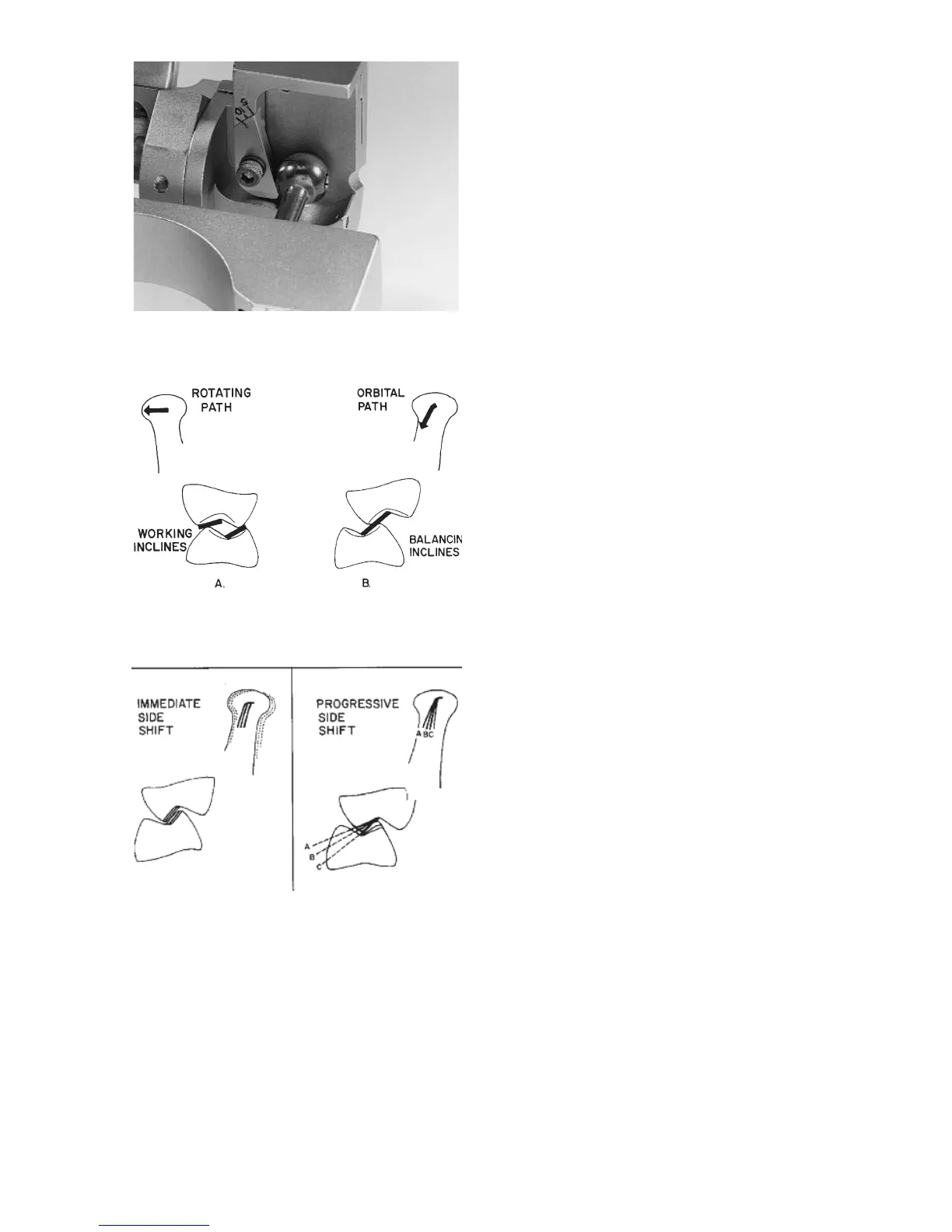
f the marginal ridge, fossa, or central
groove of the tooth (fig.21).
An increase of the progressive side shift
movement of the articulator has an effect
of flattening the balancing inclines of
cusps on the orbiting side mediolaterally
(fig. 22).
The closer a cuspal incline is to a condylar
path of movement the greater is the influ-
ence that condylar control has on occlusal
anatomy. Consequently due to the fact
that the orbiting condyle is moving down-
ward so rapidly as it moves forward, we
observe that as we move more distally in
the dental arches the lingual cusps of
maxillary molars project increasingly
downward and the buccal cusps of
mandibular molars project increasingly
upward to harmonize the occlusion to
condylar paths of movements (fig 23).
Again by observing a right lateral condylar
movement from the front of the articulator
you can see that the path of movement of
the rotating condyle (rotating path) as it
moves outward is guided by the rear and
top fossa walls (fig.24). This path of move-
ment is most closely associated with and
has its principle effect on the working
inclines of cusps on the working side (fig.
20A).
The rotating condylar path may be inclined
upward or downward as the rotating
condyle moves outward. This upward and
downward inclination of the rotating
condylar path in the coronal plane has its
principle influence on the height of the
working inclines of posterior cusps on the
rotating side (fig. 25). If the rotating condy-
lar path is inclined upward the cusps must
be flatter (fig. 25A). If the rotating condylar
path is inclined downward the cusps may
be steeper (fig. 25C). The Mark II Articu-
lator cannot be adjusted to upward or
downward movements of the rotating
condyle.
fig. 19
fig. 20
fig. 21 fig.22
Three articulator adjustments establish the
character of the orbiting path on the artic-
ulator: the immediate side shift adjustment,
the progressive side shift adjustment and
the protrusive inclination of the superior
fossa wall.
An increase of the immediate side shift
movement of the articulator has an effect
of increasing the bucco-lingual dimension


 To Next Page